Iran and China complete orbital launches

Iran's launch December 6, 2023
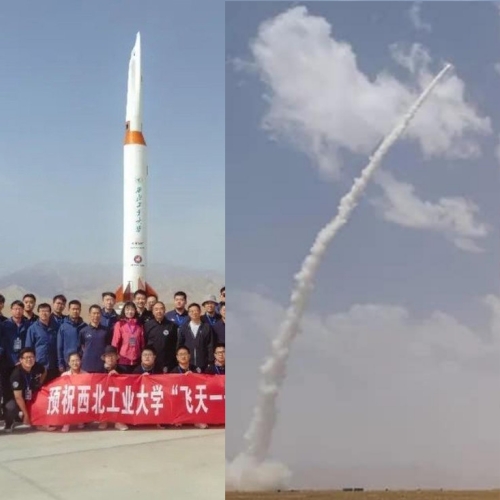
Iran’s Salman rocket lifting off today.
The launch site itself was not disclosed.

According to the official state-run press of each country, both Iran and China yesterday completed successfully launches, both of which appeared to test new capabilities of some note.

First Iran announced that it had used its Salman rocket to put a 500-kilogram capsule that it said was carrying biological samples, and was also “has the ability to carry a human,” though the mass of this capsule makes that highly unlikely. Little other information was provided. Nor has this orbital launch as yet been confirmed by the orbital monitoring services of the U.S. military. The image to the right is a screen capture from the launch video at the link, and appears to show that this rocket has only one stage, thus making an orbital launch impossible.

Assuming this orbital launch is confirmed, it was Iran’s second orbital launch in 2023 and will therefore not show up on the launch race leader board below. If further information is obtained I will update this post appropriately.

China in turn announced the successful launch today of a test satellite, using its new Smart Dragon-3 solid-fueled rocket lifting off from a barge in the South China Sea 1,300 nautical miles off the coast of Guangdong province, where Hong Kong is located. To arrive at this ocean launch location took five days. The launch thus tested the use of this mobile floating platform from remote ocean locations.

The leaders in the 2023 launch race:

89 SpaceX
56 China
16 Russia
7 Rocket Lab
7 India

American private enterprise still leads China in successful launches, 101 to 56, and the entire world combined 101 to 90. SpaceX by itself now trails the rest of the world (excluding other American companies) 89 to 90, though it has another launch planned for tonight, with the live stream here.

9 comments

Mars Reconnaissance Orbiter takes another look at the non-face on Mars

The non-face on Mars
Click for original image

In 2007, shortly after it began science operations in Mars orbit, the science team for Mars Reconnaissance Orbiter (MRO) pointed its high resolution camera at the so-called “Face on Mars”, taking a picture that confirmed (as had Mars Global Surveyor several years earlier) that this “face” was a non-face, simply a mesa whose features made it appear roughly facelike in low resolution imagery.

Now, more than sixteen years later, scientists have used MRO to take a new picture of the non-face mesa. That picture is to the right, cropped, reduced, and sharpened to post here. Compared to the 2007 photo the new photo has far better lighting conditions, revealing many details on the mesa’s eastern half that were mostly obscured by shadows previously.

In fact, these new details strongly suggest that the depression on the mesa’s eastern slopes harbors a decaying glacier. At least, that is what the features there resemble.
» Read more

11 comments

Ingenuity completes its 67th flight on Mars

Overview map
Click for interactive map.

Almost immediately after communications were re-established with Mars after the monthlong solar conjunction — where the Sun stood between the Earth and Mars — the Ingenuity engineering team uploaded instructions for Ingenuity’s 67th flight, and on December 2, 2023, the helicopter successfully completed that flight, traveling 1,289 feet to the west at a height of 39 feet for 136 seconds, almost exactly what the flight planned dictated.

The overview map above shows with the green dot the helicopter’s new position after that flight. It has moved ahead of Perseverance into Neretva Vallis, the gap out of Jezero Crater through which the rover will eventually travel. At the moment however Perseverance sits much farther east, as indicated by the blue dot, where it has been studying the surface geology of the delta that once flowed through that gap into the crater.

0 comments

Stratolaunch completes first test captive carry flight with powered Talon hypersonic vehicle

Test engineering vehicle attached below Roc
Test engineering vehicle attached to Roc during
a flight in October 2022

Stratolaunch has successfully completed the first test captive carry flight with its prototype Talon hypersonic vehicle fueled and powered, carried by its giant Roc airplane.

The flight was the twelfth for the company’s launch platform Roc and the first in which the aircraft carried a Talon vehicle with live propellant as part of a buildup approach for Talon-A’s first powered flight.

The flight lasted a total of three hours and 22 minutes and represented a significant step forward in the company’s near-term goal of completing a powered flight with the Talon-A vehicle, TA-1. A primary objective was to evaluate Talon-A’s propulsion system and the Talon environments while carrying live propellant. A second objective was to verify Roc and TA-1’s telemetry systems, which provides the situational awareness to ensure all systems are ready for powered flight during the release sequence.

The company has two contracts to do hypersonic test flights using flightworthy Talon vehicles, one with the Air Force and the second with the Navy. It is not clear however when those flights will occur.

0 comments

China launches two satellites

The Chinese pseudo-company Galactic Energy today successfully launched two satellites, its Ceres-1 rocket lifting off from China’s Jiuquan spaceport in northwest China.

China’s own state-run press illustrates how pseudo this company is by not even mentioning its name in its reporting. It mentions the launch was “commercial,” but that’s as far as it goes. China’s press knows the government runs and owns this company, and only allows it the superficial appearance of a private company to enhance competition within its space industry.

No word on where the rocket’s lower solid-fueled stages crashed inside China.

The leaders in the 2023 launch race:

89 SpaceX
55 China
16 Russia
7 Rocket Lab
7 India

American private enterprise still leads China in successful launches, 101 to 55, and the entire world combined 101 to 88. SpaceX by itself still maintains its lead over the entire world (excluding other American companies) 89 to 88.

0 comments

Italian subcontractor for Arianespace misplaces two rocket tanks

This story is hard to believe but true: The Italian company Avio, one of the subcontractors for Arianespace that builds its smaller rockets Vega and Vega-C, apparently misplaced two rocket tanks that were to be used on the Vega rocket’s last launch, thus preventing that launch entirely.

The two propellant tanks that went missing were housed in an Avio production department in Colleferro that had undergone renovation work. At some point following the completion of the renovations, the two tanks were found to be missing.

According to the initial source, the tanks had not been entered into a company-wide asset management system that tracked the location of all vital Avio components. This ensured that the teams tasked with investigating the disappearance had very little to go on when beginning their search for the missing tanks.

Despite the futility of the search, the tanks were eventually found. This was, however, not the good news Avio had hoped for. The tanks are, unfortunately, not in a usable state. They had been crushed and were found alongside metal scraps in a landfill.

The tanks power Vega’s fourth stage that deploys satellites in orbit. They were to be used on the final flight of Vega, which has been delayed repeatedly for unexplained reasons. We now know the reason.

Because this was the final flight, however, the tanks cannot be replaced because the Vega production line has been shut down. The company is considering using two of the four qualification tanks first built more than a decade ago when Vega was first being tested, but those were test tanks and have been sitting unused for as long. It will be difficult to determine their reliability.

Europe’s government-run rocket program thus at present has no rocket capable of launching. Its Ariane-5 is retired. Its Vega cannot launch. Its Vega-C, which replaces the Vega, remains grounded due to a launch failure in December 2022, with the next launch expected no earlier than late in 2024. And its new Ariane-6 rocket won’t do its first launch until the summer of 2024, at the earliest.

6 comments

South Korea successfully test launches a new solid-fueled rocket

South Korea today successfully launched a new solid-fueled rocket on its third test launch and first orbital flight.

The space launch vehicle was launched from a barge floating in waters about 4 kilometers south of Jeju Island at 2 p.m. and placed a small Earth observation satellite into orbit at an altitude of about 650 km, the ministry said.

The 100-kilogram synthetic aperture radar satellite, made by Hanwha Systems, succeeded in sending signals to a ground station at 3:45 p.m., which means it is operating normally, the company said. The rocket is designed to put a small satellite into a low Earth orbit for surveillance operations.

This four-stage rocket uses solid fuel for its first three stages and liquid fuel for the final stage. That it launched from a barge is as significant, as having this ability gives South Korea an added launch flexibility.

This was South Korea’s second launch in 2023, so the leader board for the 2023 launch race remains unchanged:

89 SpaceX
54 China
16 Russia
7 Rocket Lab
7 India

American private enterprise still leads China in successful launches, 101 to 54, and the entire world combined 101 to 87. SpaceX by itself still leads the entire world (excluding other American companies) 89 to 87.

1 comment

China launches Egyptian Earth observation satellite

China successfully launched an Egyptian Earth observation satellite on December 4, 2023, its Long March 2C rocket lifting off from its Jiquan spaceport in northwestern China.

The satellite was built in Egypt with Chinese assistence, and is designed to study water and land resources for Egypt.

No word on where the rocket’s lower stages, which use toxic hypergolic fuels, crashed within China.

The leaders in the 2023 launch race:

89 SpaceX
54 China
16 Russia
7 Rocket Lab
7 India

American private enterprise still leads China in successful launches, 101 to 54, and the entire world combined 101 to 86. SpaceX by itself now leads the entire world (excluding other American companies) 89 to 86.

2 comments

Amazon signs launch contract with SpaceX

Amazon on December 1, 2023 announced it has signed a three-launch contract with SpaceX to place its Kuiper satellites into orbit, supplementing the launch contracts it presently has with ULA, Arianespace, and Blue Origin. From the Amazon press release:

SpaceX’s Falcon 9 is a reusable, two-stage launch vehicle designed for the reliable and safe transport of people and payloads into Earth orbit and beyond, and it has completed more than 270 successful launches to date. Project Kuiper has contracted three Falcon 9 launches, and these missions are targeted to lift off beginning in mid-2025.

In 2022 Amazon had signed contracts with the other three launch companies, with ULA getting 38 Vulcan launches (in addition to 9 already signed for its Atlas-5), Arianespace getting 18 Ariane-6 launches, and Blue Origin getting 12 New Glenn launches.

The problem however is that, except for the Atlas-5, none of these rockets has yet completed its first flight. Since Amazon’s FCC license requires it to get half of its constellation of 3,200+ satellites into orbit by 2026 or face penalties, the uncertainty of these rockets has probably forced Amazon management to consider SpaceX, despite likely hostility to such a deal from Jeff Bezos (owner of Blue Origin and founder of Amazon).

Amazon management also probably decided to sign this deal because of a lawsuit filed in September 2023 by company stockholders, accusing the management of neglience because it never even considered SpaceX in earlier contract negotiations while giving favoritism to Bezos’s company Blue Origin. At that time Amazon had already paid these launch companies about $1.7 billion, with Blue Origin getting $585 million, though not one rocket has yet launched, with Blue Origin showing no evidence that a launch coming anytime soon.

The impression of a conflict of interest by Amazon’s board of directors appeared very obvious. This new SpaceX contract weakens that accusation.

More important the deal will help Amazon actually get its satellites into orbit. It appears that reality is finally biting at Amazon, and its management has realized that the three companies they have been relying on might not be up to the job (especially Blue Origin).

12 comments

SpaceX again launches 23 Starlink satellites

The beat goes on: SpaceX tonight successfully launched another 23 Starlink satellites, its Falcon 9 rocket lifting off from Cape Canaveral.

The first stage successfully completed its sixth flight, landing on a drone ship in the Atlantic.

The leaders in the 2023 launch race:

89 SpaceX
53 China
16 Russia
7 Rocket Lab
7 India

American private enterprise now leads China in successful launches, 101 to 53, and the entire world combined 101 to 85. SpaceX by itself now leads the entire world (excluding other American companies) 89 to 85.

The next two weeks will be extremely busy in the launch business, as it appears there are launches scheduled for practically single day during that period, with some days having two launches scheduled.

5 comments

Angola signs Artemis Accords, becoming the 33rd nation to join the alliance

Angola today officially signed the Artemis Accords, becoming the 33rd nation to join this space alliance conceived during the Trump administration as a way to get around the limitations of the Outer Space Treaty.

The full list of signatories is as follows: Angola, Argentina, Australia, Bahrain, Brazil, Bulgaria, Canada, Columbia, Czech Republic, Ecuador, France, Germany, Iceland, India, Israel, Italy, Japan, Luxembourg, Mexico, the Netherlands, New Zealand, Nigeria, Poland, Romania, Rwanda, Saudi Arabia, Singapore, South Korea, Spain, the United Kingdom, the United Arab Emirates, the Ukraine, and the United States.

The competing alliance of communist nations, led by China, includes only Russia, Venezuala, Pakistan, Belarus, Azerbaijan, and South Africa. That former deep Soviet bloc nations like Bulgaria and Romania, as well as previously very Marxist Angola, went with the west rather than China illustrates the international distrust of China and its authoritarian methods.

As bilateral agreements between the U.S. and each nation. the accords were designed to create for the U.S. a strong political alliance focused on protecting private property and capitalism in space, something the Outer Space Treaty essentially forbids. As I think it was conceived, the plan had been to use this alliance to eventually either force changes to the Outer Space Treaty, or abandon it entirely. Whether that plan will continue under Biden is unclear, and in fact there have been indications it will not.

These trends could all change should a different president take over after 2024.

Hat tip to BtB’s stringer Jay for cluing me in to this story.

3 comments

SpaceX launches 25 payloads, including South Korea’s first five homebuilt surveillance satellites

SpaceX today successfully used its Falcon 9 rocket to launch 25 payloads into orbit, including first five homebuilt surveillance satellites by South Korea, lifting off from Vandenberg in California.

The first stage successfully completed its seventeenth flight, landing back at Vandenberg. The fairings completed their fifth and sixth flights respectively. As of posting not all the payloads had been deployed.

The leaders in the 2023 launch race:

88 SpaceX
53 China
16 Russia
7 Rocket Lab
7 India

American private enterprise now leads China in successful launches, 100 to 53, and the entire world combined 100 to 85. SpaceX by itself now leads the entire world (excluding other American companies) 88 to 85.

SpaceX still has one more launch scheduled for today, from Cape Canaveral at 11 pm (Eastern). The link goes to the live stream.

This launch was significant for the United States. For the first time the U.S. has reached 100 launches in a single year, something that only the Soviet Union previously achieved, with 100 launches in 1982. With SpaceX’s launch tonight the U.S. will thus set a new record for the most launches in a single year by any nation.

1 comment
1 287 288 289 290 291 1,327