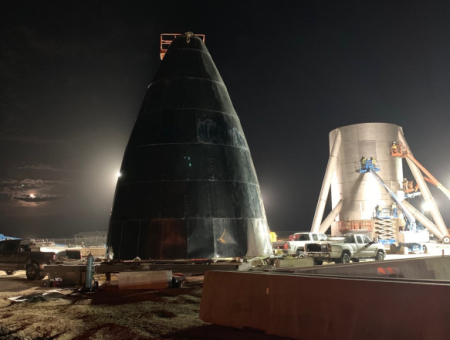
Blue Origin rethinking plans for landing its first stage?

Capitalism in space: Though the company has said little, according to this local Florida newspaper Blue Origin is rethinking its plans to use the cargo ship Jacklyn as a platform for landing its New Glenn first stages in the ocean.

The 600-foot former cargo ship has been docked at the Port of Pensacola since 2018 and undergoing a retrofit by the Pensacola company Offshore Inland to enable the ship to serve as a landing platform for the first stage of Blue Origin’s New Glenn rocket.

When contacted by the News Journal to ask if the retrofit project had been canceled, a Blue Origin spokesperson responded that no final decision had been made yet.

The company is looking at “different options” for recovery vessels that give the best chance for mission success while also being safe and cost-effective, the spokesperson said.

This could be good news or bad news. Either it means Blue Origin is now getting close to finally launching New Glenn, which is three years behind schedule, or it has suddenly realized that using this cargo ship never made sense, and it is scrambling to find a solution at this late date.

3 comments

Lucy team schedules attempt to complete solar panel deployment

Lucy solar panel graphic
Artist’s impression of solar panel

After months of discussions, the engineering team of the Lucy asteroid probe have now scheduled the week of May 9th as when they will begin their attempt to complete the deployment of the spacecraft’ partly opened solar panel.

The team is now preparing to complete the solar array deployment in two steps. The first step, tentatively scheduled for the week of May 9, is intended to pull in most of the remaining lanyard and verify that flight results are consistent with ground testing. This step will also strengthen the array by bringing it closer to a fully tensioned state. Because this step is designed to be limited in duration, the array is not likely to latch at that point.

If this step goes as planned, the second step will continue the array deployment with the intent to fully latch. Information gleaned from the first part will help fine-tune the second. The second step is currently planned for a month after the initial one, giving engineers enough time to analyze the data seen in the first attempt.

When launched in October 2021 one of Lucy’s two large solar panels did not completely open and latch, as shown above. Though the spacecraft is presently getting 90% of its expected power, the scientists want to get the panel fully open and latched to insure it will function as planned once the spacecraft gets out to the asteroid belt, where sunlight is dimmer.

1 comment

Astronomers discover new type of stellar explosion

Using data from the orbiting TESS observatory and the ground-based Very Large Telescope (VLT) in Chile, astronomers have detected evidence of a new type of stellar explosion they have dubbed a “micronova.”

The micronova appears to be a smaller version of a nova, which brightens the entire star for a month or so.

A white dwarf in a two-star system can steal material, mostly hydrogen, from its companion star if they are close enough together. As this gas falls onto the very hot surface of the white dwarf star, it triggers the hydrogen atoms to fuse into helium explosively. In novae, these thermonuclear explosions occur over the entire stellar surface. “Such detonations make the entire surface of the white dwarf burn and shine brightly for several weeks,” explains co-author Nathalie Degenaar, an astronomer at the University of Amsterdam, the Netherlands.

Micronovae are similar explosions that are smaller in scale and faster, lasting just several hours. They occur on some white dwarfs with strong magnetic fields, which funnel material towards the star’s magnetic poles. “For the first time, we have now seen that hydrogen fusion can also happen in a localised way. The hydrogen fuel can be contained at the base of the magnetic poles of some white dwarfs, so that fusion only happens at these magnetic poles,” says Paul Groot, an astronomer at Radboud University in the Netherlands and co-author of the study.

What this discover really reveals is that as our astronomical observing technology improves, we can observe a greater variety of stellar phenomenon. Expect astronomers in future years to detect an even wider variety of stellar explosions, most of which have not be detectable up until now because we simply couldn’t see them.

1 comment

Two space companies fight in the Ukraine war

Two stories yesterday illustrate how Russia’s invasion of the Ukraine has forced two different space companies, one American and the other Ukrainian, to adapt and change in order to help the Ukraine.

First, SpaceX once again demonstrated its ability to adapt, revise, and even redesign its products with lightning speed, based on unexpected facts on the ground.

After SpaceX sent Starlink terminals to Ukraine in February in an apparent effort to help Ukraine maintain its internet connection amid war with Russia, SpaceX founder Elon Musk claimed that Russia had jammed Starlink terminals in the country for hours at a time. After a software update, Starlink was operating normally, said Musk, who added on March 25 that the constellation had “resisted all hacking & jamming attempts” in Ukraine.

The speed in which SpaceX overcame Russia’s jamming was so fast that the American military was gob-smacked.

“From an EW technologist perspective, that is fantastic. That paradigm and how they did that is kind of eyewatering to me,” said Dave Tremper, director of electronic warfare for the Pentagon’s acquisition office. “The way that Starlink was able to upgrade when a threat showed up, we need to be able to have that ability. We have to be able to change our electromagnetic posture, to be able to change very dynamically what we’re trying to do without losing capability along the way.”

In other words, the Pentagon is incapable at present of doing the same thing, and now realizes it should be. The real lesson this government entity should take from this however is to stop trying to build anything at all. Hire the private sector. Let it do the work. Competing privately owned companies can always beat the government at this game. Always.

The second story involves the Ukrainian company Lunar Research Service, which until the war had used its 3D-printing technology to build components for a number of space missions, including lunar rovers. That changed immediately with the invasion.

The start-up was just about to ship its first batch of nanosatellites to their Kickstarter backers, but priorities changed within days, the company’s chief technology officer Dmytro Khmara told Space.com in an email. Instead of going to the customers, the nanosatellites were taken apart and the components handed over to the military.

Since then the company has reprogrammed its 3D printers to build parts for the Ukrainian military, including gun parts.

Though company officials say they hope to return to building components for space, circumstances might not allow it. As long as the war grinds on, the company’s profits will be found in helping the Ukriane’s military.

6 comments

ESA successfully tests controlling a robot on Earth from orbit

The European Space Agency (ESA) has successfully completed a test program, proving that an astronaut in orbit on ISS can control and operate a small robot on Earth.

Astronaut Luca Parmitano aboard the ISS [in 2019] operated the gripper-equipped ESA Interact rover in a mock lunar environment inside a hangar in Valkenburg, the Netherlands to survey rocks and collect samples. The two-hour space-to-ground test was a success, overcoming a two-way signal delay averaging more than 0.8 seconds and a data packet loss rate of 1% plus.

The value of this test is obvious. It shows that astronauts will be able to use small rovers and robots in remote operations, such as sending a probe down to the surface before landing themselves, or once on the planet sending that probe into dangerous terrain as a scout, while the astronaut stays back in safety.

At the same time, the robot used and the tasks it completed were all relatively simple. Moreover, the “mock lunar environment” was hardly realistic. A lot more work is needed before such a robot is functional in a real planetary environment.

5 comments

Astrobotics unveils nearly complete Peregrine lunar lander

Capitalism in space: Astrobotics yesterday unveiled its nearly complete Peregrine lunar lander, scheduled for launch later this year on the first launch of ULA’s new Vulcan rocket.

The lander is still being assembled, said John Thornton, chief executive of Astrobotic. Remaining work includes installation of its solar panels, two fuel tanks and decks holding payloads. The engines are “just about done,” he said, and will soon be installed.

He was optimistic that remaining work will be done quickly. “In just a couple months’ time, this will be heading out to environmental testing,” he said, followed by shipment to the launch site late this year.

This announcement now strongly suggests that Peregrine would not have been ready for Vulcan’s original launch date in late 2021. Since then the delays by Blue Origin in developing Vulcan’s first stage BE-4 engine has pushed the rocket’s first launch back by more than a year, time that apparently Astrobotics needed to finish Peregrine.

0 comments

NASA awards contracts to six companies for its future orbital communications

Capitalism in space: NASA has awarded development contracts to six different companies to test the technology for providing the agency orbital communications for its manned missions, replacing the NASA-built TDRS satellite constellation.

In addition to SpaceX and Project Kuiper, the contractors include U.S.-based ventures representing Inmarsat, SES, Telesat and Viasat. Each venture will be required to complete technology development and in-space demonstrations by 2025 to prove that its system can deliver robust, reliable and cost-effective services — including the ability for new high-rate and high-capacity two-way links.

NASA would follow up by negotiating long-term contracts with multiple vendors to acquire services for near-Earth operations by 2030, while phasing out satellite communications systems owned and operated by the space agency.

Because NASA’s own station will likely be gone when these new in-space communications constellations become operational, their likely customers will not be NASA but the private space stations now under development. NASA is thus accepting responsibility for paying the cost for getting this communications need developed, for all the private companies. While the private space stations should eventually pay for using and building these constellations, it makes sense for NASA to get this started. No one company could likely afford or even be willing to pay the entire cost, and getting them all to work out an arrangement now would be difficult. NASA in turn can get it done now, and then later negotiate contracts with the private stations to pay for its construction and use.

2 comments

South Korea raises its space budget by 19%

The new colonial movement: The South Korean government has decided to further raise its space budget for ’22, increasing the planned budget from what was spent in ’21 by 19%.

About a third of this $619 million budget will be used to develop the country’s home-built rocket. Slightly more than half will finance several different satellite projects. Much of the rest is budgeted for the nation’s planned unmanned probes to the Moon and to the asteroid Apophis.

1 comment

OneWeb signs deal to launch additional satellites using India’s GSLV rocket

Capitalism in space: OneWeb yesterday announced that it has signed a contract with New Space India, the commercial arm of India’s space agency, to launch additional satellites using that nation’s GSLV rocket.

From the company’s press release:

The first launch with New Space India is anticipated in 2022 from the Satish Dhawan Space Centre (SDSC) SHAR, Sriharikota. The launches will add to OneWeb’s total in-orbit constellation of 428 satellites, 66 per cent of the planned total fleet, to build a global network that will deliver high-speed, low-latency connectivity.

The company refused to release any additional details. The deal however clearly indicates two things. First, OneWeb wants an alternative to using SpaceX for launching the satellites that the Russians had been previously contracted to put in space. This gives it flexibility should one or another company have issues. For example, SpaceX simply might not have the immediate capacity to launch all these satellites as quickly as OneWeb wants. This second deal distributes that capacity across two launch vendors.

Second, it is likely in the long run that India is going to get a lot of business from OneWeb. This gain for India is Russia’s total loss. The deal will also help get India out of its extended panic over the Wuhan flu. Since the arrival of COVID India’s space industry has ground to a halt, completing few launches. The OneWeb deal might force it to come back to life.

0 comments

New schedule announced for landing of AX-1 crew and launch of NASA crew

Because of poor weather at the splashdown points on Earth, SpaceX and NASA have worked out a new schedule for both the landing of Axiom’s first passenger flight to ISS as well as NASA’s next launch of astronauts.

The integrated NASA, Axiom Space, and SpaceX teams have agreed on a plan for the Axiom Mission 1 (Ax-1) crew to undock from the International Space Station at 8:35 p.m. EDT Saturday, April 23, for a splashdown off the coast of Florida about 1:46 p.m. Sunday, April 24. The decision was made based on the best weather for splashdown of the first private astronaut mission to visit the International Space Station and the return trajectory required to bring the crew and the SpaceX Dragon Endeavour spacecraft back to Earth safely.

…The departure of Dragon Endeavour from the space station will clear the docking port for the arrival of Dragon Freedom and NASA’s SpaceX Crew-4 astronauts. The earliest potential launch opportunity for the Crew-4 mission is 4:15 a.m. Tuesday, April 26, with additional opportunities Wednesday, April 27, and Thursday, April 28. These launch opportunities are undergoing a more detailed program review to ensure they align with integrated operational timelines. The teams want to provide a two-day gap after Ax-1 return for data reviews from splashdown and to prepare for the Crew-4 launch, including the staging of recovery assets.

If the landing occurs on April 23rd as now planned, the Axiom passengers will have spent fifteen days in space, about four more than originally planned.

2 comments
1 488 489 490 491 492 1,327