Starfish gets a second satellite servicing contract from Pentagon

The orbital tug startup Starfish has now won a second major satellite servicing contract from the military to use its Otter tug to either service or de-orbit defunct military satellites.

The first contract, announced in late January, was from the Space Force’s Space Development Agency (SDA) for $52.5 million. Under that deal, Starfish would fly an Otter in 2027 to dock with a satellite and then de-orbit it.

The new contract, announced February 7, 2026, is with the Pentagon’s APFIT program, designed to encourage “innovative technologies”. It is for an additional $54.5 million, and calls for Otter to dock with a satellite in 2028 and service it rather than de-orbit it.

The Otter is designed to autonomously dock with and maneuver national security satellites, maximizing their operational capabilities while supporting SSC’s [Space Systems Command] need for sustained space maneuver. The spacecraft leverages autonomous rendezvous, proximity operations, and docking technology, allowing it to service satellites that were not originally designed for servicing.

As I noted in January when the first de-orbit contract was announced, while a number of contracts have been issued in the U.S., Europe, and Japan to demonstrate de-orbit technology, that was the first operational de-orbit contract. As for servicing, Northrop Grumman has already succeeded several times in prolonging the life of defunct commercial geosynchronous satellites with its Mission Extension Vehicle (MEV).

Starfish’s Otter however has only successfully demonstrated rendezvous and proximity capabilities on two missions, with a third a failure. As for docking, its Otter Pup tug has flown two missions, with the first failing in 2023 when both spacecraft began spinning unexpected. The second mission is presently ongoing, and was supposed to achieve a docking by now. After completing rendezvous maneuvers in September Starfish has provided no new updates. As far as we know, the docking never occurred or was a failure.

These contracts however suggest it has succeeded. Why else would the military suddenly issue more than $100 million in contracts to the company?

Orbital tug startup Starfish Space wins $52.5 million Space Force contract to de-orbit its defunct satellites

Remora rendezvous
Images taken by Starfish’s camera during rendezvous
maneuvers.

The orbital tug startup Starfish Space yesterday announced it has been awarded a $52.5 million contract from the Space Force’s Space Development Agency (SDA) to use its Otter tug to de-orbit satellites when they have reached their end-of-life.

Under the contract, Starfish Space will build, launch, and operate an Otter spacecraft in low Earth orbit (LEO) to safely and efficiently dispose of SDA satellites at the end of their operational lives. The mission begins with an initial deorbit, with options for multiple additional deorbits, enabled by Otter’s significant capacity and ability to service several satellites in a single mission. The mission is targeting launch in 2027.

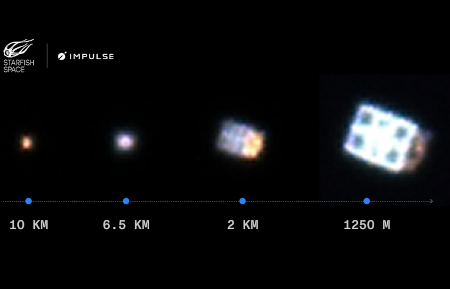
While a number of contracts have been issued in the U.S., Europe, and Japan to demonstrate de-orbit technology, this is the first operational contract ever issued. Moreover, I don’t think any of those other demo missions have actually achieved a de-orbit as of yet. Starfish itself has only successfully demonstrated rendezvous and proximity capabilities on two missions, with a third a failure. In the most recent late last year (as shown by the image on the right), Impulse’s Mira tug used Starfish software and camera to move within 1.2 kilometers of another Mira tug.

As for docking, its Otter Pup tug has flown two missions. The first failed in 2023 when both spacecraft began spinning unexpected. The second was supposed to achieve a docking, but after completing rendezvous maneuvers the company has provided no new updates. As far as we know, the docking never occurred or was a failure.

Nonetheless, it appears Starfish’s overall recent performance convinced the Space Force it could handle this new de-orbit contract.

An Impulse tug using Starfish equipment has successfully completed autonomous rendezvous maneuvers

Remora rendezvous
Images taken by Starfish’s camera.

A Mira orbital tug built by the startup Impulse Space has successfully completed rendezvous and proximity operations near a previously launched Mira tug, using software and equipment provided by the startup Starfish Space.

The Remora mission marked an industry first: a fully autonomous rendezvous executed by Starfish with a single lightweight camera system and closed-loop guidance, navigation and control software running on a peripheral flight computer.

Starfish and Impulse conducted the mission using Impulse’s Mira spacecraft that was flown on the Impulse LEO Express 2 mission. Starfish’s payloads enabled Mira to perform close-proximity maneuvers with another Impulse Mira spacecraft on orbit, which had been previously used for the LEO Express 1 mission. During operations in LEO, Starfish software autonomously controlled the LEO Express 2 Mira, guiding the satellite through a series of maneuvers which ultimately brought it to within approximately 1,250 meters of the LEO Express 1 Mira.

The significance of this test is its simplicity. Starfish has now demonstrated rendezvous technology that cubesats can use. Previously such precise maneuvers could only be done by larger satellites using more complex equipment. Starfish has orbital tug contracts using its own Otter tug, and will use this technology on those missions.

Impulse meanwhile demonstrated the maneuverability of its own Mira tug. And both companies demonstrated the ability to put this mission together quickly, in about nine months, and then launch it on a SpaceX rocket.

NASA awards small study contract to orbital tug company Starfish Space

Capitalism in space: NASA has awarded a small three-month study contract to the U.S. orbital tug company Starfish Space, to consider using its Otter orbital tug to rendezvous and inspect defunct orbital debris.

The award amount was not released, suggesting this is a very small contract designed simply to see if the company’s technology warrants a larger contract.

Some of those features — including Starfish’s Cetacean relative navigation software and its Cephalopod autonomous guidance software — could be tested sometime in the next few months on the company’s Otter Pup prototype spacecraft, which was sent into orbit in June but was forced into an unfortunate spin during deployment. Starfish stabilized the spin in August and is currently making sure that all of Otter Pup’s systems are in working order for future tests.

NASA’s follow-up contract, awarded through the space agency’s Small Business Innovation Research program, or SBIR, calls for Starfish to assess the feasibility of using its full-scale Otter satellite servicing vehicle to rendezvous with large pieces of space debris and inspect them.

This contract is comparable in goals to the one NASA issued to Astroscale earlier this week, though much smaller.

Startup orbital tug company experiences technical issues on demo flight

The first test rendezvous and docking of two smallsats built by the startup orbital tug company Starfish Space and space station startup Launcher/Vast are facing significant technical issues because both spacecraft are spinning in an unexpected manner.

Soon after Orbiter SN3 separated from the Falcon 9 upper stage, it experienced an anomaly that set it spinning at a rate on the order of one revolution per second, far outside the bounds of normal operating conditions.

By the time Launcher’s team made contact with Orbiter, fuel and power levels were critically low — and the team made an emergency decision to deploy Otter Pup immediately. In a joint statement issued today, Launcher and Starfish Space said that quick action “gave the Otter Pup mission a chance to continue.”

With assistance from Astro Digital and ground station partners, Starfish’s team contacted Otter Pup and determined that it was generating power — but was also spinning because of the circumstances of its emergency deployment.

The plan had been to deploy Otter Pup and have it rendezvous and then dock with Orbiter, demonstrating the maneuverability of both spacecraft as well as their docking equipment. The spinning now threatens the company’s ability to do this. Over the next few months engineers will make attempts to slow the spinning of Orbiter, but it is unlikely a docking can now be attempted.

Another orbital tug & servicing company raises investment capital

Starfish Space, a new entrant into the orbital tug & servicing industry, has successfully raised $14 million in new investment capital, in addition to the $7 million it had raised in a previous fund-raising round.

The company hopes to launch a test satellite later this year, dubbed Otter Pup, which will undock from the orbital tub of another company, Launcher Space, do maneuvers, and then redock.

Starfish’s plan calls for Otter Pup to be sent into orbit this summer as a rideshare payload on SpaceX’s Transporter-8 mission. The spacecraft will be deployed from Launcher Space’s Orbiter space tug, and then will execute a series of maneuvers with a xenon-fueled electric propulsion system to move away from the tug.

If all goes well, the Otter Pup will return to the vicinity of the Orbiter, and then use an electrostatic-based capture mechanism to latch onto a docking target on the space tug. It could take months to test out the Otter Pup’s systems and tweak them as necessary for its test hookups.

Though the company says it will offer tug services once operational, it appears it is mostly aiming for the satellite robotic servicing market. It, like Astroscale, has developed its own docking capture device, which it will try to convince satellite companies to attach to their satellites. It will then use this to dock and service those satellites. Since these capture devices are proprietary, the number that each company gets onboard satellites will determine that company’s future sales.

This orbital servicing industry appears to be growing very quickly, now that launch costs have come down by about 90% since the arrival of SpaceX. For example, the orbital tug company Momentus is getting ready to launch its third mission.