
Changes in the levels of sulphur dioxide since Venus Express arrived in orbit around Venus in 2006 now suggest strongly that the spacecraft has detected volcanic activity on the planet.

Changes in the levels of sulphur dioxide (SO2) since Venus Express arrived in orbit around Venus in 2006 now suggest strongly that the spacecraft has detected volcanic activity on the planet.

The SPICAV data show that the concentration of SO2 above the main cloud deck increased slightly to about 1000 parts per billion by volume (ppbv) between 2006 and 2007, but then steadily decreased over the next five years, reaching only 100 ppbv by 2012. This is very reminiscent of a pattern observed by Pioneer Venus during the 1980s, the only other multi-year dataset of SO2 measurements.

One of best explanations for these changes is a volcanic eruption back in 2006, which would have inserted a great deal of SO2 into the upper atmosphere. Since then, ultraviolet radiation from the sun has steadily destroyed it.
0 comments

The discovery of volcanoes on Io

discovery image

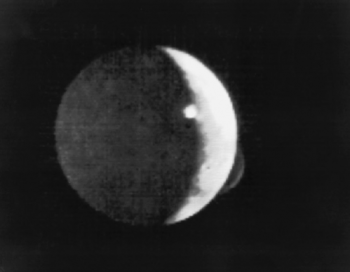
On March 8, 1979, as Voyager 1 was speeding away from Jupiter after its historic flyby of the gas giant three days earlier, it looked back at the planet and took some navigational images. Linda Morabito, one of the engineers in charge of using these navigational images to make sure the spacecraft was on its planned course, took one look at the image on the right, an overexposed image of the moon Io, and decided that it had captured something very unusual. On the limb of the moon was this strange shape that at first glance looked like another moon partly hidden behind Io. She and her fellow engineers immediately realized that this was not possible, and that the object was probably a plume coming up from the surface of Io. To their glee, they had taken the first image of an eruption of active volcano on another world!

Today, on the astro-ph preprint website, Morabito has published a minute-by-minute account of that discovery. It makes for fascinating reading, partly because the discovery was so exciting and unique, partly because it illustrated starkly the human nature of science research, and partly because of the amazing circumstances of that discovery. Only one week before, scientists has predicted active volcanism on Io in a paper published in the journal Science. To quote her abstract:
» Read more

0 comments

Mars’ clay minerals might have been formed by volcanic processes, not standing liquid water as generally believed.

The uncertainty of science: Mars’ clay minerals might have been formed by volcanic processes, not standing liquid water as generally believed, according to a new study.

Data collected by orbiting spacecraft show Mars’ clay minerals may instead trace their origin to water-rich volcanic magma, similar to how clays formed on the Mururoa atoll in French Polynesia and in the Parana basin in Brazil. That process doesn’t need standing bodies of liquid water. “The infrared spectra we got in the lab (on Mururoa clays) using a reflected beam are astonishingly similar to that obtained on Mars by the orbiters,” lead researcher Alain Meunier, with the University of Poitiers in France, wrote in an email to Discovery News. The team also points out that some of the Mars meteorites recovered on Earth do not have a chemistry history that supports standing liquid water.

If correct, this alternative explanation would mean that Mars was not that wet in the past, and would have been far less likely of ever having sustained life.

0 comments

In a paper published today in Geophysical Research Letters, researchers studying an icecore drilled in the West Antarctic Ice Sheet have found strong evidence of the 16th century Little Ice Age in the southern hemisphere.

In a paper published today in Geophysical Research Letters, researchers studying an ice core drilled in the West Antarctic Ice Sheet have found strong evidence of the 16th century’s Little Ice Age in the southern hemisphere. From the abstract:

The temperature in the time period 1400–1800 C.E. was on average 0.52 Β± 0.28Β°C colder than the last 100-year average. … This result is consistent with the idea that the [Little Ice Age] was a global event, probably caused by a change in solar and volcanic forcing, and was not simply a seesaw-type redistribution of heat between the hemispheres as would be predicted by some ocean-circulation hypotheses.

In an effort to emphasis human-caused global warming and eliminate any evidence of climate change caused by other factors, many global warming scientists have argued that the Little Ice Age was not a global event but merely a cooling in Europe. This data proves them wrong. The global climate has varied significantly in the recent past, and not because of human behavior. Other factors, such as fluctuations in the solar cycle, must be considered more seriously for scientists to obtain a better understanding of the Earth’s climate.

1 comment

The explosive Kilauea volcano

At a press conference just completed at the American Geophysical Union meeting in San Francisco, geologist Don Swanson of the U.S. Geological Hawaiian Volcano Observatory revealed that the Kilauea volcano on the Big Island of Hawaii has been in an explosive mode about sixty percent of the time in the past 2500 years. “Kilauea is not the gentle volcano that most people assume,” noted Swanson.
» Read more

0 comments

The journal Science finally admits things have not gotten warmer in the past decade

The journal Science finally admits things have not gotten warmer in the past decade.

The explanation provided, that recent volcanic eruptions cooled a warming earth, might be true, though the conclusions are based not so much on data but on climate computer models, a fact that leaves me somewhat skeptical. Nonetheless, what is significant to me about this article is that Science — which has been decidedly in the global warming political camp for years and has frequently lambasted scientists who suggested the climate’s warming has slowed or even stopped in the past decade — has now been forced to admit that the warming has stopped. That they feel compelled to push the global warming threat in the same sentence only reveals their continuing scientific bias.

0 comments
1 2 3 4