
Science operations about to resume on Europe’s two-satellite Proba-3 space telescope
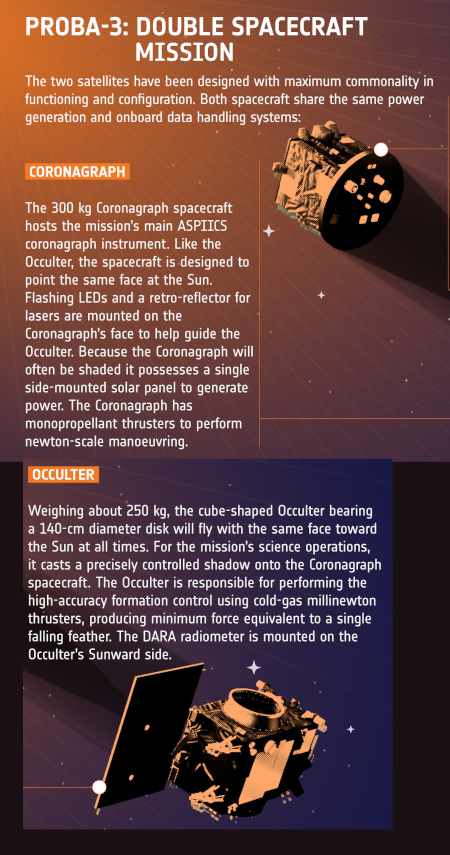
The Proba-3 mission
The Proba-3 mission. Click for original.

After months of trouble-shooting after losing contact with the coronagraph probe of Europe’s two-satellite Proba-3 solar space telesscope in February 2026, engineers have successfully resumed precise formation flying of the two spacecraft, and are about to resume full science observations of the Sun’s corona.

The mission is explained in the graph to the right. In February all contact with the coronagraph, which holds the mission’s science instruments, was lost. After a month of struggle, engineers regained contact, but it required another few months of trouble-shooting to pin down the cause of the problem and fix it. The press release provides almost no information about that cause, other than this one quote that hints it was software-based.

“One by one, we have checked the status of each of the spacecraft’s subsystems. We have also been able to successfully perform the operations that proved critical in February,” says Damien. “Back then, it triggered the unfortunate chain reaction that led to loss of connection with the spacecraft, but after patching the root cause in the software, we were confident that this activity will cause no further issues.”

With both spacecraft once again operating in tandem, the occulter can block the Sun’s light so the coronagraph can observe the Sun’s corona, its atmosphere. Essentially, Proba-3 creates an on-going artificial eclipse so as to make the corona visible for study.

4 comments

Scientists: The Sun’s bright corona acts to impede coronal mass ejections

Using data gathered by the Solar and Heliospheric Observatory (SOHO) since its launch in 1995, scientists have determined that when the Sun’s corona (its atmosphere) is bright, it acts to slow and even block the ejection of coronal mass ejections (CMEs), which if they impact the Earth’s magnetic field can have a harmful effect on our modern technology.

Using data from NRL’s Large Angle and Spectrometric Coronagraph Experiment (LASCO) on board the joint European Space Agency (ESA)-NASA Solar and Heliospheric Observatory (SOHO), the NRL team [National Research Laboratory] compiled nearly three decades of observations of the solar corona. They studied the extensive dataset to investigate trends in the brightness of the Sun’s corona and compare them to CME velocities over the same period. Their study found a strong correlation between the two datasets, with bright regions of the solar corona appearing to relate to substantially slower CME velocities and, in some cases, perhaps entirely precluding CMEs.

This data will help solar weather observers better predict the arrival of CMEs, should they erupt from the Sun aimed at Earth. It will also allow them to gauge the risk of CMEs even occurring.

8 comments

Scientists think they have finally discovered what makes the Sun’s corona so hot

Using data from Europe’s Solar Orbiter spacecraft, scientists now think they have finally pinpointed the process that causes the Sun’s corona — its atmosphere — to be many times hotter than its surface.

For decades, scientists have been struggling to explain why temperatures in the sun’s outer atmosphere, the corona, reach mind-boggling temperatures of over 1.8 million degrees Fahrenheit (one million degrees Celsius). The sun’s surface has only about 10,000 degrees F (6,000 degrees C), and with the corona farther away from the source of the heat inside the star, the outer atmosphere should, in fact, be cooler.

New observations made by the Europe-led Solar Orbiter spacecraft have now provided hints to what might be behind this mysterious heating. Using images taken by the spacecraft’s Extreme Ultraviolet Imager (EUI), a camera that detects the high-energy extreme ultraviolet light emitted by the sun, scientists have discovered small-scale fast-moving magnetic waves that whirl on the sun’s surface. These fast-oscillating waves produce so much energy, according to latest calculations, that they could explain the coronal heating.

You can read the paper here [pdf]. The results have not yet been confirmed, but if so it will solve one of the space age’s oldest scientific mysteries.

5 comments

Scientists confirm Parker entered Sun’s corona in April 2021

Scientists yesterday announced that the Parker Solar Probe successfully entered the Sun’s corona for the first time during its April 2021 close fly-by.

More information here, including some excellent short movies made from images created by Parker’s instruments.

The top edge of the corona is dubbed the Alfvén surface, and Parker’s passage across that boundary three different times during the April ’21 fly-by revealed it to be a sharp boundary that also has a great deal of topography. From the second link:

The first time Parker passed the Alfvén surface was the longest; it flew through the atmosphere for about five hours. Even as it continued flying toward the Sun, though, it popped back out, only to submerge again more deeply when it was at its closest approach — but briefly, that time exiting after just half an hour. Then, on its way outward, the spacecraft once again skimmed beneath the surface for a few hours.

“[The Alfvén surface] has to be wrinkly,” Kasper says. “It’s not fuzzy — it’s well-defined while we’re under it — but the surface has some structure to it.” So while the probe sees a smooth change in conditions while crossing the boundary, where the boundary is can change. The reason for this wrinkly surface is still an open question, though the researchers suspect the crossing over a pseudostreamer lower in the corona pushed the boundary out to enable the first crossing.

What’s clear is that inside the Sun’s atmosphere, conditions are different than just outside. Parker saw plasma waves moving back and forth instead of flowing outward. That difference was visible not just to the SWEAP and FIELDS instruments, which measure particles and electric and magnetic fields, respectively, but also to the probe’s WISPR imager.

The Parker science team also indicated that the preliminary data from the probe’s next two fly-bys — the most recent in November that was the closest yet — suggest it passed through the corona then as well.

One of the biggest unsolved mysteries about the Sun’s corona is that it appears to have a temperature in the millions of degrees, far hotter than the Sun’s surface below, something that is counter-intuitive. The expectation was that the atmosphere would be cooler than the surface. Finding out why the corona is hotter is one of the main science goals of Parker. It appears the probe is finally gathering data that might help solve that mystery.

4 comments

Confirmed: Almost 15% of NY population infected with COVID-19

Further random testing in New York state has now confirmed that 14.9% of the population has been infected with the Wuhan flu without exhibiting any symptoms.

Cuomo said 14.9% of those tested statewide tested positive for COVID-19 antibodies, which is up from the initial 13.9% statewide when a previous sample of 3,000 people was done on April 22. Cuomo said the 1% increase is statistically in the margin of error.

While the bulk of infections is in the densely populated NYC area, the data is more evidence that the Wuhan virus’s mortality rate is much lower than previously estimated, and is actually much closer to that of the flu.

13 comments