
SpaceX’s IPO sets the stage for the colonization of the solar system — by private enterprise
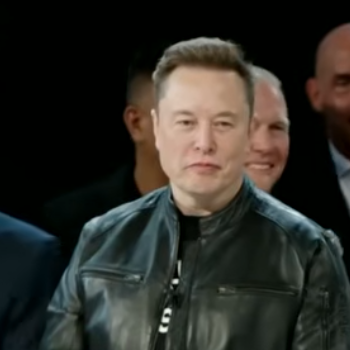
Elon Musk at the IPO opening.
While most news reports have focused trivially on Elon Musk’s status as the first trillionaire resulting from SpaceX’s successful initial public offering (IPO) last week, the real story of that IPO has to do with SpaceX itself and how that company’s extremely bright future is going to change human history.
Let me run some numbers.
The day’s earnings
First, the IPO was designed to raise capital for SpaceX by selling about 555 million shares of stock, with an opening price of $135. Once IPO opened however that price immediately jumped to $150, rising as high as $176 during the day, and by closing time settled at $160.95.
If we pick a conservative average sale price of $155 per share, this means SpaceX raised more than $86 billion in investment capital on this one day. The actual number will be less, because the brokerage houses that ran the IPO get a cut, but I would guess SpaceX will walk away with at least $75 billion once all accounts are settled.
To give this some context, NASA’s annual budget for the past two decades has been around $24 billion. NASA however cannot use that cash very efficiently, because it is required by Congress to have a huge unneeded labor force in many centers scattered around the country, to create jobs in specific congressional districts and states.
SpaceX doesn’t have that problem. For the company, this is real money. It can focus its use very precisely and efficiently for what needs to be done, and thus get a lot more bang out of the buck.
Annual earnings
SpaceX however is not limited to just the capital raised in the IPO.
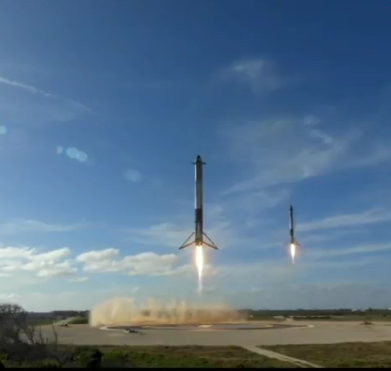
The landing of two Falcon Heavy side boosters
on its first launch in 2018
It presently earns about $12 billion per year from Starlink (a number that is guaranteed to rise in the coming years), and is now earning about $15 billion per year from a contract with the AI company Anthropic, in which SpaceX provides that company with computing hardware.
In addition, SpaceX’s rockets and capsules produce even more revenue per year. According to the company’s IPO prospectus, its space division earns about $4 billion per year. Those earnings include revenues from the 150-plus launches it does per year, plus its earnings from NASA contracts for flying manned and unmanned Dragons to ISS, as well as the independent private Dragon tourist flights.
Of course, not all SpaceX operations are in the black. According to its IPO prospectus it loses a small amount of money annually from that launch/spacecraft component, mostly because it is pumping about $2 billion per year into the research and development of Starship/Superheavy. It is also losing about $3 billion per year in its AI sector.
There’s more to this, but these numbers suggest that — ignoring expenses and research — SpaceX likely brings in about $31 billion in revenue each year from its various products.
Once again, compare that with NASA’s annual budget of $24 billion for the past two decades.
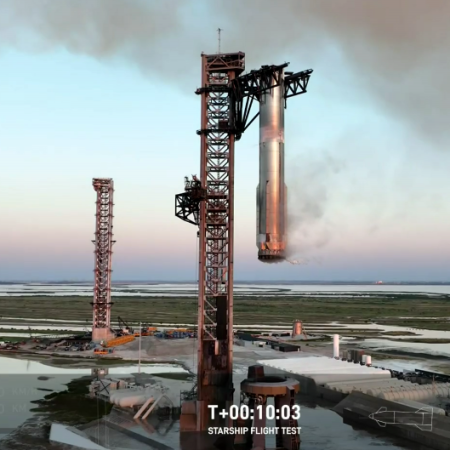
Superheavy caught in 2024 by the tower chopsticks
on the very first attempt
To put it bluntly, SpaceX not only has an annual budget that exceeds NASA, it also has a nest egg of cash equaling at minimum $75 billion. Even if it doubles its Starship/Superheavy development budget to $4 billion per year, it will have enough money to run that program for at least a decade hence. It is certain therefore that this development will accelerate and reach fruition. SpaceX will not only build the Starships NASA needs to land on the Moon, it has the resources to do anything else it chooses to do, from building data center facilities on the Moon as well as sending dozens if not hundreds of Starships to Mars.
Along the way, the company (and Musk) is focused on generating even more profits. For example, it is modeling the launch of its proposed million satellite computing/AI constellation after its Starlink constellation: Begin launching early versions of the satellites as soon as possible, thus garnering market share and revenues as soon as possible, and follow up with upgraded satellites as they are developed. It hopes to begin launching from 30 to 50 of its AI-1 satellites on Starship by early 2027.
And SpaceX can do this because unlike all the other proposed computer/data constellations, SpaceX has the rockets, the satellite factory, the computer technology, and the manufacturing capability to do it all in-house. No one else has that vertical integrated capability.
A new generation of wealth
Even more significant is the new generation of talent that SpaceX has fostered across the entire aerospace sector. The press has made much of the fact that this IPO created millionaires of more than 4,000 SpaceX employees. Previous news reports have shown something more important: A large number of former SpaceX employees have created their own startups, raised capital, and are revolutionizing not just the space sector but innumerable other hi-tech industries. The IPO now simply gives them additional financial resources for achieving their goals.
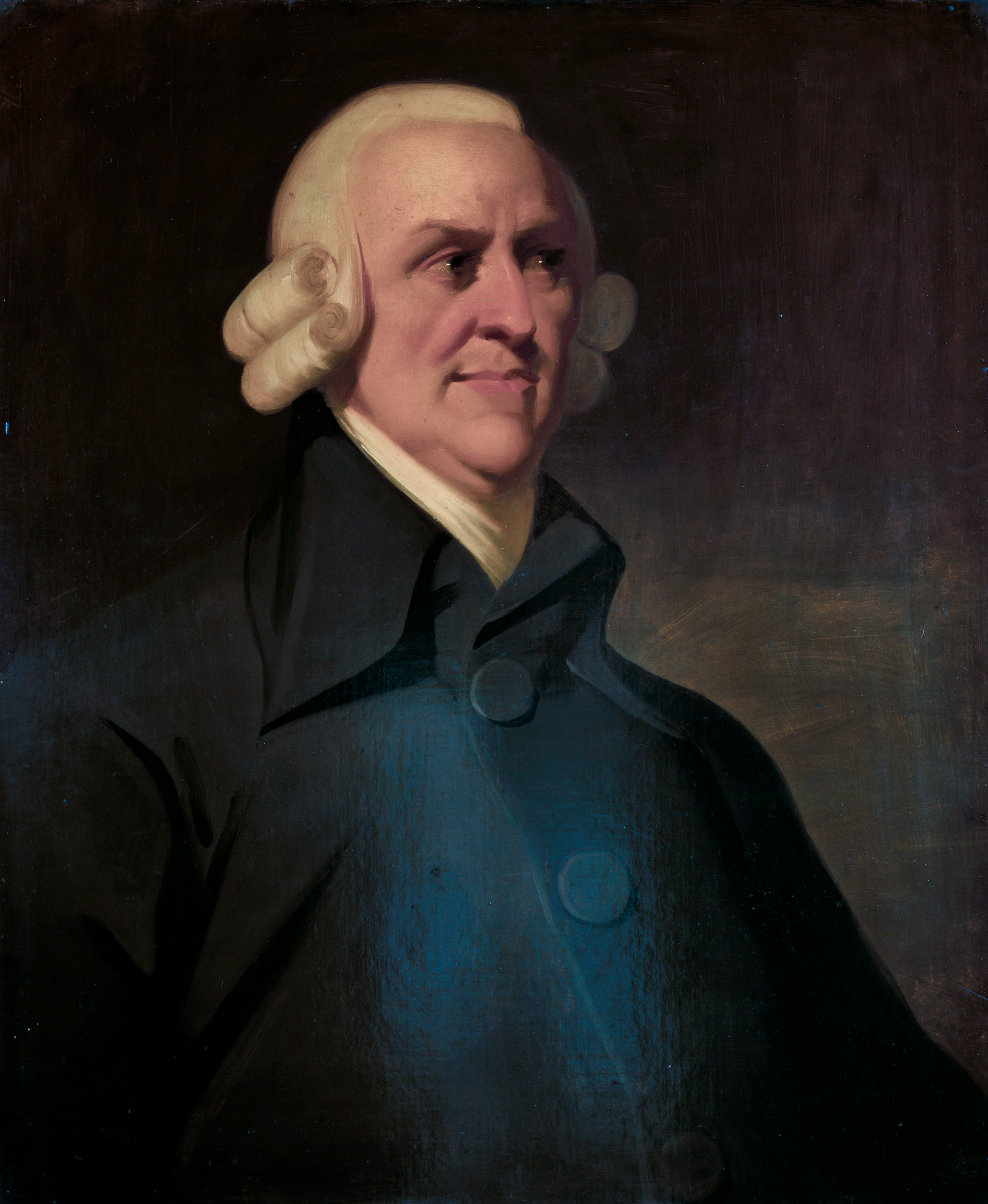
As predicted by Adam Smith in 1776 in The Wealth
of Nations. Image taken from 1880 Muir portrait.
Click for original.
SpaceX’s IPO also brings wealth and growth to countless adjacent companies, those that provide ordinary services — such as housing, real estate, schooling, contracting, transportation, groceries, etc — for the company and its employees. The prosperity SpaceX has brought to the south Texas region has been gigantic, taking what had been a depressed economy there for decades and turning it into a thriving economic engine. That wealth will begin to show up in other places, and in other industries, as SpaceX begins ramping up its space objectives.
What it all means for the future
It is very simple: SpaceX is the world’s leading space program. No one even comes close. NASA for example now builds very little. Under the administration of Jared Isaacman, it is laying out an ambitious lunar base program, but it is hiring the private sector to build practically everything. This is as it should be, but it also illustrates how ephemeral NASA is in the long term. Once the private sector develops the spaceships, rockets, and infrastructure requested by NASA, it will be in a position to make money on its own, from other customers — just as SpaceX is doing. In the long run this new energized private sector will leave NASA in the dust. And as I said, that is as it should be.
As for other countries, China’s space program is equally as ambitious and in many ways the most successful globally at this moment. It however still lacks the capabilities of SpaceX. It is working hard to develop reusable rockets, but none have yet flown successfully, and it will be at least two years before any can begin to launch reusable rockets on a regular basis, and even then none will be even close to the capability of Starship. It is building its own gigantic constellations for communications, internet, and computing, but all are as far behind SpaceX as its western commercial competitors like Amazon’s Leo.
Other countries such as India, Russia, and Europe are working to develop their own space effort, and though they all are likely to achieve good things in space, all of their proposed projects are modest when compared to what SpaceX is likely to do in the next two decades. For one, none now have the financial resources that can compare to SpaceX’s.
What is SpaceX going to do with those resources? First, it is making sure it will earn more profits, by expanding its Starlink constelallation while building its AI constellation. Next, it is going to develop its Starship lunar lander to NASA so that the agency can proceed with its planned Artemis program. Along the way it will help the agency build that lunar base, while possibly building its own facility for its own reasons.

“Proclaim liberty throughout all the land unto all
the inhabitants thereof.” Photo credit: William Zhang
And finally, it is going to create a Mars version of Starship and begin launching them to Mars, laying out the initial infrastructure for the first Mars colony. That colony will be an American one, owned by private American citizens and run privately. The government will likely be one of its customers and residents, but the colony will be made up of many, all free and working under the laws of the United States, regardless of what the Outer Space Treaty says.
All this because of the wild dreams of one man, an immigrant to America who embraced its fundamental belief that each person has the right to life, liberty, and the pursuit of happiness, following the American ideals of private property, capitalism, and earning profits. Elon Musk did this whole-heartedly, and the result is an engine of prosperity for millions, with no limit in sight.

On Christmas Eve 1968 three Americans became the first humans to visit another world. What they did to celebrate was unexpected and profound, and will be remembered throughout all human history. Genesis: the Story of Apollo 8, Robert Zimmerman's classic history of humanity's first journey to another world, tells that story, and it is now available as both an ebook and an audiobook, both with a foreword by Valerie Anders and a new introduction by Robert Zimmerman.
The print edition can be purchased at Amazon or from any other book seller. If you want an autographed copy the price is $60 for the hardback and $45 for the paperback, plus $8 shipping for each. Go here for purchasing details. The ebook is available everywhere for $5.99 (before discount) at amazon, or direct from my ebook publisher, ebookit. If you buy it from ebookit you don't support the big tech companies and the author gets a bigger cut much sooner.
The audiobook is also available at all these vendors, and is also free with a 30-day trial membership to Audible.
"Not simply about one mission, [Genesis] is also the history of America's quest for the moon... Zimmerman has done a masterful job of tying disparate events together into a solid account of one of America's greatest human triumphs."--San Antonio Express-News
https://www.youtube.com/watch?v=4MotB9K70XU&t=6s
Nice catch, from 1977 no less. At that time however the only such starships were by the government, and such the enthusiasm for this was muted. It might have even hurt sales.
Now however it is beyond timely. I hope the records sells big now.
just to expand
‘The Intergalactic Touring Band (IGTB) was not an actual music group but rather a science fiction pop music concept album released in 1977 by the now defunct Passport Records in America and Charisma Records in England. The ensemble album featured many star performers from progressive rock and other genres, including Meat Loaf, Ben E. King, Larry Fast (Synergy), Percy Jones, Annie Haslam, Rod Argent, Marge Raymond, Peppi Marchello (Good Rats),[1] and many others. The songs are loosely held together by an epic theme of multi-generational space travel and human space colonization’
I still have my vinyl, cover and insert from 1977. How many of you still have a turntable to play that precious,, irreplaceable disc like I do (although the album is available as an online recording)
Not me. But that may change. The wife and I still have a few bits of vinyl left from our misspent youths that I wouldn’t mind hearing again and the offspring recently took interest in the L.A. area retro-60s music scene. Those bands seem to put everything on vinyl.
Any recommendations on a serviceable turntable that doesn’t cost the Earth or require maintaining close watch on eBay?
I tended to think the cartridge (+ needle) was more important than the turntable. Looks like Audio-Technica seems to be currently most popular. Audacity (freeware software) is recommended for Win/Mac. Depending on your turntable, you may or may not need a preamp inline. There is a whole community out there for digitizing vinyl that you can tap into. You can find this stuff on Amazon with prices from el-cheapo to audiophile.
I tended to minimize the number of times I played a record, as they tend to wear out (needle is harder than the plastic and wears it out). Would record once and beat up the new media (started with tape, moved to CD, eventually straight digital – MP3/ MP4).
Important part is cleaning records before recording. My brother digitized a lot of vinyl in his younger days. I learned from him. He would wash his vinyl with dish soap and water, rinse them off, and dry them. We recorded about half of them damp to wet (floats the dust out of the grooves – or so they say).
Fun project. There are still a lot of oldsters who swear vinyl is a richer sound than digital. As usual, your mileage will vary. Cheers –
Thanks. Much appreciated.
In many ways, what you suggest about private enterprise being the means of settling the solar system has a parallel in Canadian history.
Much of the exploration by Europeans was as a result of the fur trade. One firm in that business was the Hudson’s Bay Company, established by British royal charter in 1670. The Crown granted exclusive rights to the rivers that drained into Hudson’s Bay as well as, I believe, their tributaries. That covers much of what is now Ontario, Quebec, and Manitoba and was known as Rupert’s Land, named after Prince Rupert.
Roughly a century after the establishment of the HBC, the North West Company was formed as a way around the monopoly, but its territory was largely in western Canada. The two firms merged over 200 years ago after dealings between them became heated.
Rupert’s Land was dissolved when it was sold to Canada in 1870, though the Hudson’s Bay Company remained as a retail enterprise until it closed its doors about a year ago.
One result of the fur industry was the establishment of a retail business through a network of trading posts. Many of those posts became permanent settlements which are now towns and cities throughout Canada. Much of the country was mapped through the search for new trapping areas as well as looking for a route to the Pacific.
Sorry to hear Hudson’s Bay closed down. In my youth I think every thick blanket in our house was a Hudson’s Bay item. The thinner ones were all olive drab US Army items – probably obtained by five-finger discount – like his issue sidearm – by my father when he mustered out in 1946. I have fond memories of the warmth and softness of Hudson’s Bay blankets.
Yes, the HBC blankets were highly prized items.
Unfortunately, the Bay fell upon hard times. It was, at one time, publicly traded on the Toronto stock exchange.
The Bay outlet closest to me was an anchor store in a nearby shopping centre. It feels kind of odd seeing it shuttered.
I know the feeling. Retail rise and fall has been a continual story here in Southern California.
I lived for awhile in Downey in the mid-1970s and there was a very impressive deserted megastore – by the standards of the time – just a mile or two from my apartment. It was part of a discount chain called – and I kid you not – White Front.
I giggle a bit at the prospect of trying to start up something with that name these days, especially in CA. It seemed a bit “out there” even in the 70s But the chain had been founded in the pre-PC year of 1950 – and in South-Central L.A. of all places.
The linked picture is not of the Downey location and is from happier times in the mid-60s, but they all looked pretty similar.
I lived in Downey in 1975-6 and the chain had only gone bust the year before, but the parking lot was, of course, quite empty and forlorn and the physical plant was already looking a bit ragged around the edges.
I moved away from Downey the following year to spend a couple of years working as a expat in Europe. Haven’t been to Downey since, but I’m sure the building has long since been demolished. Given the half-lives of CA retail chains, whatever replaced it might well have gone through an entire life-cycle including bankruptcy and demolition by this time too. Maybe even a third such go-around. Or it could all be condos.
Compared to a lot of other places, Southern California has never had much of an “edifice complex.” On balance, that is probably a good thing.
And then, of course, there are the buildings that get red-tagged and taken down after every major earthquake. Mother Nature sees to a certain amount of structural churn even apart from what we people creatures do.
Hudson Bay!
I remember reading about the first settlements on the western shore of Hudson Bay. Of course, they came in the spring/summer, when the Bay is NOT frozen. Along comes winter, the Bay freezes, and it turns out some of the settlements are in the path of the annual polar bear migration. Oops.
While our settlement of the Solar System will not have to deal with migrating bears, there will be other unknowns.
This is when I would love to discover how to join Lazarus Long and the Howard Families. Just imagining the next few hundred years makes my heart glad.
You raise an interesting point. The preferred launch windows for flights to and from, say, Mars occur roughly every two years. Similarly, access to ports on Hudson’s Bay (and, for that matter, James Bay) is best when there’s little or no ice. That’s one reason why there’s a short shipping season from Churchill, Manitoba.
During the time of Rupert’s Land, trading posts like York Factory stored furs until they could be shipped. In the meantime, furs could be delivered by water when the rivers were ice-free or by sled when the ice was thick enough.
Those posts and the resulting settlements were able to exist because they paid for themselves. Many of their costs could be offset by using local resources, particularly if located below the tree line. (I’ve heard similar arguments used for lunar and martian colonies: get them to pay their way and live off the land.)
And on NASA’s flat budget, the “unneeded labor force” sent four people to the Moon this year.
Jeff,
A successful flight doesn’t prove anything useful or valuable was done. We cannot establish industry on the Moon, or do much in the way of science, at the cost of a billion dollars per person. It’s just not going to happen. NASA’s workforce is much too large and should be trimmed, starting with MSFC.
That’s punishing success.
At any rate, the Greens busting your chops at SPF forgot that you advocate servers in space rather than the oceans.
Perhaps you could remind them that server farms in blue holes need not transmit heat to the whole ocean–and remind them of undersea volcanoes dumping far more heat than all sea-servers ever could…. especially that Titan Ridge eruption.
Ask them their REAL reason to be against server farms
You never fought them like you did me–and we are much closer in terms of wanting the conquest of space.
You want America to look better in international settings, and you could make great outreach.
Not all success is created equal. Some is more trouble than its worth. This is the case for the SLS: there is no future where it could realistically build and support a lunar base without other vehicles doing all the hard work.
Heh. You keep thinking I’m someone over at some other forum. Sorry, Jeff, I’m not. Whatever these people are discussing, perhaps you should post there.
Just to expand a bit upon Bob’s point. SpaceX isn’t just ahead, with the capital from this IPO it is about to LEAP ahead in a way that is almost impossible to imagine anyone else ever catching up.
First they will soon have 2 complete Gigabays with 48 booster/ship construction/refurbishment/storage berths and 5 separate launch pads for Starship/Superheavy rockets. On top of this they are actively building air separation and methane liquefaction facilities for all of their pads which will give them a material advantage in fuel costs for these rockets which once they become rapidly reusable will be the largest component of their launch costs.
Next, as explained in the video they shared this last week they are now building out some 10M square feet of manufacturing facilities to create space appropriate solar panels (from raw materials in to ready-to-launch product out), and the Starlink, Starlink Mobile, and AI1 satellites that will use them at a scale no one else even imagines.
Then it seems likely that all of this doubles up again when they likely succeed in procuring the Exxon acreage in Louisiana. And assuming this becomes another company town a la Starbase they will likely develop another 5-10GW of terrestrial data center capacity as well (a la Colossus) since everyone else in the country are shunning these facilities.
SpaceX is on an exponential curve and we are about to witness what that REALLY looks like in a very big way.
In a recent video Susan Kokinda of the Promethean Action PAC said that when the Founding Fathers were developing the American System, Alexander Hamilton realized Capitalism would maximize human creativity.
Bob–
All this sounds very promising for the future of humanity and American culture, along with your reminder of Musk’s embrace of those iconic words in our 250 yr old Declaration of Independence. One thing I’d really, really like to hear Mr. Musk acknowledge is Who endows us with those 3 inalienable rights; and which every one of our Founding Fathers, including the author (Mr. Jefferson) of those stirring words, fervently believed.
I feel this critically important given the whole current enterprise and plan is leveraged on “artificial intelligence”: a plan that its principals, including Musk, seek to create “humanity 2.0”.
The danger of this hubris was foreseen by one of the most brilliant of the Founding Fathers and stands as a warning to us today:
“….Because We have no Government armed with Power capable of contending with human Passions unbridled by morality and Religion. Avarice, Ambition, Revenge or Gallantry, would break the strongest Cords of our Constitution as a Whale goes through a Net. Our Constitution was made only for a moral and religious people. It is wholly inadequate to the government of any other.”
From President John Adams address to the 3rd Brigade, 3rd Division, Massachusetts Militia 11 October 1798
There will be no “redemption” of mankind unless or until the idea that Man is evil by nature is rejected. Unless or until this occurs, his alleged highest ideal remains as concerning himself with others and/or the Creator. Concurrent with such nonsense is its “currency-in-trade,” sacrifice.
Man must come to himself as capable, worthy and indeed, noble! However, he must make the choices necessary to become these things. His nature of being self-interested must become one of RATIONAL self-interest.
My final point to “Concerned,” is, why do you suppose that “Creator” was chosen in Jefferson’s Declaration as opposed to “God?”
Rational self-interest can easily and readily be abused to do all sorts of horrific things.
And the horrors of the Twentieth Century should have put paid to the idea that mankind is not inherently evil (let alone the devastation unleashed by so many revolutions, from the French to the Russian and beyond).
I prefer the term *enlightened* self interest. It’s OK to get ahead, not OK to get ahead by pulling or pushing down others.
SpaceX and Elon Musk deserve all the kudos they are getting. This is a major change to the whole space economy in ways we still can’t really see.
Despite the incredible lead the company has, others should still continue to meet SpaceX where they are. It will take a lot of time and money but there are riches worth going after – but you have to be bold to get them.
Robert,
Thank you for putting all that together in one place, like that.
The settlement of the solar system could look much like the settlement of the American prairies, the Homestead Act, except without the limitations of government. When SpaceX gets to Mars, no one will own it, so no one will limit homesteaders to 160 acres and only if they can live on and improve the land for five years.*
I see great things in the near future, especially on Mars, but I also imagine, in a farther distant future, O’Neill-like colonies orbiting planets that have limited planetary settlements and colonies, because the energy to get off of planets makes surface colonies less desirable than orbital colonies. Right now, we have a bias toward living on planets, but the future is likely to choose less costly places to live and work, especially for products that move around the solar system.
You titled one of your sections “A new generation of wealth,” but I envision new generations of prosperity that make the prosperity of the past two hundred years look meager. In 1826, railroads were barely starting, and it was the railroads that made expansions of human civilization happen. I envision rockets as the railroads of the future, bringing people and goods around the solar system to places or orbits that can bring prosperity to those who settle there and the products that they make will bring prosperity to the rest of us.
It was nice to be alive when humans first went to another world, bringing us a whole new perspective of the universe and our place in it. It should be nice to still be alive when humans first settle another world, be it the Moon or Mars. This should bring an even better perspective, especially what we can do with the solar system and then with the universe.
Fifty years ago, we had expected NASA to follow through on that first perspective, but we forgot that government is not the solution. Instead, we get silly NASA missions that don’t bring us goods or services, so that Artemis missions currently look like make-work, like digging ditches where no ditches are needed, paying people to do what looks like productive work but isn’t. We the People are our own solutions, and we always have been, choosing what needs to be produced, then producing it. Bringing this attitude back to Americans may be one of the greatest treasures that we get out of our fledgling flights into the solar system.**
Happy 250th, America.
ad astra prosperitas
______________
* By the way, one of my related ancestors, my grandfather’s aunt, had tried her hand at homesteading in South Dakota. Unfortunately, she did not last the full five years and asked one of my great uncles (or multiple greats) to come take her back home, where she then tried her hand at dairy cows on the family farm. She was industrious, and my grandmother loved her very much.
** I’m pretty sure that I started out with a different conclusion in mind, and if I ever think of it again, I will add more commentary.
I believe a colony on Mars is possible, even likely, but I have my doubts that many people would actually want to live there as permanent residents.
There would need to be strong reasons for people to fully leave Earth behind.
People will live on Mars for many of the same reasons that their ancestors did when they went to the New World. Some will go there for adventure and exploration. But many will go because of opportunities that they don’t have where they are, such as a chance to seek their fortunes through economic independence. Others will go for political or religious freedom.
Earlier, I mentioned the fur trade in Canada. Many of the men who worked for the Hudson’s Bay Company or North West Company came over to simply make money and, after a few years, went back to the old country.
In all of these cases, there has to be an incentive or potential reward to leave what they have here.
On the other hand, I’m reminded of a line from a well-known song recorded by Reginald Dwight, better known as Elton John:
“Mars ain’t the kind of place to raise your kids…..”
The flaw in that analogy is that the adventure and exploration were largely for the discovery of resources and/or a better life. Mars has few resources for a better life, even if there are minerals to eventually discover.
Why do you believe Mars has few resources, F? While there’s substantial need for ground truth, we know for a fact it has virtually everything needed to support all kinds of industries, agriculture, and much more.
Martian settlements might be much like the mines in Canada’s Northwest Territories and Nunavut:
https://www.miningnorth.com/mines
Much of what is needed to operate at those facilities has to come from outside the area. But the associated costs are offset by the revenue resulting from what those mines produce.
Do the moon and Mars have resources that might be worth extracting? Possibly, which is one reason to explore to see if there’s anything and how much. If there’s enough of a particular mineral that it’s worth mining, that could lead to an extraction facility, such as a smelter. Once there’s a smelter, then, perhaps, a mill that can produce finished stock material such as I-beams or pipe.
If it ever gets to that stage, those settlements could become economically self-contained, and, perhaps, export what they produce.
Lunar and Martian industry will be, for some time, mostly in service of building and launching more AI data center satellites. There are people who think they can make money by harvesting Helium-3 on the Moon and maybe they can. But compared to SpaceX’s AI data center satellite works – and all of the upstream mining, smelting and forming associated with that, any production of physical commodities for shipment back to Earth is going to be a rounding error compared to what the SpaceX – and perhaps Blue Origin – lunar industries yield for use directly on the Moon and Mars or in their vicinities in space and, at some point, solar orbits. The main thing exchanged between Earth and the Moon and Mars will be – outbound from Earth – raw data to be crunched by space-resident AI data centers and -inbound to Earth – the AI models produced from said raw data.
Eventually, there will be other significant uses for what is mined and refined on both the Moon and Mars – giant rotating O’Neill habs being among them. But there will never be much actual mass exported by the Moon and Mars back to Earth. Interplanetary trade – except for energy at some point – is likely to remain in the realm of highly-refined intellectual property for the most part with only a tiny trade in curios, scientific samples and such being physical matter.
I saw something a while ago that large rotating O’Neill habitats were not possible with current relatively cheap materials.
Do you have a link? I’ve also seen it said that O’Neill habs would not be dynamically stable in terms of their axial rotation. I believe some engineering grads once put together an analysis that came to a similar conclusion about Larry Niven’s Ringworld.
Yes, Island 3 would be unstable, which is why they’re always depicted with another Island Three counterrotating to provide the necessary stability. Al Globus attempted to account for this when sketching out Kalpana One and Two.
Respectfully disagree. Mars has water ice. Lots of it in a gravity well a third that of earth. It also has a pair of moons begging for mining. And it is some 75 million km closer to the asteroid belt than Earth. Of course, that is mitigated by the NEO / NEA population. Cheers –
Early pioneering is always a rough go – e.g., ‘Little House on the Prairie.’ But even the Moon or Mars are never going to be quite as tough as a 19th century sod house in December. Some people who come from Earth will, doubtless, return at some point. But some won’t. And any children born there will just accept matters as they are in the way children always do.
I’ve heard it said that people won’t do well on the Moon or Mars because they’ll have to be indoors in artificial environments all the time. The typical US urbanite is already in an artificial environment all but a few percent of the time and even the outside time is mostly inside automobiles. Most people motivated enough to go anywhere extraterrestrial in the first place will, I think, get into the swing of things at their destinations fairly readily.
Don’t forget the Martian gravity. While some may enjoy the feeling of being “lighter” than they do on Earth, it will likely bother many people.
The variable G guys worry about exactly what gravity level turns on / off health issues. We know from ISS there are significant issues after long-term exposure to zero G. The other solar system bodies can be grouped into those with 1/6 G or 1/3 G. What is the level where health issues happen? Somewhere along the line, we are going to need a variable G facility for long term experimentation. Cheers –
Mr. Z.,
I’m going to quibble with you about the net proceeds to SpaceX from the IPO;
‘Normally,’ a Company with an IPO does a ‘roadshow’ to gauge interest and undergo initial price-discovery, which informs an initial price, and helps them judge how many shares could be sold. A range is calculated and an initial spread is established.
->SpaceX skipped this step for obvious reasons and went with a fixed price.
->Musk also negotiated with the Underwriters to make available 20-30% of all shares exclusively to retail-customers, to avoid immediate institutional capture.
All the IPO shares went out the door at $135, and SpaceX received that amount minus the underwriting fees of 0.75%, which is called the “gross spread,” or “underwriting spread.”
(“Normal” underwriting-fees are generally 5-7% or more, and the only other company in history to command such a low gross-spread was GM in 2010.)
–>The SpaceX Treasury received 99.25% of the gross IPO price or $133.98 per share.
The moment all the shares are out the door, trading in the secondary market begins, and SpaceX itself does not benefit directly from any price increase off the IPO price.
Concurrently, all the Underwriters begin trading on their own accounts. The Capital has been raised. Everything that happens after this point is between buyers & sellers in the open market.
There is also an “over-allotment option,” called a “greenshoe option” that is negotiated between SpaceX and the Underwriter’s, which allows them to sell Options on up to 15% more shares than the base amount.
— In SpaceX’s case, the greenshoe option allowed its lead underwriter, Morgan Stanley, to purchase an additional 15% of the IPO shares (about 83 million shares) at the IPO price of $135 per share for up to 30 days.
This method helps maintain price stability, improve liquidity, and prevent excessive volatility in newly listed shares, and allows insiders and those wishing to monetize their previous investments at a price closely approximating the IPO price.
-If demand is strong Underwriters buy ‘excess’ shares from SpaceX at the IPO price to cover their short positions.
-If demand falls and the stock price drops, Underwriter’s purchase stock on the open market to cover their short positions. (Known as a “reverse greenshoe” or reverse “over-allotment” option.)
Yes wayne has it exactly right!
Also note that Elon approved the greenshoe options, but only if the bankers actually wore green shoes! https://x.com/futurejurvetson/status/2065526675983470631
So SpaceX total take from their IPO: 555.6M shares, plus 15% more greenshoe shares, at $135 per share, minus $500M fee: $85.75B
Yep that’s right, no extra fee on the greenshoe shares. link text
Hang on, we are in for a wild ride…
“…the first Mars colony. That colony will be an American one, owned by private American citizens and run privately… made up of many, all free and working under the laws of the United States, regardless of what the Outer Space Treaty says.”
Very overwhelmingly likely such a colony will be under United States law; not only because Space-X is/will be an American company, almost certainly operating under the American flag — but, additionally, because the Outer Space Treaty itself overtly puts any such American colony under American law. Yes, that’s right: it would not be true despite the treaty, but at least partly because of it. (Though land rights and ownership off Earth are indeed in rather a terrible mess, at present.)
It’s important to distinguish not only the Outer Space Treaty of 1967 from the deservedly-infamous — and arguably now either failing or already failed — Moon Treaty of 1979/1983, but also to separate what either or both of them actually says from what a horde of commentators will merrily tell you (or already have said) one or both says or means or does.
Here, as a non-expert with exactly zero “credentials” in international or space law, all I’m going to do is (hopefully briefly) point you, the reader, at what the OST itself actually says it does, and how nicely it dovetails with the Artemis Accords. All these points can be verified with the publicly available texts, as found easily on the Internet.
From Article VIII of the Outer Space Treaty:
A State Party to the Treaty… shall retain jurisdiction and control over such object [one it launched into space], and over any personnel thereof, while in outer space or on a celestial body. Ownership of objects launched into outer space, including objects landed or constructed on a celestial body, and of their component parts, is not affected by their presence in outer space or by their return to the Earth. [end]
So, to summarize in my own words: if it was yours, it stays yours. If you built it Out There, it began as yours and yours it stays. Jurisdiction, if it means what it says, tells you your own laws (assuming you wrote them or interpreted them to apply ‘celestially’) are in force within your craft and your colony modules, and also to any “personnel” that, so to speak, ‘belong’ to them. (And note, anyone venturing into space more or less has to ‘belong’ to some country, at least by the Outer Space Treaty, see Article VI.)
This is actually recognized with the International Space Station; though it does have its own (pre-existing) set of agreements, to minimize the truly amazing trouble-making potential of NASA modules being U.S. ‘soil’ and Russian modules Russian, and JAXA modules Japanese, etc., if anyone were ever to be so boorish as to push the issue hard.
The only fly in the soup here (and it’s a big buzzer), as noted, is land off-Earth. Even on this what the treaty actually says is rather minimal:
Article II (in full):
Outer space, including the Moon and other celestial bodies, is not subject to national appropriation by claim of sovereignty, by means of use or occupation, or by any other means. [end]
Lots of people will tell you the above prohibition on nations claiming or annexing land (unilaterally) “makes outer space a commons” or some such drivel; but do carefully note the words, what they do say and don’t say. An international allocation of specific land areas, to assorted individual nations as theirs — is at the very, very least not expressly prohibited.
Also note that, very much unlike the Moon Treaty (see its Article 11.3, which basically forbids all private, government, or other land ownership in space, except for some anticipated “international regime” which gets a total loophole pass on all that), the Outer Space Treaty says nothing to explicitly ban either private or national land ownership — only that you can’t get to it simply by saying “okay, now that’s mine!” or by playing squatter on-site and then shouting “mine!” etc.
Now, let’s go look at what the Artemis Accords (freely available, unlike their Chinese-Russian-etc. counterpart) say on this:
Section 10.2
The Signatories emphasize that the extraction and utilization of space resources… should be executed in a manner that complies with the Outer Space Treaty… Signatories affirm that the extraction of space resources does not inherently constitute national appropriation under Article II of the Outer Space Treaty… [end]
Combined with some other references (see for example 10.3 and .4), this sounds to me just about exactly like “now we’re gonna go use resources in space, and never mind naysayers or bleating about the Moon Treaty.” It is also very interesting what the Artemis Accords say about the Moon Treaty.
Nothing. Whatever. As if it never existed; as if it’s about to be ignored straight to utter eternal oblivion.
This is where we are, right now. If nearly without any “case law” so far.
No, it’s not perfect, it’s so amazingly far from perfect. Land ownership is (we can easily argue) a basic human right. Assigning ownership of the entire Solar System to some Earth-based “regime” (Moon Treaty) would’ve been a travesty begging (in some later century) to become a tragedy; and it’s great we at least dodged all that horror by not ratifying the Moon Treaty.
This is what we have, instead, in current international treaty law and in “our” ever-expanding Artemis Accords alliance.
And, taken all together, it’s at least a decent start.
Nicely put. You outline in different words what I have said since the day the Artemis Accords were announced: The accords are designed to overcome the Outer Space Treaty’s legal limitations on imposing American law in space. They are also designed to develop an alliance with enough clout to make those limitations irrelevant.
It still remains a fact that property ownership of any surface on any space object remains questionable because of the Outer Space Treaty. It is going to take some strong action to fix this.
The key ambiguity, I think, is this language from Article 2 stating that outer space bodies are “not subject to national appropriation by claim of sovereignty.” The key assumption here, I think, is that all nations that might potentially claim sovereignty are those located on Earth. A declaration of sovereignty by the actual long-term residents of, say, the Moon and/or Mars, though, appears to fall entirely outside this prohibition. This may well provide the legal basis for establishing US-style property rights to real estate on extraterrestrial bodies.
Ah you mean the colonists might decided to declare independence from the home world, establishing their own government of, for, and by the people? What a concept! I wonder: has anyone ever done it before?
Long time ago. ‘Bout 250 years if memory serves.
The idea of private companies helping settle the solar system isn’t new. Some readers may remember a TV science fiction movie that ABC (I think) broadcast in the early 1990s. Its title, I recall, was Plymouth.
The premise is that a small town in Oregon or Washington was made uninhabitable because of an industrial mishap (a nuclear accident as I remember). The company responsible offered to relocate the residents to its mining facility on the moon and they accepted provided that they could keep their community together.
It was interesting in that it touched on numerous issues that will eventually have to be considered when establishing a permanent habitation on the moon or Mars. That included how such a community would be run and whether it was possible to approximate a terrestrial climate underground by producing artificial rain indoors. The climax focused on space weather and how people had to seek shelter when there was an influx of radiation due to solar activity.
The movie was meant to be the pilot for a continuing series, but that was where it remained.
Pete Conrad makes a brief on-screen appearance as a technician.
BMJ: What is different now is that the private sector increasingly has the capital to do it. In the past, all we had was sci-fi and failed companies, with NASA and the government working hard to shut down any private competition.
When the movie was aired, the space business was dominated by large aerospace firms. (I believe it was broadcast around the time that the McDonnell-Douglas DC-X Delta Clipper was being tested.) There were, however, smaller firms such as Orbital Sciences, the Pegasus having already flown.
I don’t think that anybody back then would have ever thought that a private company, one which itself began as a start-up, would ever become the space program of a country, let alone using its own money.
Yeah, I saw that at the time. The boss lady was played by the estimable Cindy Pickett and Pete Conrad had a role as a sort of funny janitor-type a bit reminiscent of Chuck Yeager’s role in The Right Stuff a few years earlier. He certainly lived up to his rep as the Clown Prince of the Apollo-era astronaut corps. Good physical comedian including gags based on his short stature.
I think the intent might have been for the notional follow-on series to be a “dramedy” as the term of art was from the mid-80s to the early 90s. It struck me as a bit unsure of where to strike the balance between humor and drama, a problem a number of other short-lived and still-born dramedies had during those years.
Yes, I remember “Mrs. Bueller” as the town’s physician.
Because of the topic, I’m not sure the writers would have had enough material for a viable weekly series without it turning into a soap opera (As the Asteroid Turns, or some such thing). Perhaps a number of 2-hour movies might have been better.
Still, the movie brought up some interesting points which eventually will have to be dealt with in reality, particularly since SF more than just starships, ray guns, and little green men. What’s life going to be like on the moon when the inhabitants will include schoolteachers or shopkeepers? Will Amazon make deliveries there? (The flick was made during the early days of the Internet and Amazon didn’t even exist back then.) Since there will eventually be families there, when will children be born and how will they grow up in 1/6-g?
The habitation was a town in which the main employer was a mine. (I don’t remember if what was being mined was ever identified, but it was something on or just underneath the lunar surface. H3, maybe?) What’s going to happen to the town and its residents if the mine should close because the deposit was exhausted or the price of the mineral dropped low enough to make the operation uneconomical?
With some imagination, the producers and writers of the series could have told some interesting stories. Similarly, anybody who’s seriously considering lunar or, for that matter, martian settlements will have to give some thought to matters like that.
I remember Cindy Pickett more for playing early-60s SR-71 pilot Craig T. Nelson’s wife and Elisabeth Shue’s mom in a single-season TV show named Call to Glory that ran in 1984-5. Good show. So of course it got cancelled.
Her first listed credit in IMDb is something I also saw, a Roger Vadim picture called Night Games that plays at being a psycho-drama but, being a Vadim picture, also included a lot of nudity and general silliness. About all one can say is that both Cindy Pickett and Joanna Cassidy, her co-star, looked absolutely sensational in the buff in 1980. Say what you want about his quite questionable directorial skills, but Vadim was always an ace judge of female flesh.
On the matter of Plymouth, the writers and everyone else involved, I’m sure, did their best. But deep meditations on the future of mankind in space are the wheelhouse of few in TV-land – the late Gene Roddenberry and, once in awhile, Rod Serling or Joseph Stefano notably excepted.
At least Plymouth had the good grace not to be pretentious or – worse yet – to take its pretensions seriously as was the case with the truly execrable The Expanse. In the future, apparently, everyone living off-Earth will be either a ghetto gangsta, a drug trafficker, a fascist or a Mormon. As every other character in the series was a complete horse’s arse, little old atheist me rooted hard for the Mormons during the one season I watched the thing. They were planning to leave the Solar System entirely on an enormous generation ship with a giant gold statue of the Angel Moroni on its nose. Compared to hanging around in a Solar System that was far too much like the current State of California writ large, that seemed an altogether excellent idea. Naturally, there was a truly idiotic alien-organism story line that involved, among other things, their ship being stolen. What happened in subsequent seasons I neither know nor care. I hope the cast’s checks were all fat and didn’t bounce.
Plymouth can also be excused for the lack of Internet as a plot device given the general tech-illiteracy of most TV types. Anyway, at the time Plymouth was in production, Tim Berners-Lee was just putting the finishing touches on the first release of the World-Wide Web. The concept of a browser was even more embryonic as even Mosaic had not yet appeared, never mind Netscape.
The future of humanity off-Earth is going to be almost entirely the doing of SpaceX for at least the next decade and, likely, well beyond that. SpaceX intends to increase the amount of AI compute power available to the human race by an additional order of magnitude roughly every 30 months for at least five or six cycles – likely more. This is no small undertaking. Everything else done by humans in space will be, at best, a thin crust of snow on the mountain that is SpaceX’s AI project.
You raise some legitimate and interesting questions anent what everyday life will be like in lunar and Martian settlements. Retail establishments, I think, will appear as fast as goods can be shipped in and then, as quickly as possible, produced locally – especially food. Elon’s brother Kimbal seems likely to be heavily involved in off-Earth food production at scale. Vegetables and grains will be fairly easy, I think. The most efficiently producible forms of animal protein will probably wind up being eggs, chicken and fish – tilapia and catfish I suspect. Locally-produced cheese may take awhile and will most likely be goat-based rather than cow-based when it does appear, in quantity, in lunar and Martian diets.
So expect to see Raising Cane’s, Chick-fil-A, Church’s and KFC pretty quickly. Pizza Hut and Domino’s may take awhile.
Something else that may well – and certainly should – get some early attention is the matter of locally-produced textiles. Natural fibers will probably prove easier to gin up at scale off-Earth than synthetics. This will have to start by devoting some fraction of total agricultural capacity to the raising of plants that produce usable fiber – cotton for sure and maybe flax as well.
As much of the early off-Earth population is likely to be single male hardhats and factory rats, the question of female companionship – either exclusive or time-shared – will also quickly arise. There will be women other than sex workers on the Moon and Mars, but likely not too many, relatively speaking, in the early years. There are aspects of lunar and Martian settlement that will closely resemble that of U.S. Westward expansion in the 19th century. This will, quite possibly, include bars and “dance halls” with upright pianos played by either people or Optimus robots – both perhaps outfitted with shirts, sleeve garters and derby hats for that Old West boomtown atmosphere.
I remember Call to Glory as well when it was on ABC. I’ve heard a lot about The Expanse but never saw an episode.
There have been a number of TV and movie depictions of what life in an extraterrestrial settlement would be like. One that comes to mind for me is Moon Zero Two, starring James Olson (about the time he was in The Andromeda Strain) and Catherine Schell (perhaps best known for her role in the second season of Space: 1999). It shows a settlement complete with a saloon and some form of law enforcement, as well as mining claims and claim jumping.
It was produced by Hammer Films, so don’t expect anything of the quality of Stanley Kubrick’s magnum opus. (By the way, did either Kubrick or Clarke ever think that private industry was the way to settle the moon? I don’t think that the novel ever mentioned it, either.)
Another was the Sean Connery film Outland, set in a rather rough and rowdy mining colony on, I recall, Jupiter’s moon Io. Around the time the movie was released, the Voyagers showed that Io wouldn’t have been a good place to live. Still, one had an idea of what such an establishment might be like in a more suitable place.
Then there was the 1980s BBC series Star Cops, starring David Calder and it’s about a police force based on the moon, but which also has jurisdiction in cislunar space. Only 9 episodes were made. Its premise was where there are people, there’s bound to be crime.
Somewhere in my collection of space videocassettes is one made in observance of the landing of Viking 1 on Mars, almost 50 years ago. One of the people interviewed for that was Harlan Ellison and he speculated about what a permanent habitation on Mars would be like. He looked forward to shopping centres there where ordinary people would go to stores such as Walmart, just like they do here.
Among the other people that were interviewed for that show were authors Ray Bradbury and Frederik Pohl. It’s interesting that neither of them, nor Ellison, mentioned the possibility that a private company might be the way the solar system would be settled, let alone provide the funding for it.
Interesting times we’re living in, aren’t they?
Sorry to be so long responding. Combination of some illness and some Cloudflare weirditude on this site.
You managed to miss The Expanse? Lucky you!
Never saw Moon Zero Two but I think I’ll look for it. There was some pretty good – and some at least agreeably goofy – Brit sci-fi from that era that I’ve seen references to and clips from that look worth a view. I think particularly of UFO with all of the yummy female characters dressed in silver mini-skirts and wearing garish purple Dynel wigs.
The transplantation of Old West tropes to outer space has a long history – including one of the lower-quality episodes of the original Star Trek (Spectre of the Gun) which had a Gunfight at the OK Corral theme. This episode was likely the work of lazy writers looking to try conjuring a connection between Star Trek and Hour of the Gun, one of many flimic retellings of the OK Corral fight that had been in theaters the year before with James Garner as Wyatt Earp and Jason Robards Jr. as Doc Holiday.
Outland, which you mention, and which I saw in first-run, was another example of this. It was promoted as a sort of outer space version of High Noon. The resemblance was minor, at best, and none of the departures were improvements. Not a great film, but Connery did his usual credible job. Outland was one of a number of sub-par films Connery found himself in during a career that, fortunately, included far more good than mediocre or bad films. Compared to Zardoz, say, Outland was frickin’ Shakespeare.
Star Cops gets added to my list of Brit sci-fi stuff to track down.
The notion of private enterprise in space has actually been pretty common going back a half-century or more. Of course the film-making “community” being dominantly left-wing, the corporations portrayed were always evil. The Weyland-Yutani Corporation from the Alien franchise is a typical example.
Very interesting times we are living in.
Cindy Pickett studied Drama at the University of Houston, where her Dad, Cecil Pickett, was the head Professor. The other star pupil from around that time was one Brent Spiner.
Neat!
I agree about The Expanse. My wife and I got through two seasons before it became Woke and the alien organism plot was ridiculous. Some of the physics was wrong. Ceres would have flown apart by rotating it to 1/3 g at the equator on the surface. It could have been so much better.
The character Holden was a complete jerk, the black woman girlfriend on the Rocinante should have been spaced early on as she was so annoying. Only their thug (a takeoff on Jayne Cobb?) and Martian pilot (Wash?) were somewhat sympathetic. A ripoff of Firefly in some places but without the humor, just an ever increasing count of blown up spaceships and dead bodies.
Amen, brother!
Well, BMJ, the moon is a harsh mistress………
Ah, yes. I’d forgotten about that. I recall starting to read it nearly 60 years ago, setting it aside, and never getting back to it. Maybe I’ll have to add it to my list.
But reading your comment reminded me that something like SpaceX had been portrayed in fiction over 7 decades ago. It was the movie Destination Moon.
A retired general convinces a rocket scientist and the owner of an aircraft company that it’s feasible to make a lunar landing. After a bit of skepticism, that owner (a visionary sort of like Musk with, possibly, the pioneering spirit of Jimmy Doolittle) meets with some fellow industrialists and gets them to support the idea. He’s interested because he saw it as a technical challenge, but the other CEOs are finally persuaded when the general mentions that such a project would be in America’s national interest.
Also, the point was made that such a project could only be possible through private industry because their companies had the capabilities needed to build the rocket. No mention was made of any government contracts.
Robert Heinlein was one of the writers (the story being, apparently, loosely based on his novel Rocket Ship Galileo), so the movie was, for the most part, technically accurate. No whooshing of spaceships in this film.
Much of the story would be familiar to many of us. Because the rocket used water as a propellant with a nuclear reactor providing the heat to turn it into steam, there were some Greenpeace-type anti-nuke protestors who tried to stop the launch. As well, the flight was covered by radio networks, so the public followed what was happening.
Interestingly enough, the first words that were spoken after two of the crew members set foot on the lunar surface were similar to what was on the plaque on the Eagle‘s descent stage.
Heinlein was also in the Viking video I mentioned earlier, but I don’t remember him mentioning that private enterprise might be the way to get to Mars.
The moon is a harsh mistress as previously mentioned.
But also, Moonrise and Moonwar from Ben Bova’s Grand Tour series.
Dud! You managed to start reading a Heinlein and didn’t finsih?
Sorry, That’s Dude! and finish.
I think you had it right the first time. (Still chuckling about that…..)
I think I was about 12 years old when I started reading it and, for some reason, it never captured my attention. I didn’t read much Heinlein, focusing, instead, on Clarke as well as a lot of Asimov’s short stories. Later, I had a subscription to Analog and read that for a few years.
Analog subscriber myself. Also belonged to the Science Fiction Book Club. Read all of Heinlein I could find. Clarke and Asimov too. My favorite Clarke book is Earthlight. Cinematic as hell. I don’t know why it’s never been made into a movie or a mini-series.
Given that Heinlein wrote The Man Who Sold the Moon, I don’t think he can be successfully accused of never having entertained the notion of a private-sector space future.
This conversation is interesting, but I find it ironic. My post was about the reality of private enterprise colonizing the solar system. The discussion has devolved into talking about sci-fi that attempted to predict this, but overall did it poorly, with only a few exceptions.
Robert,
Interesting conversation, yes, but perhaps not unexpected. We have many science fiction depictions of commerce in space, but only the one reality, and that reality is, so far, limited. As for colonization, well, that is going to have to wait until the 2030s.
I wonder whether the Moon or Mars will be colonized first. Since the Moon is so close, it may start out as a station, outpost, or settlement, but Mars is going to be forced into a form of self sufficiency fairly quickly.
On the other hand, if a colony is defined as growing its own food (as in Weir’s The Martian story), then I suspect that a moon settlement/outpost/station would do some of its own farming (hydroponic?) early on in order to save on food transportation costs.
To return to your original essay, you wrote:
You are right on this, of course. Right now, we see launches to space as the main business of space, but SpaceX has already surpassed that with its communication constellation, and its data business is likely to quickly outpace even that booming business.
This tells me that the launch business is not where the money is, anymore. The money and the space economy is quickly shifting to space operations. This is as it should be.
The whole idea of launch is to get into space so that the real business can be performed. As I have said many times before, in the 1990s there were several space operators who told the launch industry that if the price of access to space could be reduced to $2,000 per pound (1990s dollars), then there would be a surge in business. Eventually SpaceX brought about that price point, and the surge came.
Other NewSpace companies are getting into the act. Rocket Lab is also seen as a launch company, but it has diversified into much more, much of which is servicing other companies and their operations in space.
Manned space is another topic. There were skeptics that thought SpaceX could not make a successful manned spacecraft. It turned out that it was the heritage, OldSpace, companies that could not make a successful one. Why they couldn’t is a mystery, since they had been doing reasonably well with manned space station modules, and even the Orion spacecraft works.
The real money is not in getting people to space (e.g. space tourism) it is the productivity that they can provide once there. Research for space manufacturing should prove very valuable, especially when that space manufacturing can be done unmanned.
So, I, too, see a very strong commercial space industry in the near future. NASA’s focus will have to change, if it is to remain a useful institution. NASA will not be responsible for colonizing the solar system. They may even lose out to commercial operators who are eager to explore resource opportunities throughout the solar system.
That, too, is as it should be.
Let me point out that the American and Canadian West were settled by private enterprise (although I will acknowledge the impact of the Church in the Southwest). As a matter of fact, Canada’s legendary Hudson’s Bay Company (HBC -”Here Before Christ’) is the oldest joint stock company in the world.
How many of you have snuggled before the fire in your genuine trade blanket you bought at the Bay?
I’m Canadian and I don’t recall ever having owned an HBC blanket. Still, the Bay (as we nicknamed it) was a place in earlier times where one could get all sorts of dry goods, kitchen utensils, and appliances.
I grew up in a town in NE British Columbia. My parents and I moved there well over 60 years ago. The Bay outlet there, apparently, still dealt in fur pelts back then.
Snuggled in an HBC blanket too many times to recall. But in bed or on a couch, never in front of a fire as neither of my childhood homes had a fireplace. The first of these domiciles had a stoker-fed coal-fired forced-air furnace like the one Ralphie’s father colorfully “fought” in A Christmas Story. The second was heated by fuel oil from a big tank in the basement when we moved in and then converted to natural gas when the pipelines reached Michigan’s Upper Peninsula in the mid-60s. My hometown in the 1950s had a lot of similarities to the rest of America in the 1930s and 1940s.
If Elon had invented anti-gravity, yes…I could see private initiative colonizing the Solar System.
But that’s not how the USAF and USN became so powerful. For some reason, NewSpacers don’t want there to be a space version of a Rickover or LeMay.
China understands aerospace must be funded at a national level at some point—and don’t think they cannot innovate.
https://www.secretprojects.co.uk/threads/chinese-article-on-core-key-technologies-of-advanced-aircraft-engines-2024.51834/
Ironically, the profit-motive on the part of American big-business (and Green NIMBY alliances) gave us rust belts and bailed China out from Mao’s nonsense. One cannot serve God and Mammon…and Jesus wasn’t a supply-sider :)
You write about antigravity quite a lot. I haven’t seen you give a good argument yet why we need it to colonize the Solar System.
This is a total non sequitur from the previous sentence, and the bolded statement appears to be invented out of whole cloth. Do you just find arguments that sound good to you and write them down without considering if they’re coherent?
The US’s strength has always been the initiative of its people, not reliance on the government. Witness the staying power of SpaceX versus the rapid curtailment of Apollo once we’d put a man on the Moon.
In typical Jeff fashion you give the government no responsibility for how it attempts to regulate the economy, the Chinese no credit for industriousness, and you get Jesus completely wrong in that He was completely outside the state. He wasn’t ‘anything’ when it comes to our economic systems.
Anti-gravity could be – depending upon exactly how it worked – a considerable accelerant to Solar System settlement and industrialization. But, as Nate points out, it is hardly a prerequisite. Elon certainly has no plans to wait for problematical crypto-physics to appear before getting on with the job.
Your notion that NewSpace is somehow generally hostile to the US military is readily refuted by looking at all of the NewSpace firms who have made changes to their business plans to focus more on military work since Trump took office for the second time. It’s practically a standard paragraph in every press release.
The PRC has been trying, and failing, to build jet engines to even Russian levels of quality and efficiency for, literally, decades. It is light-years from being able to produce anything even as good as the engines the US had in the 1950s. I’m talking J-79s here. Stuff the Arfons brothers were running, in land-speed-record “cars” at Bonneville in the 60s.
That linked article more or less proves my point. It’s not the usual PRC compendium of braggadocio about some new capability but exactly what its abstract says – it’s a laundry list of things the PRC needs to be able to do to make modern jet engines. None of the items on said laundry list are things the PRC can currently do.
The PRC is, in any case, an entity that is sunsetting with some rapidity. Its extant population is draining away at a rate that will average 25 million per year through mid-century. That’s about 68,500 per day. That’s close to a half-million a week – a number that is more than two orders of magnitude greater than are Russian battlefield losses in Ukraine. The PRC’s last three generations have been tiny, tinier and miniscule, respectively. The only thing that will slow the absolute rate of loss after mid-century is that there will be fewer and fewer people reaching the average life expectancy age because of all the people who were not born during the One-Child years and since. Even so, the PRC population will still be more lopsidedly oldster than it is now. There will be nearly no Han Chinese left in what is now the PRC by century’s end.
The PRC, itself, will have fallen decades before that – likely well before mid-century. And likely into fractious warlord statelets as has been the case for way too much of its long history. Xi has seen off literally everyone who might have shown even a slight bit of what it would take to replace him. When he goes – and that could be any time – there simply is no succession plan because he wants no qualified successors in the here-and-now. Apres moi le Deluge as Louis XV allegedly said.
When that happens, things will get ugly fast. Any big-deal plans the PRC has for space or much of anything else will immediately hit the wastebin.
The PRC also has more debt as a percentage of GDP than any other large nation on Earth. It is also, by miles, the nation most dependent upon the free-trade regime established at the Bretton Woods Conference right after WW2.
Despite that, the PRC ties to bully the entire world. All it would take to starve the entire current PRC population to death would be to blockade it for a year. That could easily be done by any nation with even a modest Navy at a few key points so distant from the PRC that its own PLA Navy would utterly lack the range to resist. India could do it. Japan could do it. Freakin’ Australia could do it.
Do not waste your time paying undue attention to the PRC. It is not going to be a long-distance runner.
And last, no, Jesus was not a supply-sider. He wasn’t a Socialist or a Communist either. Those are economic notions based on – or in opposition to – capitalist economies. There were none in existence during Jesus’s time. In those days, nearly everything of value, including many humans, belonged to states and their aristocracies.
I can assure you that Australia could NOT blockade China.
Maybe not airtight, but substantially.
You could rotate your three Hobart-class destroyers to block any bottoms en route to the PRC via the Malacca Strait and capture and intern any such coming from the PRC. The seven Anzac-class frigates could escort such captures back to internment at ports in Oz. The Collins-class subs could sink one or two ships on any other route to or from the PRC and the insurers would do much of the rest.
For best results, of course, Oz shouldn’t contemplate doing this until the US has its Golden Dome system up. I can see where you might need a wee bit of assistance against the various models of Dong Feng ballistic and maneuvering hypersonic missiles.
Hmm… NewSpace versions of Rickover or LeMay.
Rickover created the American nuclear navy, so a NewSpace equivalent might be Musk, who is creating spacecraft for moving men and materiel throughout the solar system. If you are not a fan of Musk, there is also Beck, of Neutron fame, or Bezos, of New Glenn fame, and a few others making launch vehicles, space stations, or communication constellations. We may be a bit early in the NewSpace Age to have come up with a suitable equivalent, but then the U.S. Navy was a few decades old when Rickover came along. NewSpace is, well, new, and may not have yet created our equivalent of Rickover.
LeMay was more methods than hardware, but perhaps Isaacman is an adequate NewSpace equivalent. He performed some amount of private, commercial, NewSpace exploration and tested some prospective hardware for use in space. Now he is heading up an OldSpace institution in a way that resembles NewSpace attitudes and that addresses NewSpace needs rather than doing the same-old same-old of OldSpace.
Jeff, you may not like Isaacman, because he is almost certainly going to be the one who officially announces the obsolescence of the Space Launch System, which is OldSpace expensive, but SLS’s launch cadence is lower than any OldSpace equivalent. And it is expendable in a NewSpace reusable world. Heck, even the OldSpace Space Shuttle was reusable — and had wings, which SLS does not.
In conclusion, it seems to me that NewSpacers are rather excited about their versions of Rickover and LeMay.
Dick–
Hudson Bay Company– I’m in Michigan and we would often visit relatives in Dearborn and then cross to Windsor to shop. Some of my best Winter jackets were from HB.
—————————————————-
Planetary Railgun Strike on Mars Stealth Ballistic Missile Platforms.
The Expanse
Season 3 Episode 3 “Assured Destruction”
https://youtu.be/sjFfw7dcYqY?t=213
6:38
Nicki & Steven React
“1883” Episode One
https://youtu.be/gJAAemS1Bq8?t=68
“The Dutton family embarks westward through the last bastion of untamed America. James Dutton arrives in Texas, where he and his family prepare to make their way through The Great Plains in search of a new home and the promise of opportunity.”
“While the Dutton’s themselves are fictional, the series incorporates real historical figures and events, such as General George Meade, Charles Goodnight, and Jim Courtright, and accurately portrays the hardships of 19th-century frontier life, including disease, starvation, rough terrain, wagon accidents, river crossings, and Indian attack.”
So much has been said here that is a refreshing contrast with the seething hatred and anti-growth class warfare which has been directed at Elon in other quarters online this weekend…
This is a set of high risk gambles by Elon. But they are also very high reward if they pay off. And so far, Elon has always made his high risk moves pay off. I hope that is the case with these moves, too. Because we really would, finally, become multi-planetary if they do.
Lambert’s Problem,
A not well-known fact about ownership here is that, legally, the Russian built Zarya module is actually owned by NASA, not Russia. (Zarya was actually built under contract to NASA by the Khrunichev State Research and Production Space Center in Moscow.) That is part of the Intergovernmental Agreement which governs the ISS, and it was made as compensation for the US heavily underwriting the completion of the Russian Orbital Segment, given that Yeltsin’s Russia was in dire financial straits at the time.
Practically speaking, the Russians and Americans seem to treat Zarya as part of the Russian side, in terms of day to day operations. I do wonder if there are situations under which NASA would forcefully assert its legal rights over Zarya, or if they always meant to just treat this as nothing more than a bookkeeping trick.
I suspect that settling Mars is going to have fewer unknowns, and fewer dangers than driving a Conestoga Wagon out West and settling there. There’s going to be lots of testing, thinking, pre-exploring, tech demos etc. and no hostiles wanting to kill you or drive you back East. Supplies and tested equipment will be pre-positioned.
It will still be dangerous. But it won’t be the leap into the unknown that settling the West was.
Saville–
ref: Conestoga Wagons; minor autist-factoids and Adaptations to the Oregon Trail.
-In the East, a Conestoga Wagon could carry up to 6 tons and often weighed over 1,200 lbs. empty.
While representing timeless classical old-west themes, it was the Prairie Schooner rather than the Conestoga that became the dominant mode of transport in the 1860’s drive to the West; the same craftsman who originally built Conestoga wagons re-engineered them by cutting the weight in half, reducing the number of parts, and bringing necessary tools & spares for replacement. As wagon weight often dictated the route, the Prairie Schooner enabled easier river crossing and mountain travel.
link text
At least on the Oregon Trail you didn’t have to seriously worry about your oxygen supply. Mars will be less forgiving.
On the upside as you note, pre-supply will be the key to survival.
Large parts of Mars have sub-surface ice either all but at the surface or not far below. A small drill, run by a deployable solar array, could quickly get one enough water to electrolyze to keep pure oxygen in habs at 3 psi for extended periods – long enough to get help with whatever difficulty has stymied you and stuck you in one spot. It’s not like having an actual breathable atmosphere, but it would do in a pinch on many parts of Mars.