
Leonardo da Vinci: An art director, a painter, and a man whose life epitomized the uncertainty of existence
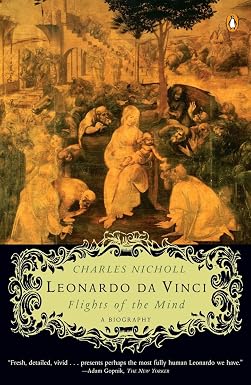
I recently have finished reading two books on the life and work of Leonardo da Vinci. One is not worth mentioning, as it was poorly written but had the benefit of including a lot of da Vinci’s drawings from his many manuscripts. There are many such books, and the internet makes this work even more accessible, so why plug a bad book?
The other book, however, is very much worth recommending. Charles Nicholl’s 2005 biography, Leonardo da Vinci: Flights of the Mind, is a finely detailed work that carefully documents what is know, and what is not know, about da Vinci’s life.
And there are endless uncertainties. Nicholl’s makes these clear, and then provides a lot of good background information to give the reader a good sense of where reality lies, while recognizing much of what we know about Leonardo and his life remains guesswork that can never be resolved.
What Nicholl does best however is give a much more accurate portrayal of da Vinci as an artist and scientist. The myth that exists today is that da Vinci was mostly a failed painter and sculptor who repeatedly failed to finish his projects. This is wrong. In life he was actually quite successful as a painter, his work well admired and in demand. He only failed to complete a handful of projects, and in each case the failure was not his but his client. In one case, the Sforza Horse, he was unable to case the giant sculpture because his client sold the bronze to make war weapons. In another, The Adoration of the Magi, he failed to finish the painting because his client simply paid him too little. And in a third, the Battle of Anghiari, the client decided to make it a competition between dueling frescos by da Vinci and Michelangelo. and after learning this da Vinci chose not to participate.
In between he completed many great works, such as the Mona Lisa and the Last Supper. And in fact, even the three incomplete works above made him famous, because all three were completed enough to show their unique originality and beauty. Da Vinci had style, and his work was always stunning to the eye.
Even so, like those unfinished works, almost everything da Vinci did hold mysteries and questions that today cannot be answered. We often don’t know who hired him or who his subjects were. Often his original work is lost, and all we have are copies made by others later. They copied because they were enthralled by da Vinci’s talent, but unfortunately we no longer can see it directly. All we have is a distorted mirror image, created by others.
Nicholl also reveals a side of Leonardo that is rarely mentioned, but carries with it another kind of obscurity. He was a musician who also designed sets for plays and masques, and he did so repeatedly his entire life for the different rulers who hired him as their court artist. This work was praised highly by those who saw it, but it was also ephemeral, immediately discarded afterward so that no real record of its existence remains. The best we have are some of Leonardo’s planning sketches, and the commentary of witnesses.
Nicholl also provides a good overview of Leonardo the scientist, but once again uncertainty abounds. He was often hired by those rulers to design architectural projects and even weapons of war. In doing this work da Vinci the artist became obsessed with studying how the world worked, from the point of view of physics. Much of what he postulated in these observations — available in the manuscripts he left behind that were not published for centuries after his death — predated discoveries of the Industrial Revolution.
In science however the myth of da-Vinci-the-failure applies. Though he studied the world with a clear eye in a manner well ahead of his time, little of this work was ever finished. He not only never published it, he never even wrote it up in any kind of finished form. All we have are many manuscripts with many scribbles and notes, written over many decades in a somewhat haphazard manner.
In the end, the sum of da Vinci’s life is that sense of incompleteness — not of the man himself but of our knowledge of him. We know this man did great work, but somehow in all he did there are unknowns and gaps that make it hard to see the full picture. As Nicholl notes, everything about da Vinci carries with it “a characteristic note of uncertainty.”
But then, isn’t this the normal state of things? We can never really know the full picture of anything. All our lives are far more complicated than anyone who knows us can imagine. The truth is always hard to pin down. It lies hidden under many layers of facts, many of which are contradictory.
Da Vinci’s life merely provides us a stark illustration of that reality.

On Christmas Eve 1968 three Americans became the first humans to visit another world. What they did to celebrate was unexpected and profound, and will be remembered throughout all human history. Genesis: the Story of Apollo 8, Robert Zimmerman's classic history of humanity's first journey to another world, tells that story, and it is now available as both an ebook and an audiobook, both with a foreword by Valerie Anders and a new introduction by Robert Zimmerman.
The print edition can be purchased at Amazon or from any other book seller. If you want an autographed copy the price is $60 for the hardback and $45 for the paperback, plus $8 shipping for each. Go here for purchasing details. The ebook is available everywhere for $5.99 (before discount) at amazon, or direct from my ebook publisher, ebookit. If you buy it from ebookit you don't support the big tech companies and the author gets a bigger cut much sooner.
The audiobook is also available at all these vendors, and is also free with a 30-day trial membership to Audible.
"Not simply about one mission, [Genesis] is also the history of America's quest for the moon... Zimmerman has done a masterful job of tying disparate events together into a solid account of one of America's greatest human triumphs."--San Antonio Express-News