
The real history of the United States
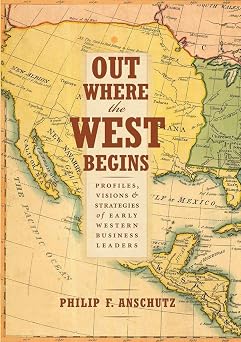
In August last year Diane and I made one of our many visits to the Grand Canyon. Along the rim near the Bright Angel trailhead there is a bookstore/gift shop. As we were not doing any hiking on this visit, merely touring the rim like millions of other tourists, we stopped in to browse the trinkets, art, and books. In doing so, I happened upon a two volume history of the American west by Philip Anschutz, entitled Out Where the West Begins.
At the time I was reading a biography of Cornelius Vanderbilt, the transportation giant of the 1800s who built Grand Central Station in New York and for a time owned and operated almost every railroad in the eastern United States (see my November 2025 review). That book was not only teaching me things about Vanderbilt I had never known, it was telling me something about basic American history that was never covered at all in my public schooling: The country was built by businessmen, free, competitive, aggressive, and largely ethical (though often with a streak of the scoundrel about them).
American public schools ignore this history. Instead, their lesson plans focus almost entirely on the politicians and economic and social background of our history. Though important for sure, the nation was not really built by those battles. Good politicians might have freed the slaves, or laid down the legal framework for settling the west, but most of what they did was violent or caused division. Economics and social studies merely provide context and background. It was people like Vanderbilt who did the actual construction, and they did if for profit.
As I was reading Vanderbilt’s biography last summer, I sensed this large gap in my knowledge of our country’s past. Who were the other businessmen and women who built our country? What obstacles did they face and overcome? I very much wanted those questions answered.
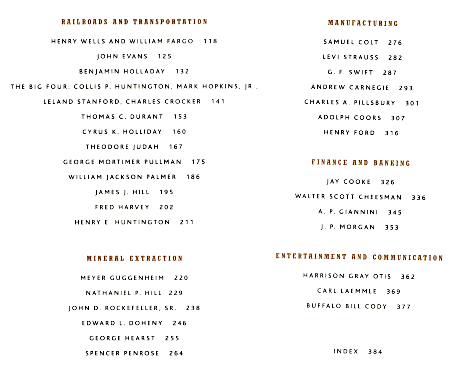
Thus, when I noticed Anschutz’s two-volume history in that Grand Canyon gift shop and looked at the table of contents for volume 1 (partly shown to the right), I knew immediately this was a book I wanted to read. While many of the names listed (such as Ford and Carnegie) are well known, most I had never heard of. And even with the well known names my education had taught me relatively little about them.
I immediately bought both volumes at full price (though you can get it for less on line).
I have now finished reading both, and recommend them highly to every American as a great starting point for learning American history, a subject we all should be reviewing as our nation celebrates its 250th anniversary. Anschutz provides a quick, detailed,, and honest portrayal of each of these American individuals, avoiding the shibboleths of modern leftist dogma that generally sees business as a necessary evil. Instead, Anschutz focuses on describing their achievements and how they struggled and succeeded. He doesn’t paint them as heroes, but as profoundly important but flawed men and women who made things happen.
For example, though I was very aware of the name of Guggenheim — due the modern art museum in New York — I had had no idea that the family wealth was made in mining in the western U.S., and that their patriarch was a Jewish Swiss immigrant who came to America to find his fortune. Initially investing in mines, he and his seven sons eventually found it more profitable and effective to develop the smelters for processing the ore. Eventually their company became the largest metal refinery company in the western hemisphere.
And that’s only one story. Each individual in that table of contents made a significant contribution to creating the American nation, from its founding in the late 1700s into the 20th century. More importantly, most have been ignored by the schools and the public education system. They deserve better, because their history is the true history of the nation. And the best part? Anschutz’s work is a great first history for all these stories. He gives you a thumbnail sketch of each, and from there you have the guidance for delving deeper.

On Christmas Eve 1968 three Americans became the first humans to visit another world. What they did to celebrate was unexpected and profound, and will be remembered throughout all human history. Genesis: the Story of Apollo 8, Robert Zimmerman's classic history of humanity's first journey to another world, tells that story, and it is now available as both an ebook and an audiobook, both with a foreword by Valerie Anders and a new introduction by Robert Zimmerman.
The print edition can be purchased at Amazon or from any other book seller. If you want an autographed copy the price is $60 for the hardback and $45 for the paperback, plus $8 shipping for each. Go here for purchasing details. The ebook is available everywhere for $5.99 (before discount) at amazon, or direct from my ebook publisher, ebookit. If you buy it from ebookit you don't support the big tech companies and the author gets a bigger cut much sooner.
The audiobook is also available at all these vendors, and is also free with a 30-day trial membership to Audible.
"Not simply about one mission, [Genesis] is also the history of America's quest for the moon... Zimmerman has done a masterful job of tying disparate events together into a solid account of one of America's greatest human triumphs."--San Antonio Express-News
Wow, what a great recommendation! Thank you for covering stuff like this in your blog.
Here’s another great one:
The Power Makers: Steam, Electricity, and the Men Who Invented Modern America By Maury Klein.
Interesting. I had a career in the rail industry and worked, for a time, for one of his companies DRGW/SP. I loved that period as it allowed me, a boy who didn’t cross west of the Mississippi until I was 30, to see the most of the Western US. Book looks interesting.
Also note that the Guggenheims endowed early aeronautical engineering schools at Georgia Tech, Cal Tech & U- Michigan, which laid the foundation for many aerospace advancements
Minor point. Before anyone gets on Bob , the Commodore did, indeed ,build Grand Central Station but it was NOT the structure standing in New York today. As the 42nd Street facade proclaims, it is Grand Central TERMINAL, and replaced the station in the early 20th Century, long after his death.
https://www.alamy.com/stock-photo-a-view-north-to-the-grand-central-terminal-gct-facade-86607078.html
The sad part is, this kind of thing was hardly taught when *I* was in school in the 1980’s. Today, it is so, so much worse, in both public and private schools.
To just give one example, Howard Zinn’s Zinn Education Project provides lesson plans that over 177,000 teachers around the country use now. For Zinn, men like Cornelius Vanderbilt might as well be the devil himself. However bad you think it is. it’s even worse now.
“The Men Who Built America”
Season 1, Episode 1
“A New War Begins”
https://youtu.be/DydmaedDIhE
1:26:32
“Out of the turmoil of the Civil War, America enters an age of enlightenment and industrialism that will change the landscape of the country forever.”
The Men Who Build America Opening Theme Song (with snippets)
“Save My Soul,” Blues Saraceno (2012)
https://youtu.be/SoE6o8M-V-Y
3:34
Hell on Wheels;
“Mr. Durant’s Speech” Season 1, Episode 1
https://youtu.be/yAHL5oPXOD0
2:59
“Make no mistake, blood will be spilt, lives will be lost, fortunes will be made, men will be ruined. There will be betrayal, scandal, a perfidy of epic proportions.”
“100 years hence, when this railroad spans the Continent and America rises to be the greatest power the world has seen, I will be remembered as a cadif, a malefactor, who only operated out of greed for personal gain. All true, all true. But remember this, without me and men like me, your glorious railroad would never be built.”
A good list of textbooks on history from the early 20th Century schools would be appreciated.
Yep. History is a good thing. I’m all for it.
But what this country really needs is to get its collective head out of its you know what. If reading a book will do that, fine. But we don’t have a lot of time. The midterms are just months away now, and people are still in defeatist mode.
If anybody reading doesn’t know what I’m referring to, then all you have to do is to read the friggin’ news.
Enough said.
“Step out of line, the man come and take you away…”
Rockefeller’s Court Speech
“The Men Who Built America”
https://youtu.be/DBrz57sNAc4
2:41
“I took a second-rate, inefficient market, and built an Industry….. No one complained when I brought light into every home. No one complained when I provided thousands of jobs or millions of dollars from exports. Oil is what this Country runs on. You call it monopoly; I call it enterprise. Now, you tell me, why am I here?”