
Climate scientist banned from Saudi Arabia for showing picture of dog with Saudi dress
Climate science meets Islam! A climate scientist was immediately banned from Saudi Arabia when he showed a picture of dog with Saudi dress during a lecture there.
Climate science meets Islam! A climate scientist was immediately banned from Saudi Arabia when he showed a picture of dog with Saudi dress during a lecture there.
Two papers published this week by the American Geophysical Union once again indicate that the science of climate change remains exceedingly uncertain. More significantly, the models that try to predict the future of the Earth’s climate continue to appear unreliable, with such large margins of error that it is at this time foolish to make any policy based on their predictions.
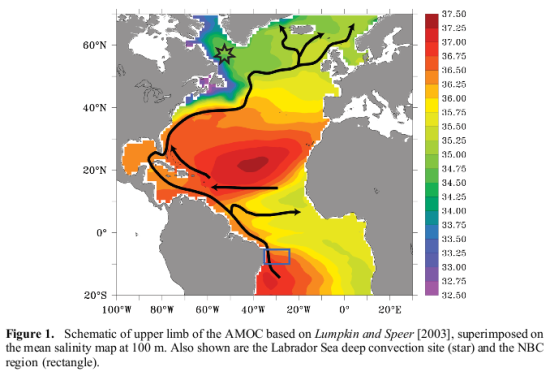
The first paper took a close look at the deep water currents in the Atlantic to see if it could track changes to what the authors’ call the Atlantic meridional overturning circulation (AMOC), more generally referred to as the Atlantic conveyor belt. This conveyor belt begins with the sinking of salty dense water in the northeast Atlantic off of Europe and Africa. The deep water current then travels south and into the Indian and Pacific Oceans where it comes to the surface only to flow back to the Atlantic, traveling north along the coast of North America as the Gulf Stream, bringing with it the warm temperatures that make Europe’s climate much warmer than its latitude would normally suggest.
According to most global warming models, higher temperatures should cause the glaciers in the Arctic and Greenland to melt, thereby pouring an increased amount of fresh water into the North Atlantic. This infusion of fresh water is then expected to lower the salinity and density of the Atlantic water, thus preventing it from sinking and thus acting to slow the conveyor belt, and possibly even causing it to shut down. The consequence would be no more Gulf Stream to warm the climate of Europe.
In other words: Disaster! Death! Destruction! All caused by global warming!
Unfortunately for these global warming models, the paper above found no trend at all. The conveyor belt is not slowing, as predicted. To quote the paper’s abstract:
» Read more
Why don’t we just repeal it? “An umbrella group representing premier organizations such as the Mayo Clinic wrote the administration Wednesday saying that more than 90 percent of its members would not participate, because the rules as written are so onerous it would be nearly impossible for them to succeed.” There’s also this lovely quote:
[The Obamacare regulations] are overly prescriptive, operationally burdensome, and the incentives are too difficult to achieve to make this voluntary program attractive.
Pork and more pork: NASA is considering turning Congress’s heavy-lift rocket requirement, the program-formerly-called-Constellation, into a shuttle-derived rocket that would cost $10 billion and only fly once.
The first tourist in space was not Dennis Tito, but this woman from Britain.
ISRO, India’s space agency, pushes to get funding for a reusable spacecraft.
In mid-April the Crab Nebula erupted for six days, repeatedly emitting the most powerful flares ever recorded from the supernova remnant.
Scientists think the flares occur as the intense magnetic field near the pulsar undergoes sudden restructuring. Such changes can accelerate particles like electrons to velocities near the speed of light. As these high-speed electrons interact with the magnetic field, they emit gamma rays.
To account for the observed emission, scientists say the electrons must have energies 100 times greater than can be achieved in any particle accelerator on Earth. This makes them the highest-energy electrons known to be associated with any galactic source. Based on the rise and fall of gamma rays during the April outbursts, scientists estimate that the size of the emitting region must be comparable in size to the solar system.
An evening pause: An 8th grade project to build a Rube Goldberg device to turn on a light. I like how this video illustrates the difficulty of building such a device.
Vesuvius: Europe’s ticking volcano time bomb.
Dawn captures its first image of the asteroid Vesta as it closes in on a rendezvous set for July 16.
Did a fungal infection kill forty percent of the world’s amphibians?
The above article outlines an intriguing solution to this mysterious die-off. Sadly, the article also makes a silly effort to link everything to climate change, without justification. Pay attention to the former and ignore the latter.