
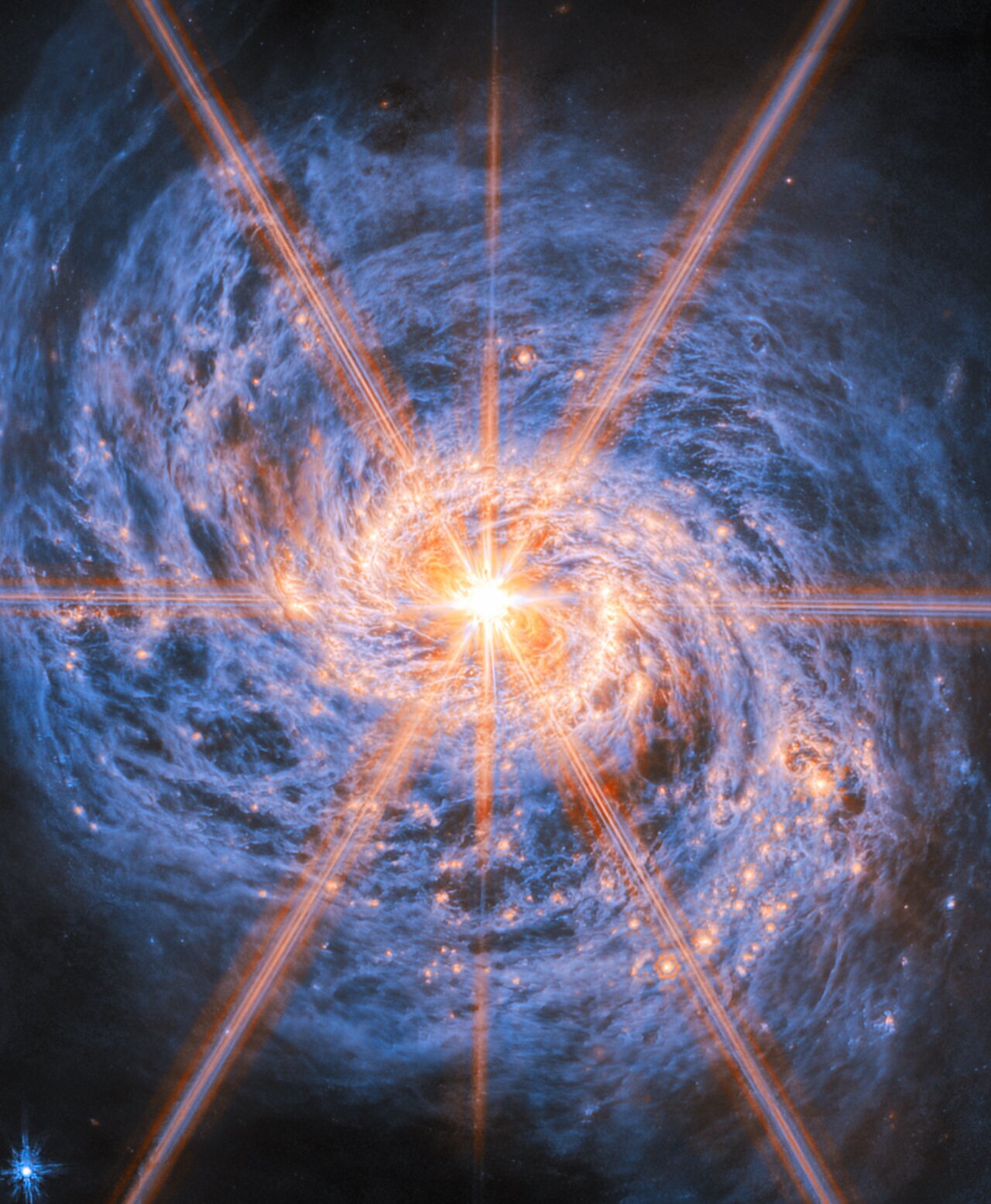
An active galaxy peered at by Webb in the infrared
Click for original image.
Cool image time! The false-color infrared image to the right, cropped and reduced to post here, was taken by the Webb Space Telescope as part of a research of “massive, nearby, star-forming galaxies.” It shows Messier 77 (M77), a barred spiral galaxy located 45 million light-years away.
What makes the image cool are the eight diffraction spikes, which are an artifact of Webb and its camera.
Called diffraction spikes, they are created because the intense light from the unresolved AGN is bent (“diffracted”) very slightly at the edges of Webb’s hexagonal mirror panels and around one of the struts that hold up its secondary mirror. This distinctive six-plus-two-pointed pattern is the same for any image taken by Webb. For diffraction spikes to appear, the light source has to be very bright and very concentrated, so they’re most often seen on stars. But in some galaxies, as here, the nucleus is bright and compact enough to make diffraction spikes appear as well.
In the case of M77, the nucleus is especially bright.
At the heart of M77 is a compact region filled with hot gas that handily outshines the rest of the galaxy put together, even overcoming the light-gathering capacity of Webb’s cameras. This is an active galactic nucleus (AGN), and it’s powered by M77’s central supermassive black hole, which is eight million times as massive as our Sun. Gas in the galaxy’s central regions is pulled by the strong gravity into a tight and rapid orbit around the black hole, where it crashes together and heats up, releasing tremendous amounts of radiation.
The result is this very cool image that also highlights a great deal about galaxies and their evolution.

On Christmas Eve 1968 three Americans became the first humans to visit another world. What they did to celebrate was unexpected and profound, and will be remembered throughout all human history. Genesis: the Story of Apollo 8, Robert Zimmerman's classic history of humanity's first journey to another world, tells that story, and it is now available as both an ebook and an audiobook, both with a foreword by Valerie Anders and a new introduction by Robert Zimmerman.
The print edition can be purchased at Amazon or from any other book seller. If you want an autographed copy the price is $60 for the hardback and $45 for the paperback, plus $8 shipping for each. Go here for purchasing details. The ebook is available everywhere for $5.99 (before discount) at amazon, or direct from my ebook publisher, ebookit. If you buy it from ebookit you don't support the big tech companies and the author gets a bigger cut much sooner.
The audiobook is also available at all these vendors, and is also free with a 30-day trial membership to Audible.
"Not simply about one mission, [Genesis] is also the history of America's quest for the moon... Zimmerman has done a masterful job of tying disparate events together into a solid account of one of America's greatest human triumphs."--San Antonio Express-News
WOW
Do black holes have a temperature? I know their gravity prevent light from escaping. But does the gravity also stop the heat/energy from vibrating the hole stuff ( in the same manner as the heat that keeps the Sun from imploding on itself ). The question being, as all this material streams into the black hole, does its temperature increase, causing the size of the hole to increase?
Black holes do not have a temperature the way we can measure it.
In essence, there are two parts of a black hole: the event horizon and the mass that creates the event horizon. Whatever the temperature of that mass may be, we are unable to measure it. The size of the black hole is measured by its event horizon, the diameter of the sphere from which nothing, even light, can get away and reach infinity, or reach the edge of the universe (whatever “edge” means to the universe). The event horizon is not an object or a thing, it is a location, sort of like an earthly horizon. If you get close to the event horizon, you can see deeper into the region, but don’t get too close or you won’t be able to get out. You may be stretched out by tidal forces, too.
The Earth does not have an event horizon. Earth has an escape velocity that matter can attain so that the Earth’s gravity will never draw that particle of matter back to the Earth. This is the velocity at which Earth’s gravitational pull decreases faster than the particle slows down.
The black hole’s event horizon is the minimum distance at which particles could conceivably travel fast enough to reach escape velocity, if they can be accelerated to such a speed. In essence, that is the speed of light.
The temperature of the material falling into the black hole can be measured, especially in the X-ray part of the spectrum, and it is very hot. There is a lot of potential energy (the energy of a mass’s distance above the gravitational body), and much of that seems to be released when the material falling toward the event horizon collides with each other, a heat caused by friction and radiatively released. The rest of the energy held by that particle falls into the black hole with the particle and probably adds that energy as heat.
I think that we can conclude that a black hole is pretty hot.
However, the size of the black hole is not due to the heat or the heat energy, it is due to the mass of the material that makes up the black hole.
Does its temperature increase? We can assume so, because there is a whole lot of potential and kinetic energy falling into the black hole.
On the other hand, we really don’t know much about what really happens beyond the event horizon. We deduce many things about the universe based upon the way physics works, but we have few real observations within black holes. Could it be that some, most, or all of that energy that falls into the black hole eventually turns into mass in a way opposite to the release of energy from fission and fusion?
The universe is a strange and mysterious place, so I wouldn’t be surprised.
I believe what is produced is Synchotron Radiation
BINGO1
Synchrotron Radiation in Active Galactic Nuclei
In active galactic nuclei (AGN), synchrotron radiation is a key emission mechanism that produces much of the radio and microwave light observed from these powerful systems.
What is Synchrotron Radiation?
Synchrotron radiation is electromagnetic radiation emitted when relativistic electrons spiral along magnetic field lines. The emitted light has a power-law spectrum (often described as
v
−
1
+
δ
) and is forward-directed in the electron’s rest frame, making it highly beamed when viewed from Earth Springer.
Role in AGN
In AGN, synchrotron radiation is produced in relativistic jets and accretion disk corona regions. These jets are collimated streams of plasma ejected along the rotation axis of a supermassive black hole (SMBH) at the galaxy’s center Science Mission Directorate. The electrons in these jets are accelerated to ultra-relativistic energies (often
~
10
14
eV) by processes such as magnetic vortex tubes or shock acceleration Springer.
Key Features in AGN
Power-law spectrum: The radio continuum from AGN often follows a synchrotron power law, with a break at higher frequencies where other emission mechanisms (e.g., thermal emission, inverse Compton) dominate pages.astro.umd.edu.
Beaming: Relativistic beaming enhances the observed flux when the jet is pointed toward Earth, producing blazars — a subclass of AGN with the most luminous synchrotron emission Wikipedia.
Spatial distribution: Synchrotron emission is often spatially resolved in radio images, showing compact cores and extended lobes or jets GSU Astronomy.
Energy source: The electrons are energized by the SMBH’s accretion process and magnetic field interactions, with the jet’s magnetic field strength and electron density determining the luminosity Springer.
Observational Significance
Radio surveys (e.g., 3C, PKS catalogs) identify AGN based on their synchrotron-dominated radio emission GSU Astronomy.
Multi-wavelength studies combine radio synchrotron data with optical, X-ray, and gamma-ray observations to model the AGN’s jet and accretion disk physics.
Feedback effects: Synchrotron-emitting jets can inject energy into the interstellar medium, influencing galaxy evolution Science Mission Directorate.
In summary: In AGN, synchrotron radiation is the dominant radio emission mechanism, produced by relativistic electrons in magnetic fields within jets and coronae. It is a direct tracer of the SMBH’s jet activity and plays a central role in the AGN’s electromagnetic output and feedback to its host galaxy.