
New poll shows Trump barely winning Utah

More news on the upcoming November Democratic primary: A new poll in Utah shows Donald Trump getting only 29% of the vote, with Hillary Clinton getting 26%, and Libertarian Party candidate Gary Johnson getting 16%.

The article correctly notes that Utah has been solidly Republican for decades, until now.

Bear in mind that Utah is a state that Mitt Romney won 73/25 over Barack Obama in 2012, boosted no doubt in part because of Romney’s Mormon faith. Still, John McCain won Utah in 2008 by a 63/34 margin as well. Utah has not been competitive in decades, with the smallest margin in recent times coming in 1996 — a 21-point win by Bob Dole on his way to a national defeat.

It appears that a large percentage of Utah’s conservative voters are choosing Johnson, which might be their only conservative choice, though sadly he might not be much of a conservative or libertarian as he claims From this second link:

When Johnson took the tiller in New Mexico in 1995, the budget stood at $4.397 billion. When he left in 2003, it had grown to $7.721 billion, an increase of 7.29 percent a year. Of the eleven governors who filed to run for president this year (two Democrats, Johnson, and eight Republicans), only one had a worse record on spending growth. In New Mexico, Bill Richardson, Johnson’s Democratic successor, clocked in a little better than he did, but Richardson’s successor, Susana Martinez, has shown what a fiscal conservative looks like: New Mexico currently spends less than it did when she took office. It’s not just at a state level that being more fiscally conservative than Johnson is a bipartisan achievement. Federal spending during the time Johnson was in office grew at an average annual rate of 4.49 percent. Late Clinton and early Bush weren’t as successful in their efforts to fight spending cuts as they might have been, but Johnson makes them look like Coolidge, and federal spending since then has grown at an average annual rate of 4.56 percent.

One piece of good news from the poll in the first article above. It shows down ticket Republicans doing very well, despite the poor support for the party’s presidential candidate. And that really is what is most important at this point. It is essential the public vote in as many conservatives as possible to force whomever is President to move in a conservative direction. As Milton Friedman so wisely noted,

I do not believe that the solution to our problem is simply to elect the right people. The important thing is to establish a political climate of opinion which will make it politically profitable for the wrong people to do the right thing.
12 comments

Insurance companies abandon Colorado because of Obamacare

Finding out what’s in it: Almost a hundred thousand Coloradans are about to lose their health insurance because of Obamacare.

More than 92,000 Coloradans will lose their Obamacare health care coverage in 2017 as four leading insurance companies scale back or eliminate their plans while others propose rate hikes of as much as 40 percent. Insurance holders with individual plans through Anthem, UnitedHealthCare, Humana and Rocky Mountain Health Plans will need to find new coverage for the 2017 coverage year, according to a Monday statement from the Colorado Division of Insurance.

But don’t worry. Thanks to the wisdom of the majority of Republican Party primary voters, when we vote in the November we will have a choice between the official Democratic candidate, a member of the party that shoved this monstrous law down our throats, and a liberal Democrat who thinks Obamacare didn’t go far enough.

We truly do get the government we deserve.

1 comment

FAA warns public of military GPS jamming tests

The FAA has issued a warning that GPS at high elevations may be unreliable during jamming tests being conducted by the U.S. military during June.

The FAA issued an advisory warning pilots on Saturday that global positioning systems (GPS) could be unreliable during six different days this month, primarily in the Southwestern United States. On June 7, 9, 21, 23, 28, and 30th the GPS interference testing will be taking place between 9:30am and 3:30pm Pacific time. But if you’re on the ground, you probably won’t notice interference.

The testing will be centered on China Lake, California—home to the Navy’s 1.1 million acre Naval Air Weapons Center in the Mojave Desert. The potentially lost signals will stretch hundreds of miles in each direction and will affect various types of GPS, reaching the furthest at higher altitudes. But the jamming will only affect aircraft above 5,000 feet. As you can see from the FAA map below, the jamming will almost reach the California-Oregon border at 40,000 feet above sea level and 505 nautical miles at its greatest range.

1 comment

National Science Foundation considers shuttering Arecibo

Faced with tight budgets, the National Science Foundation (NSF) is considering several options for the future operation of the Arecibo Observatory, the world’s largest single radio telescope dish, including its complete removal.

[T]he NSF could mothball the site, shutting it down in such a way that it could restart (sometime in the future). Or it could dismantle the telescope altogether and restore the area to its natural state, as required by law if the agency fully divests itself of the observatory and closes it. Previous studies have said such a process could cost around $100 million—more than a decade’s worth of its current funding for telescope operations. Jim Ulvestad, director of the NSF Division of Astronomical Sciences, says the agency is still investigating, not concluding. “No alternative has been selected at this juncture,” he says. And much consideration will go into the final financial decision, whatever it may be. Some outside the agency see writing on the wall. “NSF is dead serious about offloading Arecibo funding to someone else—anyone else,” says Ellen Howell, a former staff scientist at Arecibo and now a faculty member at the Lunar and Planetary Laboratory (LPL) in Tucson, Arizona.

The article spends a lot of time talking about how wonderful Arecibo is, but never tells us how many astronomers actually demand to use it. Is it oversubscribed, like Hubble, where five times the number of astronomers request time than can be handled, or does it often sit unused because not enough astronomers require its use? NSF and the government do not have unlimited funds, and need to focus their spending where the demand is. If Arecibo is not in demand, then they are wise to consider closing it, or handing it off to someone who wants it.

3 comments

Elon Musk to meet with Defense Secretary

The competition heats up: A private meeting to discuss modern innovation between Elon Musk and Defense Secretary Ash Carter has been scheduled for Wednesday.

Ash Carter, the U.S. Secretary of Defense, and Elon Musk, SpaceX’s founder and chief executive, will discuss innovation June 8 in a private meeting, the Pentagon’s top spokesman said. “Elon Musk is one of the most innovative minds in this country and the secretary, as you know, has been reaching out to a number of members of the technology community to get their ideas, their feedback, find out what’s going on in the world of innovation,” Peter Cook, the Pentagon’s press secretary said during a June 6 briefing. “The secretary’s had a number of meetings with business leaders and innovation leaders in particular out in Silicon Valley, other parts of the country, and I think that’s his goal here: to hear directly from Elon Musk on some of these issues.”

The meeting is private, which means an agenda or discussion items are generally not released. More details were not immediately available.

I am sure about one thing: This meeting is going to make the corporate board of ULA very nervous.

0 comments

The history of the stopwatch

Link here. The most fascinating part of this story is the recent discovery of the very first stopwatch, previously unknown, built in 1816, and remarkably similar to the standard analog stopwatches used for decades until the arrival of digital equipment.

The layout of the compteur also makes one suspect it ended up in 1816 via a time machine. Instead of inking paper, it has a silvered and frosted metal dial dominated by a large fraction-second hand like later stopwatches, and three subdials for marking hours, minutes, and whole seconds Along with this, the stopwatch has a button at 12 o’clock to start and stop it, plus an 11 o’clock button to instantly reset the dials. This is a feature common to modern stopwatches and one not thought to be invented until 1862 by Adolphe Nicole.

1 comment

LISA Pathfinder proves space-based gravity wave detection technology

Engineers have announced that the gravity wave detection technology being tested in orbit by Europe’s LISA Pathfinder works.

To show that the necessary sensitivity is possible, LISA Pathfinder measures the distance between two masses, both of which are inside the spacecraft. “We’ve shrunk the arm of a large gravitational wave antenna to 35 centimeters so we could show it works properly,” Paul McNamara, LISA Pathfinder project scientist, told the press conference.

LISA Pathfinder was launched in December 2015 to a spot 1.5 million kilometers from Earth. When its test masses where first released to float free in February, “the relief was unbelievable,” McNamara says. Science operations began on 1 March and on that first day the team was able to measure distance variations between the masses much smaller than LISA Pathfinder’s mission requirements, Stefano Vitale, the mission’s principle investigator, told reporters. After a month, the variations were even smaller, “very close to [eLISA] requirements,” he says.

They now hope to launch an array of at least three such spacecraft by the mid-2030s.

0 comments

President Roosevelt’s announcement of D-Day, June 6, 1944

An evening pause: On this anniversary of D-Day, it is worthwhile to go back in time and relive that time to understand better what our country then stood for. Below is President Roosevelt’s radio speech to the nation, announcing the D-Day invasion and its apparent initial success. What is striking is that he spends little time talking about what happened, nor does he spend any time extolling the triumph of his administration. Instead, he humbly turns his speech into his heartfelt prayer for the lives of the soldiers, the people at home, and the people in Europe who are suffering under Hitler’s rule, reminding everyone of the nation’s real goal: “A peace that will let all men to live in peace, reaping the just rewards of their honest toil.” He then ends the prayer with these words, “Thy will be done, almighty God. Amen.”

This speech tells us as much about the nation that Roosevelt lived in as it does about Roosevelt himself. He knew his audience, and he knew they believed deeply in freedom, truth, human rights, and moral commitment. He also knew they would be honored to join him in this prayer, with the same humbleness as he was expressing. He knew they would not be offended, whatever their faith, because the important thing was to have good will and to strive for a just conclusion of the war.

If only such things could happen today.

Hat tip Wayne DeVette.

0 comments

Russia delays next manned Soyuz flight

Russia has confirmed previous reports and has officially delayed the next manned Soyuz launch to ISS from June 24 to July 7.

They remain vague about the issue causing the delay, this time only saying they want more time to test software. Previous reports suggested the issue was with the capsule’s control thrusters.

Meanwhile, no word on whether they have figured out why the upper stage on the previous Soyuz rocket launch shut down prematurely.

0 comments

SpaceX lobbies Texas government for spaceport backing

The competition heats up: In testimony today before the Texas legislature, a SpaceX official called for more government funding to support the company’s spaceport construction in Boca Chica near Brownsville, Texas.

At a recent joint legislative committee hearing held at UT-Rio Grande Valley in Brownsville, Caryn Schenewerk, senior counsel and director of governmental affairs for SpaceX, pointed out that zero dollars were appropriated to the Texas Spaceport Trust Fund during last year’s legislative session. In contrast, Schenewerk said, Florida commits $20 million a year to its spaceport infrastructure fund.

“One of the things I want to highlight for you is that unfortunately, the spaceport trust fund was not funded in the 84th Legislature and we will certainly be advocating for it to be considered by the 85th and for it to be part of the budget in the 85th Legislature,” Schenewerk testified. “By contrast, Florida consistently funds its space infrastructure fund to a tune of $20 million a year. Those infrastructure matching grants go to exactly the kind of activities that we are undertaking at Boca Chica. They are public-private partnerships for investing specifically in what is so costly an undertaking, the infrastructure.”

Obviously, SpaceX’s spaceport is going to require an increased financial commitment by the state government to build and maintain the increased infrastructure that such large operations require. At the same time, SpaceX doesn’t need a handout. They shouldn’t expect the taxpayers to pay for their private spaceport.

The article does provide some updated information about the spaceport’s construction status. It looks like they are aiming for a 2018 launch date.

6 comments

Sunspot cycle update

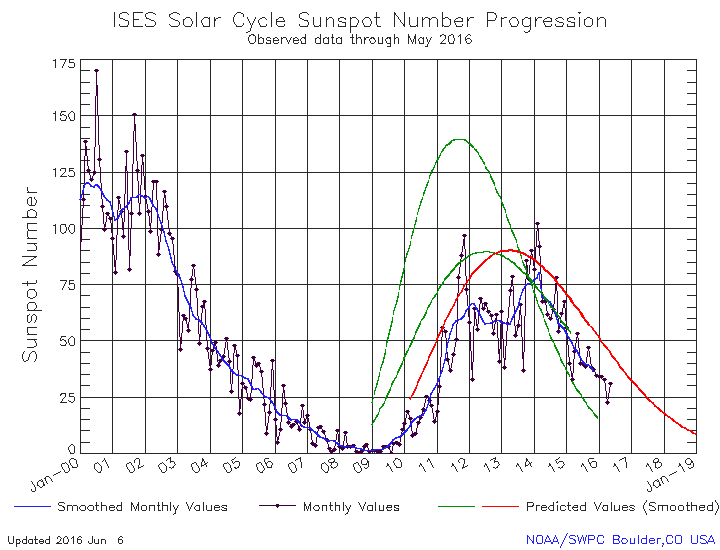
NOAA today released its monthly update of the solar cycle, showing the Sun’s sunspot activity in May. It is annotated and posted below.

Mayl 2016 Solar Cycle graph

The graph above has been modified to show the predictions of the solar science community. The green curves show the community’s two original predictions from April 2007, with half the scientists predicting a very strong maximum and half predicting a weak one. The red curve is their revised May 2009 prediction.

Though sunspot activity increased in May, the increase was not significant. The ramp down from solar maximum continues to track the 2007 low prediction for this maximum.

Meanwhile, the Sun continues its first multi-day string of blank days since 2011, now up to 3 days with all indications suggesting it will continue at least one more day. This early blank string, combined with the relatively fast decline in sunspots in the past two years, suggests that the solar maximum is ending sooner than predicted by the 2009 prediction (the red curve above), and that the next minimum will possibly be longer as well.

9 comments

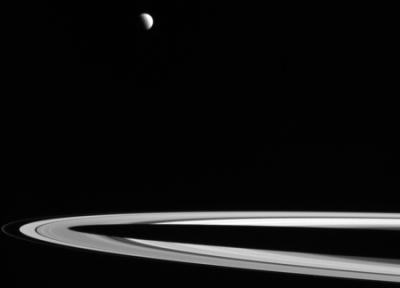
Titan over Saturn’s rings

Titan over Saturn's rings

Cool image time! The picture on the right, taken on January 26, 2016 by Cassini and reduced and cropped to show here, captures Titan above Saturn’s rings, which are themselves partly obscured by the shadow of Saturn (unseen on the right) that falls across them.

Make sure you go to look at the full image. This is the kind of vista that artists in the 1950s imagined we’d see once we began to explore the solar system.

0 comments
1 102 103 104 105 106 171