United Arab Emirates teams up with Japan

The new colonial movement: The United Arab Emirates Space Agency (UAESA) has signed a cooperative agreement with Japan’s space agency JAXA.

The details are slim, but I suspect it is similar to the recent UAE/India deal and involves the UAE providing some of its oil money in exchange for getting some of Japan’s technical help.

Update: My suspicions were correct. UAESA has purchased launch services from Japan Mitsubishi for its Mars mission, dubbed Hope, scheduled for launch in 2020.

0 comments

New supersonic passenger plane coming?

Boom! A new aviation company thinks it can develop a new supersonic passenger plane with ticket prices far less than the Concorde’s.

If youโ€™re ever stuck on a plane pining for the glory days of air travel, hop on YouTube and search for โ€œthe Concorde.โ€ Among the results are a bunch of firsthand accounts of people sipping Champagne and scarfing down caviar on one of the bygone supersonic jets while they travel at 1,300 miles an hour. Try to appreciate the joy on their faces, or at least remember that they paid as much as $20,000 round trip, while youโ€™re crammed into a middle seat with nothing but a dollop of hummus and a few overpriced crackers to get you through the next few hours.

Or perhaps find some solace in this: A Denver startup called Boom Technology plans to bring supersonic passenger travel back, and to bring it to the massesโ€‰โ€ฆโ€‰ish. While the finished product is years away, on March 23, Boom will unveil its design for a 40-seat plane that can fly 1,451 mph (Mach 2.2). At that speed, a New York-to-London flight would take about 3 hours and 24 minutes. Blake Scholl, Boomโ€™s founder and chief executive officer, says round-trip tickets will cost $5,000. โ€œThe idea is for a plane that goes faster than any other passenger plane built before, but for the same price as business class,โ€ he says.

The project is barely past the PowerPoint stage, so color me skeptical. Nonetheless, I also believe it is possible, especially when I noticed in reading the article the similarities between between this company’s founder and that of SpaceX’s.

0 comments

China shuts down its first space station

Though still in orbit, China has turned off Tiangong-1, its first space station, launched in 2011 and since visited by three manned crews.

The news story, from the state-run Chinese news organization, notes that the module’s orbit will slowly decay and eventually burn up in the atmosphere. It does not say how the Chinese intend to control that re-entry, since Tiangong-1 is likely large enough for some parts of it to survive and hit the ground.

0 comments

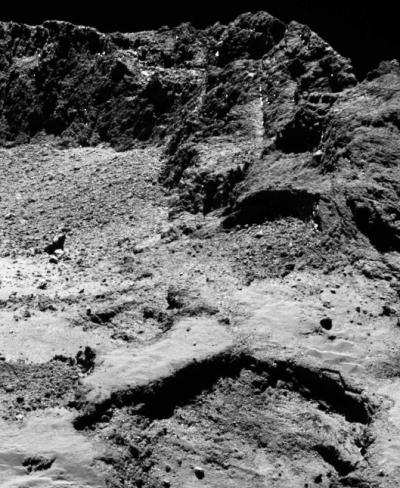
Getting real close to Comet 67P/C-G

Close-up of Comet 67P/C-G

Cool image time! As Comet 67P/C-G moves away from the sun and cools down, the Rosetta science team has been able to move the spacecraft back in close to the comet. The image on the right was taken on March 5 from only 12.6 miles above the comet’s surface, and has a resolution of 14 inches per pixel.

I have brightened the image and cropped it to show it here. At this scale, if they managed to photograph the location where Philae sits we would see it with no problem at all. As it is, the detail is remarkable. For example, look at the slope below the cliff in the lower right. You can see what look like a very faint series of terraces, suggesting the existence of onion-like layers below the surface.

Go to the link. There is a second high resolution image there that is as amazing.

4 comments

The Irish not of Celtic origin?

The uncertainty of science: The discovery of a burial site in Ireland has thrown into doubt all theories concerning the Celtic origins of the Irish.

โ€œThe DNA evidence based on those bones completely upends the traditional view,โ€ said Barry Cunliffe, an emeritus professor of archaeology at Oxford who has written books on the origins of the people of Ireland. DNA research indicates that the three skeletons found behind McCuaig’s are the ancestors of the modern Irish and they predate the Celts and their purported arrival by 1,000 years or more. The genetic roots of today’s Irish, in other words, existed in Ireland before the Celts arrived.

The article is quite detailed and outlines the overall scientific problem of the Celts, which is now quite unclear about who they were, where they came from, and where they went.

In related news: Scientists have found new evidence of a human presence in Ireland as far back as 12,500 years ago.

4 comments

Exoplanet with cometlike orbit

Worlds without end: Astronomers detect an exoplanet with an orbit so eccentric that the orbit is more like a comet’s.

The eccentricity of a planetโ€™s orbit is measured on a scale of 0 to 1, with 0 representing a perfectly circular orbit, and figures closer to one indicative of increasingly elliptical orbits. Earthโ€™s orbital eccentricity, for example, is 0.017, and the most eccentric planet in our solar system โ€“ Mercury, assuming that we no longer class Pluto a planet โ€“ has an eccentricity of 0.205.

Our new friend, HD 20782, on the other hand, has an orbital eccentricity of 0.96, meaning its ellipse as it travels to and from its star is almost flat; and when it does finally return to its sun, after a 597-day orbital journey, it careers furiously round the star to slingshot back into space. โ€œIt’s around the mass of Jupiter, but it’s swinging around its star like it’s a comet,โ€ said Dr. Kane.

1 comment

SpaceX sets date for next Dragon launch

The competition heats up: SpaceX has scheduled April 8 for the next Falcon 9 launch, set to carry its first Dragon capsule since the launch failure last year.

Though this is the most important news contained by the article, its focus is instead on the various preparations that SpaceX is doing at its Texas test facility to prepare for this launch as well as the increased launch rate required for the company to catch up on its schedule.

Note that the Dragon launch will also be significant in that it will be carrying Bigelow’s inflatable test module for ISS, built for only $17 million in less than 2 years. NASA, ESA, or JAXA would have required at least half a billion and several years to have accomplished the same.

0 comments
1 140 141 142 143 144 171