
Another Falcon Heavy customer switches to different rocket

The competition heats up: Afraid of more delays in SpaceX’s Falcon Heavy rocket, Inmarsat has booked a Russian Proton rocket for a 2017 commercial satellite launch.

London-based Inmarsat is the second Falcon Heavy commercial customer to have sought a Plan B given the continued uncertainties in the launch schedule of Falcon Heavy, whose inaugural flight has been repeatedly delayed. Carlsbad, California-based ViaSat Inc. in February moved its ViaSat-2 consumer broadband satellite from the Falcon Heavy to Europe’s Ariane 5 rocket for an April 2017 launch, securing what may be launch-service provider Arianespace’s last 2017 slot for a heavy satellite.
3 comments

ExoMars ready for launch

The European ExoMars Mars orbiter and lander mission, set for launch on March 14, is assembled on its Proton rocket and is ready for launch.

This European project was originally going to be in partnership with NASA, but the Obama administration pulled out of the deal. The Russians then offered to come in and provide a rocket for the mission.

1 comment

Iran tests ballistic missiles

Does this make you feel safer? Iran today completed two more ballistic missile tests, with rockets capable of reaching Isreal that were supposedly marked in Hebrew with the phrase, “Israel must be wiped off the Earth.”

The firings took place on the second and final day of a large-scale military drill, which marked the first time Tehran has fired ballistic missiles since signing a deal with world powers on its nuclear program in July.

U.S. officials said Tuesday that the tests did not violate the nuclear agreement, known as the Joint Comprehensive Plan of Action, but were very likely in breach of a U.N. resolution calling on Iran not to undertake ballistic missile activity. U.S. officials threatened Tuesday to raise the issue at the Security Council.

Well, I am so glad these tests didn’t violate the Obama Iran deal. That makes me feel so much better.

4 comments

Monthly Solar Cycle update

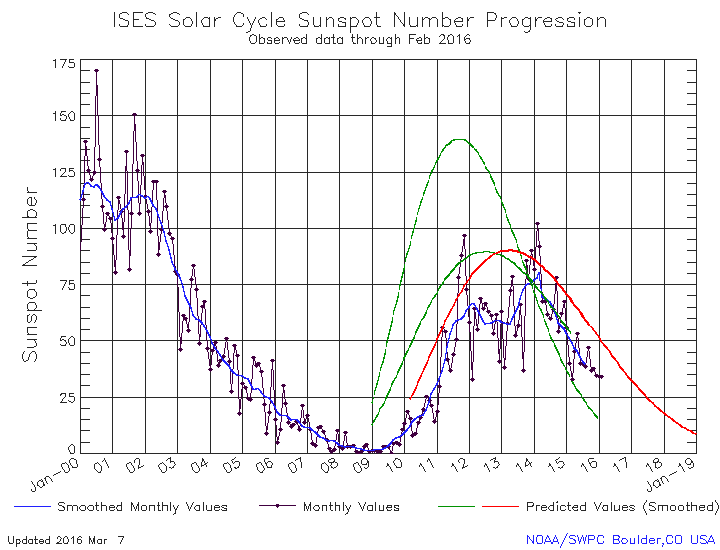
NOAA released on Monday its monthly update of the solar cycle, showing the Sun’s sunspot activity in February. I am once again posting it here on Behind the Black, as I have done monthly since 2010.

February 2016 Solar Cycle graph

The graph above has been modified to show the predictions of the solar science community. The green curves show the community’s two original predictions from April 2007, with half the scientists predicting a very strong maximum and half predicting a weak one. The red curve is their revised May 2009 prediction.

The change in this month’s graph is so small that you will have to look real close to see it. Essentially, the February sunspot activity dropped only a tiny amount from January’s numbers, though it did drop. As such the decline from solar maximum continues to track perfectly the decline predicted by the low prediction of the 2007 predictions. This prediction success should not be taken very seriously, however, since that same prediction expected the solar maximum to begin two years earlier than it actually did.

0 comments

College student faces charges for expressing conservative opinions

The coming dark age: A student senator at the University of Southern California (USC) faces removal from office merely because he is a conservative.

The complaint against him cites three charges, all absurd. The best however is this one:

The third violation Ellenhorn is accused of also concerns a Campus Reform article, but in this case, he is charged with failing to secure permission before filming the “Consent Carnival” that was held on campus in January by several student groups. The complaint specifies that university rules require approval “for any filming required as part of an event (including footage for use on YouTube, Facebook, and other online platforms).”

In other words, according to the fascist making the charges, no one is allowed to film anything on this so-called college campus without first obtaining permission first from school authorities. Such a charge demonstrates that this fascist has a complete lack of understanding of the concept of freedom, or the first amendment.

6 comments

Want to discover gravitational waves? You can!

The citizen science project, Einstein@home, will begin providing its participants data from the upgraded LIGO gravitational wave detector beginning March 9.

Rather than looking for dramatic sources of gravitational waves, such as the black-hole merger that LIGO detected on 14 September, Einstein@home looks for quieter, slow-burn signals that might be emitted by fast-spinning objects such as some neutron stars. These remnants of supernova explosions are some of the least well understood objects in astrophysics: such searches could help to reveal their nature.

Because they produce a weaker signal than mergers, rotating sources require more computational power to detect. This makes them well-suited to a distributed search. “Einstein@home is used for the deepest searches, the ones that are computationally most demanding,” Papa says. The hope is to extract the weak signals from the background noise by observing for long stretches of time. “The beauty of a continuous signal is that the signal is always there,” she says.

To participate all you have to do is let their software become your screensaver, doing its work whenever you walk away from your computer.

0 comments

Jeff Bezos gives a tour of Blue Origin

The competition heats up: Jeff Bezos gave his first tour of Blue Origin’s facilities for eleven journalists on Tuesday.

The article is chock full of interesting details about the company’s plans. To me these details about their New Shepard test program are the most interesting:

“We’re going to fly it until we lose it,” he said. The plan is to test the spaceship many, many times without humans aboard. At some point, Blue Origin will run a test in which the crew capsule will have to blast itself clear from the propulsion module at maximum dynamic pressure – a scenario during which the propulsion module will almost certainly be destroyed.

Not to worry, though: More crew capsules and propulsion modules are already under construction at the factory. “By the time anybody gets on, I think you should be willing to bring your mom,” Bezos said.

They also hope that this test program will proceed to launching humans by 2017.

7 comments

Second solo Ariane 5 launch in 2016

The competition heats up: In successfully placing a commercial communications satellite in orbit last night, Arianespace also did its second consecutive single satellite launch.

The Ariane 5 rocket is designed to carry two satellites, and normally does so in order to maximize its profit per launch. That they have done two straight commercial launches without a second satellite suggests to me that the competition from SpaceX is taking customers from them. The scheduling of the secondary payload usually suffers because priority is given to the primary satellite. Those customers thus might be switching to SpaceX in the hope they can gain better control over their own launch schedule, while also paying far less for their launch.

Then again, considering how unreliable SpaceX’s own launch schedule has been, it is unlikely these customers will have yet gained any scheduling advantages.

1 comment

NASA reschedules rather than cancels InSight

Forced to delay its launch because its primary instrument, built by the French, would not be ready for its 2016 launch, NASA has decided to go on with the InSight Mars mission, rescheduling it for a May 2018 launch, rather than cancelling it outright.

The seismometer, built by the French space agency CNES, will be repaired in time to make the 2018 launch window, said Jim Green, the head of NASA’s planetary sciences division in Washington DC. “That’s terrific news,” he told a planetary sciences advisory panel on 9 March. The Jet Propulsion Laboratory in Pasadena, California, will assume responsibility for building a new vacuum enclosure for the seismometer.

The last sentence above suggests that NASA has decided to take certain responsibilities from the French to make sure they get done right. It also means that the cost will be born by the NASA’s planetary program, cutting into other possible future missions.

0 comments

Ceres’s big mountain

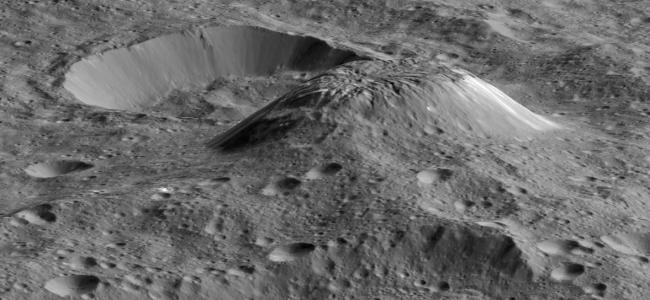
Ahuna Mons on Ceres

The Dawn science team has released an oblique angle image of Ceres’s big mountain, Ahuna Mons. I have cropped and reduced it above to show it here.

Despite looking almost toylike in this image, the mountain is quite monstrous, especially considering Ceres’s relatively small size.

This mountain is about 3 miles (5 kilometers) high on its steepest side. Its average overall height is 2.5 miles (4 kilometers). These figures are slightly lower than what scientists estimated from Dawn’s higher orbits because researchers now have a better sense of Ceres’ topography.

Consider: Mount Everest is not quite six miles high, on a planet with a diameter about 7926 miles across. Ceres however is only about 600 miles across at its widest, which means a 3 mile high mountain is 0.5% of Ceres’s entire width! Such a thing could only occur on such a small body, whose gravity is not quite great enough to force things into a completely spherical shape. It is for this reason it could be argued that Ceres doesn’t qualify as a dwarf planet, but would be better labeled a giant asteroid.

3 comments
1 146 147 148 149 150 171