
Methane ice on Pluto’s mountain peaks

New images from New Horizons of the dark Cthulhu region have revealed white-capped mountain peaks, thought to be methane ice.

Scientists think this bright material could be predominantly methane that has condensed as ice onto the peaks from Pluto’s atmosphere. “That this material coats only the upper slopes of the peaks suggests methane ice may act like water in Earth’s atmosphere, condensing as frost at high altitude,” said John Stansberry, a New Horizons science team member from Space Telescope Science Institute, Baltimore, Maryland.

We as humans are attracted to features on other worlds that remind us of Earth, mainly because this allows us to quickly understand what we are seeing. It is important however to remind ourselves continually that Pluto is not Earth, and is in fact a very alien place. Many things we think we recognize are really very different than what we assume. For example, the methane ice here is coating mountains made of water ice that is as stable as granite in Pluto’s super cold environment.

One more thing: It appears that at this point, seven months after New Horizons flew past Pluto, they have still only downloaded less than half the data obtained. This is not a problem, as this is how things were planned, but it does mean that there are likely many more discoveries yet for us to see.
2 comments

Building a log cabin, alone

An evening pause: This is the first part of a longer work. To quote the youtube webpage,

“Alone in the Wilderness” is the story of Dick Proenneke living in the Alaska wilderness. Dick filmed his adventures so he could show his relatives in the lower 48 states what life was like in Alaska, building his cabin, hunting for food and exploring the area. Bob Swerer has taken the best footage from Dick’s films and he has created 3 videos about Dick, “Alone in the Wilderness”, “Alaska, Silence and Solitude” and “The Frozen North”

I like this because it gives a good hint at what life was really like for the original mountain men who first explored the American west. They were resourceful, clever, strong-willed, and technologically very sophisticated. Dick Proenneke shows us how to do it again.

Hat tip Rocco.

2 comments

Hubble finds galaxy with record-breaking redshift

The uncertainty of science: Using the Hubble Space Telescope astronomers have discovered a galaxy with the largest redshift ever measured, 11.1, making it the most distant object so far measured and only about 400 million years after the Big Bang..

The uncertainty is that all theories have said that this galaxy was not supposed to exist at that time.

However, the discovery also raises many new questions as the existence of such a bright and large galaxy is not predicted by theory. β€œIt’s amazing that a galaxy so massive existed only 200 million to 300 million years after the very first stars started to form. It takes really fast growth, producing stars at a huge rate, to have formed a galaxy that is a billion solar masses so soon,” explains Garth Illingworth of the University of California, Santa Cruz.

Marijn Franx, a member of the team from the University of Leiden highlights: β€œThe discovery of GN-z11 was a great surprise to us, as our earlier work had suggested that such bright galaxies should not exist so early in the Universe.” His colleague Ivo Labbe adds: β€œThe discovery of GN-z11 showed us that our knowledge about the early Universe is still very restricted. How GN-z11 was created remains somewhat of a mystery for now.”

16 comments

Titan’s changing shorelines

Shoreline changes on Titan

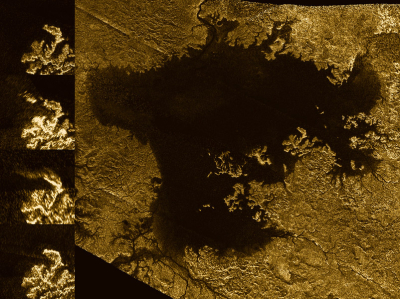
Cool image time! Using radar images taken during the past decade by Cassini scientists have discovered changes taking place along the shorelines of Titan’s hydrocarbon seas.

Analysis by Cassini scientists indicates that the bright features, informally known as the “magic island,” are a phenomenon that changes over time. They conclude that the brightening is due to either waves, solids at or beneath the surface or bubbles, with waves thought to be the most likely explanation. They think tides, sea level and seafloor changes are unlikely to be responsible for the brightening.

The images in the column at left show the same region of Ligeia Mare as seen by Cassini’s radar during flybys in (from top to bottom) 2007, 2013, 2014 and 2015.

These shoreline changes are not the only ones spotted by Cassini. However, because these are radar images, not visual, there are many uncertainties about what causes the changes, which is why they list several possibilities. For example, with radar, a simple roughness on the surface (such as waves) could cause a brightening.

1 comment

Free government money for Aerojet Rocketdyne!

Crony capitalism: Even though ULA prefers Blue Origin’s engine for its Atlas 5, the Air Force continues to fund Aerojet Rocketdyne’s new engine.

The U.S. Air Force announced Feb. 29 it was investing $115 million this year, and with options, as much as $536 million over the next five years, in [Aerojet Rocketdyne’s] AR1, a new liquid oxygen- and kerosene-fueled main-stage engine. The contract award is part of an Air Force initiative to end reliance on the Russian-built RD-180 engine that powers ULA’s Atlas 5 workhorse rocket.

Aerojet says it has two potential other customers to use the engine, but will not name them. In reviewing the field, the only customer I can think of that might be interested would be Orbital ATK (for its Antares rocket), and even there I have doubts. Thus, it appears to me that these funds are really being distributed to prop up a company that is failing, not to build anything useful the government needs.

0 comments

Trump winning open primaries, Cruz winning closed ones

Link here.

If true, why does this matter? Because so far the primary calendar has been heavily tilted toward open primaries. But there have been four closed elections: the Iowa caucus, the Nevada caucus, and Super Tuesday’s Oklahoma primary and Alaska caucus. Ted Cruz won three of those four closed elections.

This suggests that, as a number of polls have indicated, Trump’s victories have largely been aided by moderate Democratic voters crossing over to vote for him, mostly I suspect out of disgust at the extreme leftist tilt of their own party.

A more important factor to consider, however, is that the primaries will be increasingly shifting to closed primaries in the coming weeks. This weekend alone there are four primaries/caucuses, and they are all closed. No Democrats can vote in them. If Cruz tops Trump in most, it will indicate Trump’s true weakness within the Republican Party, a fact that could make it far more difficult for him to achieve the nomination than presently indicated.

And if Trump does well in these closed primaries? Then the nomination is likely his.

24 comments

India’s space agency ISRO gets a budget boost

In its new budget approved by India’s government the country’s space agency ISRO was the only science agency to get a significant budget increase, approximately 7.3%.

In the short run this is good, as ISRO has been using its funds wisely and accomplishing a lot for a little, while trying to encourage private development in India’s aerospace industry. In the long run, however, this will not be good, as government agencies always grow more than they should while sucking the innovation and creativity from the private sector. This is what NASA did in the U.S.

Hopefully, India will see how things are changing in America with private enterprise reasserting itself after a half century of government stagnation in space development and copy what we are doing.

0 comments

Astronauts return after 340 days on ISS

After 340 days in space astronauts Scott Kelly and Mikhail Kornienko safely returned to Earth early today.

Now the real research begins. Because Kelly has an identical twin, Mark Kelly, who is also a former astronaut, researchers will be able to gain a great deal of knowledge comparing the differences in how their bodies changed over the nearly full year, with one in weightlessness and the other on Earth.

However, what I want is longer missions, two or three years long, thus far exceeding what it would take to travel to and from Mars. Only then can we find out if humans will be able to make the journey safely.

4 comments
1 148 149 150 151 152 171