
Looking at Jupiter’s southern hemisphere
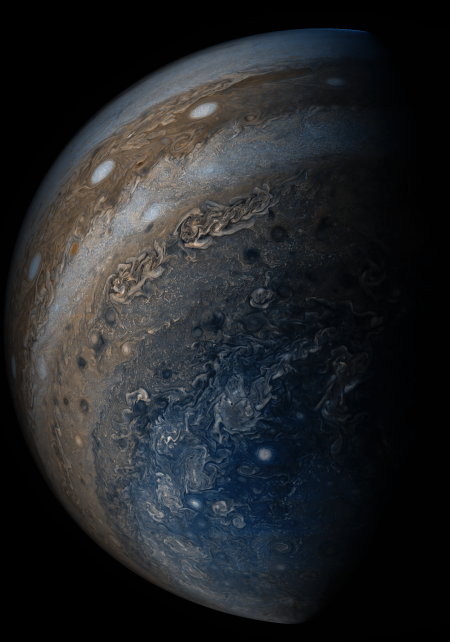
Jupiter's southern hemisphere

Cool image time! The image on the right, reduced to post here, shows Jupiter’s south pole and much of its southern hemisphere. It was taken during Juno’s last orbital fly-by of the gas giant’s cloud tops last week, and has been enhanced by Fevig-58, an ordinary citizen who downloaded the raw image and then uploaded his enhanced version to the Juno website.

It is definitely worthwhile taking a close look at the full resolution image. At the top its shows the horizontally banded Jupiter at equatorial- and mid-latitudes that has been that planet’s familiar face for centuries. In the middle is the transitional region from those horizontal bands to the chaotic polar regions. And at the bottom is the pole, where there the storms appear to follow no pattern and form a mish-mash.

One thing about Jupiter’s pole. It appears very different than Saturn’s. While I am certain they will find a vortex of some kind there, so far there is no indication of a coherent jet stream, as seen by Saturn’s hexagon. This once again demonstrates the one unbroken rule of planetary science that has been found with every planetary mission to every planetary body, whether they be pebbles, asteroids, dwarf planets, gas giants, or moons: Every single one of them is different and unique. They might fall into a single category, say gas giants, but each has its own unique features that make it different from every other member of that category.

5 comments

Egypt considers creating space agency

The Egyptian government is considering creating an Egyptian Space Agency.

The Egyptian government believes that the establishment of a space agency is necessary to invigorate and administer space programmes in Egypt, that in turn – it is hoped – will revitalize Egypt’s economy and entrepreneurship. While this approach is not without merit, it has been the cause of significant political controversy in Egypt as many of its citizens have voiced harsh criticism of the country’s space plans as the economy continues to deteriorate.

The proposed space agency will also administer Egyptian ambitions to build and even launch its own satellites.

Essentially, the government needs certain space capabilities (military and communications satellites), and a space agency would serve as its corporate arm for obtaining and managing those capabilities. It would also serve as a place where lots of foreign aid cash could be deposited into the government to be distributed to various friends. Along the way it might also help the economy and help shift Egypt in a more western and commercial direction.

How successful this becomes will depend on whether the Egyptian government lets the crony component dominate the process.

1 comment

The Muffs – Don’t Pick on Me

An evening pause: What makes this music video appealing is the cartoon, which recreates the style of Hollywood’s early 1930s black & white cartoons.

Hat tip Jim Mallamace.

As always, I welcome suggestions for Evening Pauses. If you think you have something and have not emailed me any suggestions previously, mention in a comment that you want to suggest something. Do not post the link to the video. I will contact you myself.

1 comment

Threats and violence against dissent at university

Fascists: A white professor as well as numerous students who came to his defense have been physically threatened by mobs at Evergreen State University, demanding their removal from the college.

The protest apparently got so out of hand that Professor Weinstein reported on Twitter that the police had warned him that he would not be “safe on campus” because they could not protect him. “To be clear: the police told me I am not safe on campus. They cannot protect me. Students in jeopardy. No contact from admin,” Weinstein wrote.

In another tweet, he alleged that students defending him have been “singled out” and threatened, posting a screenshot of an individual who claimed to have the “names and faces of students in Bret’s class” so that other can “see these faces for your own safety.”

Meanwhile, The Olympian reports that hundreds of students participated in the protest, which was also partly inspired by “anti-black comments on social media.” According to a blog post on Liberty Hangout, student Kai-Avé Douvia became “public enemy number one” on campus after he responded to a post from a peer advocating for the creation of a class specifically for “black/brown people” to study multiculturalism.

In his response, Douvia had experimentally reworded the post to replace “black/brown” with “white” in an effort to demonstrate the post’s racist nature, sparking a backlash on social media that eventually escalated to public shaming and threats from classmates. “Rather than respectfully responding and having civil discourse, I was then threatened and/or insulted by many so called ‘inclusive activists,’ leading to me to contact the police for protection,” Douvia writes in his blog on the matter. “This highlights a massive issue–the left is now mobilizing against itself to push its overused rhetoric on every free thinker, and if you disagree well, welcome to being every ‘-ist’ in the book.”

Everyone realizes that these thugs are not going to be punished for their fascist behavior. Consider the university’s mealy-mouthed response:

“It’s been an intense and useful conversation with a group of students,” spokesperson Zach Powers told The Olympian. “The college is working with the group to address their issues. This type of conversation is being replicated across the country right now. We remain committed to providing a great education to all students.”

These mobs could kill someone and the university administration might finally gasp in horror. It still wouldn’t do anything, however.

What no one is realizing is that these thugs are going to graduate from this university and move into the political arena, armed and willing to use their jackbooted fascist tactics wherever they can. The future does not look good.

1 comment

First science results from Juno

The Juno science team today released their first research results since the spacecraft entered orbit around Jupiter in July 2016.

“Although many of the observations have terrestrial analogs, it appears that different processes are at work creating the auroras,” said SwRI’s Dr. Phil Valek, JADE instrument lead. “With JADE we’ve observed plasmas upwelling from the upper atmosphere to help populate Jupiter’s magnetosphere. However, the energetic particles associated with Jovian auroras are very different from those that power the most intense auroral emissions at Earth.”

Also surprising, Jupiter’s signature bands disappear near its poles. JunoCam images show a chaotic scene of swirling storms up to the size of Mars towering above a bluish backdrop. Since the first observations of these belts and zones many decades ago, scientists have wondered how far beneath the gas giant’s swirling façade these features persist. Juno’s microwave sounding instrument reveals that topical weather phenomena extend deep below the cloudtops, to pressures of 100 bars, 100 times Earth’s air pressure at sea level.

“However, there’s a north-south asymmetry. The depths of the bands are distributed unequally,” Bolton said. “We’ve observed a narrow ammonia-rich plume at the equator. It resembles a deeper, wider version of the air currents that rise from Earth’s equator and generate the trade winds.”

Juno is mapping Jupiter’s gravitational and magnetic fields to better understand the planet’s interior structure and measure the mass of the core. Scientists think a dynamo — a rotating, convecting, electrically conducting fluid in a planet’s outer core — is the mechanism for generating the planetary magnetic fields. “Juno’s gravity field measurements differ significantly from what we expected, which has implications for the distribution of heavy elements in the interior, including the existence and mass of Jupiter’s core,” Bolton said. The magnitude of the observed magnetic field was 7.766 Gauss, significantly stronger than expected. But the real surprise was the dramatic spatial variation in the field, which was significantly higher than expected in some locations, and markedly lower in others. “We characterized the field to estimate the depth of the dynamo region, suggesting that it may occur in a molecular hydrogen layer above the pressure-induced transition to the metallic state.”

What I want to see is a depth map showing where Jupiter’s atmosphere ends and its solid core begins. I expect Juno will eventually be able to give us a first glimpse.

1 comment

Star becomes black hole without supernova explosion

The uncertainty of science: Astronomers think they have identified a star that, rather than die and become a black hole in a supernova explosion, merely fizzled into a black hole.

Starting in 2009, one particular star in the Fireworks Galaxy, named N6946-BH1, began to brighten weakly. By 2015, it appeared to have winked out of existence. The astronomers aimed the Hubble Space Telescope at the star’s location to see if it was still there but merely dimmed. They also used the Spitzer Space Telescope to search for any infrared radiation emanating from the spot. That would have been a sign that the star was still present, but perhaps just hidden behind a dust cloud.

All the tests came up negative. The star was no longer there. By a careful process of elimination, the researchers eventually concluded that the star must have become a black hole.

There are a lot of uncertainties here. Nonetheless, astronomers have theorized that some stars could collapse into black holes with any explosions, and it appears they might have found their first example of that.

6 comments

Civil War museum closes rather than remove its Confederate flags

The coming dark age: A Civil War museum is forced to close when Virginia county officials ordered them to remove all Confederate flags.

A Henry County commissioner requested a few months ago that a local Civil War museum remove its Confederate flags.

But without that symbol, the Nash Farm Battlefield and Museum announced that it can’t conduct its mission properly and will close June 1. In a Facebook post, the museum’s directors cited the request by District 2 Commissioner Dee Clemmons that all Confederate flags be removed from the museum, in addition to the gift shop, “in an effort not to offend anyone.”

“To exclude any Confederate flag would mean the historical value has been taken from our exhibits, and a fair interpretation could not be presented to each guest,” the post read. “Confederate flags were on this hallowed ground, as were the Union flags. To remove either of them would be a dishonor.”

In other words, it is better now for people to be ignorant of history so that they might avoid looking at a flag.

23 comments

College professor arrested for attacks against Trump supporters

Fascist: Berkeley policy have arrested the college professor who was identified as committing several violent attacks on pro-Trump demonstrators during protests in Berkeley in April.

Video of the most vicious attack, smashing a bike lock on a person’s head, can be seen at the link. It is quite ugly to see. There is also a video showing how the attacker was identified.

Note that this guy was a college professor, and he also followed the procedures of the fascist thugs that have been attacking conservatives in Berkeley, wearing a mask during protests and using violence against those he disagrees with. That he has been identified and arrested is a positive step forward. That it took an investigation by private citizens to force Berkeley police to arrest him is not good.

6 comments

Russia completes first military launch in a year

Russia today successfully launched a military payload on a Soyuz rocket, ending a year long gap in such launches due to the discovery of faulty and corrupt practices at rocket engine manufacturing facilities.

The lull in activity has in part been down to manufacturing defects and quality control issues affecting Russia’s production of rocket engines. A contractor was found to have been using cheaper materials in place of precious metals in alloys used to make parts of the engines. Seventy-one Proton engines and a number of Soyuz engines were recalled for inspection and repair.

Reliability concerns have lingered around Russia’s launch fleet in recent years, with Proton failing ten times since 2007 and Soyuz experiencing seven failures in the last eight years. Two Rokots and a Zenit have also failed in the last decade, while Russia’s flagship Fobos-Grunt mission to Mars never left low Earth orbit after the spacecraft itself malfunctioned.

In 2016, Russia experienced just one launch failure – with a Soyuz-U rocket suffering a third stage failure during December’s attempted launch of the Progress MS-04 vehicle to resupply the International Space Station. Despite this, there were two near-misses: a Soyuz-2-1b underperformed during the launch of a GLONASS navigation satellite last May, and the Proton launch in June suffered a second stage engine failure. In both cases the rockets’ upper stages – Fregat-M and Briz-M respectively – were able to alter their flight plans and inject the satellites into their planned orbits despite the anomalies.

They hope to resume Proton flights next month. Either way, it looks likely that in 2017 Russia will launch the fewest rockets in decades.

1 comment

Rocket Lab launches its first Electron rocket

Capitalism in space: Rocket Lab today successfully completed the first test flight of their Electron rocket.

The rocket did not reach orbit, though it did reach space altitude. More details here.

“It has been an incredible day and I’m immensely proud of our talented team,” said Peter Beck, CEO and founder of Rocket Lab. “We’re one of a few companies to ever develop a rocket from scratch and we did it in under four years. We’ve worked tirelessly to get to this point. We’ve developed everything in house, built the world’s first private orbital launch range, and we’ve done it with a small team.

“It was a great flight. We had a great first stage burn, stage separation, second stage ignition and fairing separation. We didn’t quite reach orbit and we’ll be investigating why, however reaching space in our first test puts us in an incredibly strong position to accelerate the commercial phase of our program, deliver our customers to orbit and make space open for business,” says Beck.

It appears they had a problem with the upper stage. Nonetheless, this is a great achievement. They were completely privately funded. They built their own launchpad. When they make orbit they will be the first company to have done such a thing.

I have embedded footage of the launch below the fold.
» Read more

8 comments

Boeing wins DARPA contract to build reusable first stage spaceplane

Capitalism in space: DARPA has selected Boeing to build its XS-1 spaceplane concept, a reusable first stage that would launch vertically and land on a runway.

Boeing will develop its “Phantom Express” vehicle for phases 2 and 3 of DARPA’s Experimental Spaceplane 1 (XS-1) program, which has the goal of performing 10 flights in 10 days to demonstrate responsive and low-cost launch. Phase 2 will cover development of the vehicle and ground tests though 2019, with a series of 12 to 15 test flights planned for phase 3 in 2020.

DARPA spokesman Rick Weiss said the value of the award to Boeing is $146 million. The award is structured as a public-private partnership, with Boeing also contributing to the overall cost of the program, but Boeing declined to disclose its contribution. “As it’s a competitive market, we do not plan to disclose our investment,” Boeing Phantom Works spokeswoman Cheryl Sampson said. “We are making a significant commitment to help solve an enduring challenge to reduce the cost of space access.”

It makes sense that Boeing won the contract, since that company also built the X-37B and knows how to do this. Moreover, with this contract it appears that DARPA is following in the footsteps of NASA initial cargo and crew commercial contracts, where the companies were required to commit some of their own capital for development, the costs were kept low, and the resulting spacecraft belonged to the company to market to the launch industry.

In this case, Boeing is going to have a first stage that it can combine with many other available upper stages to produce a rocket that can compete both with SpaceX and Blue Origin.

11 comments

How to land a space shuttle

An evening pause: This talk was given in October 2016, so the speaker, Bret Copeland, readily admits with great humor that he is describing something that no longer happens. Nonetheless, there will come a time when this will be done again, by vehicles better made and more often used. It is important to know how it was done.

Hat tip Edward Thelen.

3 comments
1 101 102 103 104 105 164