Rocket Lab launch scrubbed again due to weather
Capitalism in space: Rocket Lab has once again scrubbed its first test launch of its Electron rocket due to weather.
They will try again tomorrow.
Capitalism in space: Rocket Lab has once again scrubbed its first test launch of its Electron rocket due to weather.
They will try again tomorrow.
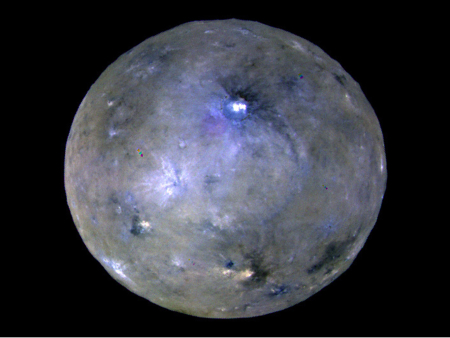
Cool image time! The image on the right, reduced in resolution to show here, was taken by Dawn on April 29, 2017, when the spacecraft had been positioned between the Sun and the dwarf planet at a moment when its entire surface was lit. They have enhanced the colors to bring out the contrasts.
Images combining these different color filter perspectives reveal fine details of Ceres’ surface. For example, they emphasize the distinct compositions and textures of the material ejected from craters. The brightest region on Ceres, called Cerealia Facula, is highlighted in Occator Crater in the center of this image. Vinalia Faculae, the set of secondary bright spots in the same crater, are located to the right of Cerealia Facula.
One of the darkest regions on Ceres is next to Occator, and represents ejected material from the impact that formed the crater. The ejected material forms a large arc that extends over several hundred kilometers, below the center of Ceres in this image. That material’s distribution is partly determined by Ceres’ rotation.
Be sure to take a close look at the full image. It isn’t super high resolution, but it reveals a lot of interesting details
Astronauts will perform an emergency spacewalk on May 23 to replace the failed MDM electronics relay box that failed on Saturday.
So, they have a spare on board, which is good. The article does note, however, that the unit that failed had only been installed less than two months ago, on March 30. This is not good. These units should last longer than two months, especially considering how critical they appear to be.
Capitalism in space: Rocket Lab has delayed its first test launch of its Electron rocket because of predicted high winds.
The company has not yet said if they have rescheduled for Tuesday.
This article gives a very detailed overview of the rocket, its engines, and the history of its launch site. It also notes that if successful, the launch will be first orbital flight ever from a commercial company from its own commercial launch site.
ISS managers are meeting to make a plan to deal with the failure on Saturday of the #1 data relay electronics box on the S0 truss of the station.
The unit, called an MDM, has an identical backup in place so no station operations have so far been effected. However, that backup had failed back in 2014 and required a spacewalk to replace it, so it is not clear to me as yet whether the station has any additional spares available to replace the newly failed unit. If so, it will still require a spacewalk to make the switch.
If there is no spare, they will likely have to ship one up on the next cargo flight, as the MDM is essential for operating the solar panels and radiators as well as the robot arms.
The coming dark age: The academic journal Cogent Social Science has published a hoax paper that claims the penis is a social construct that is causing global warming.
The authors begin, “Anatomical penises may exist,” but the “conceptual penis is better understood not as an anatomical organ but as a social construct.” It goes downhill from there. “There are many women who have penises,” they boldly claim. Then, they gratuitously listed some crude synonyms for the penis, such as: “beaver basher,” “custard launcher,” “pork sword,” and “mayo shooting hotdog gun.” They explained that “manspreading” — when a man sits with his legs open — is “akin to raping the empty space around him.”
At this point, it is worth stopping to ponder that this didn’t raise any red flags with the editors of the journal. Not only did they think this was perfectly intellectual, publishable material, they praised the authors for their work.
Yet, the absurdity didn’t end there. The authors tied everything in to climate change.
Even more astonishing was this statement by the authors:
In their tell-all article in Skeptic, the authors admit they jammed the paper full of jargon and made it purposefully incoherent. They said, “After completing the paper, we read it carefully to ensure it didn’t say anything meaningful, and as neither one of us could determine what it is actually about, we deemed it a success.” Finally, they made this particularly damning observation: “We assumed that if we were merely clear in our moral implications that maleness is intrinsically bad and that the penis is somehow at the root of it, we could get the paper published in a respectable journal.”
Make sure you read the tell all article, which step by step reveals the utter bankruptcy of the entire social science field that would allow this fraud to get published, getting passed by two reviewers and a partner journal that recommended the paper to Cogent Social Science.
As I said earlier this week, the time has come to cut off all funding to any university that supports anyone who teaches this crap. Donations from alumni should cease. Parents should refuse to send their children there. And the students there now should rise up in outright revolt, demanding their money back.
The law is such an inconvenient thing: The U.S. Court of Appeals has ruled that a recently imposed FAA requirement that amateur drone operators register their drone with the FAA is illegal.
Introduced in 2015, the mandatory drone registry required owners of unmanned aircraft weighing between 0.55 and 55 lb (250 g and 25 kg) to register their machines with the FAA. If not, they faced fines of up to $250,000.
This drew the ire of some in the drone industry, and the many hobbyists who had been flying small aircraft recreationally for years. One such hobbyist, John Taylor, went to the lengths of challenging the FAA’s new rule in the US Court of Appeals. Today, that court ruled in his favor.
“Taylor is right,” the decision reads. “In 2012, Congress passed and President Obama signed the FAA Modernization and Reform Act. Section 336(a) of that Act states that the FAA ‘may not promulgate any rule or regulation regarding a model aircraft’ … The FAA’s 2015 Registration Rule, which applies to model aircraft, directly violates that clear statutory prohibition. We therefore grant Taylor’s petition and vacate the Registration Rule to the extent it applies to model aircraft.”
It is not surprising that a bureaucrat or government agency would try to impose more regulations on the public than is required or allowed. It is all about power, and these regulations give power to the regulators. What is different today is that the federal bureaucracy is now so large and so involved with regulating so many private activities, while the law has simultaneously become so complex and difficult to track, that these abuses happen routinely, unless someone with enough personal resources and determination decides to fight. And even here there is no guarantee that the courts will apply the proper law.
An evening pause: Hat tip Edward Thelen.
Juno has successfully completed its fifth flyby and orbit of Jupiter, dipping to within 2,200 miles of the top of the gas giant’s atmosphere.
The next flyby is set for July 11, and will zip across directly above the Great Red Spot.
The uncertainty of science: Astronomers today have noticed that Tabby’s Star has begun to dim precipitously again, and have put out a call for people to observe it.
No one still has a good theory to explain the star’s light changes, so having the chance to gather data throughout an entire dimming cycle will be invaluable.
The White House has denied reports that they have decided not to move the U.S. embassy to Jerusalem, and have instead said that the decision on whether to move the embassy will only be made after Trump’s Middle East trip.
Since neither story identified the White House official making the claims, either for or against the move, I suppose we should file this whole thing under fake news. These are unsubstantiated leaks, and should not be taken seriously.
Capitalism in space: Sky and Space Global (SAS) has delivered the first three nanosats — of a planned 200 nanosat constellation — to India for launch.
The first three nanosats are to be launched by India on its PSLV rocket, but SAS has contracted Virgin Orbit to use its LauncherOne to put the next 197 up. They had made this first announcement last summer, saying the first three would launch in the second quarter of 2017. It appears that they are holding to that schedule.
They also said that LauncherOne would begin launching the other 197 satellites in 2018. For this I remain far more skeptical, since the track record at Virgin in getting its spacecraft off the ground on schedule has not been good.