Europe considers a helicopter drone for future Mars missions

The European Space Agency is considering flying a technology demonstration helicopter drone on a future Mars mission.

Note that they don’t yet have the money to build this, and it appears that they don’t yet have a mission to fly it on. What they have done is just completed a preliminary study, which suggests the idea is feasible. They are now lobbying for more cash to move forward.

3 comments

Georgia governor signs spaceport bill

Capitlism in space: The governor of Georgia yesterday signed into law a spaceport liability law that will make that state competitive with other states.

I’m not sure yet how realistic Georgia’s hopes are for a viable spaceport. Vector’s next test suborbital flight is scheduled to occur there, but will other companies shift their business there? I am not sure. Nonetheless, this raises the level of competition, which can never be bad.

2 comments

Brittle and weak welds on SLS tanks?

Government in action! The hydrogen tanks that will be used for the first SLS rocket flight were welded using a technique that NASA has since found to be untrustworthy.

Although the weld strength issue stopped welding the qualification and flight articles of the LOX tank before it could start, the issue wasn’t caught until after both LH2 tanks were welded with the modified pin tool last summer. The implications of the two tanks possibly having below design strength welds disrupted the original, post-weld plans.

The LH2 qualification tank, which will be used for structural testing at Marshall Space Flight Center in Huntsville, Alabama, was welded first and after setup and configuration was taken to Building 451 in December of last year both for proof testing of the welds and to qualify the test facility and procedures for subsequent flight tanks. Hydrogen tanks are proof tested by pressurizing them with nitrogen gas while a hydraulic test rig applies loads to the structure. “We wanted to wring out…the control system – 451 was another building that was made bigger to fit the hydrogen tank,” Doering said. “The control system is all new, the reaction fittings are all new, along with all the actuators. We didn’t want to put the flight asset in there to try to use it for the first time, so [using] the qual[ification] article [first] was also trying to wring out the pressurization and the actuation of the control system in 451.”

Originally, the plan included a test case to pressurize the qualification tank to slightly above flight pressure to help as a part of that “pathfinding” work; however, the discovery that the welds may be below design strength forced plans to be reconsidered.“We couldn’t say with any real degree of certainty that these welds would make it to [flight pressure],” Doering said. “In a pneumatic test, pressurizing it like that, it’s like a balloon…there’s a good portion of the community that thinks it will survive, there’s another portion of the community that says you don’t know enough to be able to say that, [and] there’s another portion of the community that says…’no way.’ [emphasis mine]

This is merely the qualification tank, built to find out if the tank design, which appears to be overly complicated to begin with, will work. The flight tank?

Lower pressure isn’t an option for the LH2 flight tank, which must perform at flight pressures both in testing and in flight. The SLS Program developed and is working on multiple, parallel options for consideration that include repairs and/or replacement of the already-welded flight tank. “We’re looking at use as-is – can I get to the point where I’m comfortable using that flight tank?” Doering said. “The answer to that is probably not, just because the analysis tools don’t exist yet to do this.” [emphasis mine]

They are faced with the likely possibility that they will have to repair the tank, which will likely cause the now 2019 launch date for the first unmanned test to be delayed further.

The rumors that NASA is considering making that first test flight a manned one makes me think that they are considering that decision as a cover for these additional delays. “We need more time to make this work as a manned flight,” NASA management will claim, using that extra time to fix the tanks as well. They will also claim they need more money, as they always do.

Meanwhile, NASA is having trouble building rocket tanks, an item that aerospace engineers figured out how to build half a century ago. Way to go, NASA!

6 comments

The status of all of Trump’s executive appointments so far

Link here. The article is a very detailed and thorough look at the number of Trump appointments, nominated, approved, or missing, for almost all the major cabinet positions, noting above all the lack of names submitted for many positions.

At the end of Trump’s first 100 days, only 27 of 556 political appointments had been confirmed, as compared with 69 for former President Barack Obama and 35 for former President George W. Bush.

If blame is appropriate, there’s plenty of it to go around. The administration blames Democrats for slow-rolling nominees. But Democrats and some Republicans counter that the White House isn’t sending names quickly enough. And a handful of nominees have taken themselves out of contention, mostly because of their various business interests. Since the president likes hiring business leaders, that’s proving no small problem.

The lack of confirmed appointees means agencies are severely limited in the scope of their policy action, whether it’s enacting changes made by Congress or following through on dozens of executive orders Trump has signed.

What strikes me is the feeling that probably a lot of these people are simply not needed. They are political appointees, given posh government jobs in exchange for their work helping presidents get elected. Almost across the board, the agencies involved are functioning just fine without these appointees in place. Trump can tell these civil servants what he needs done, and they can do it.

At the same time, the inability to get these appointees named and approved speaks volumes about the increasing failure of the federal government to function. They can’t even get political appointees in place, people who really aren’t needed and are really only there to pay back favors. What does this tell us about their ability to accomplish things that must get done?

19 comments

Sunspot update for April 2017

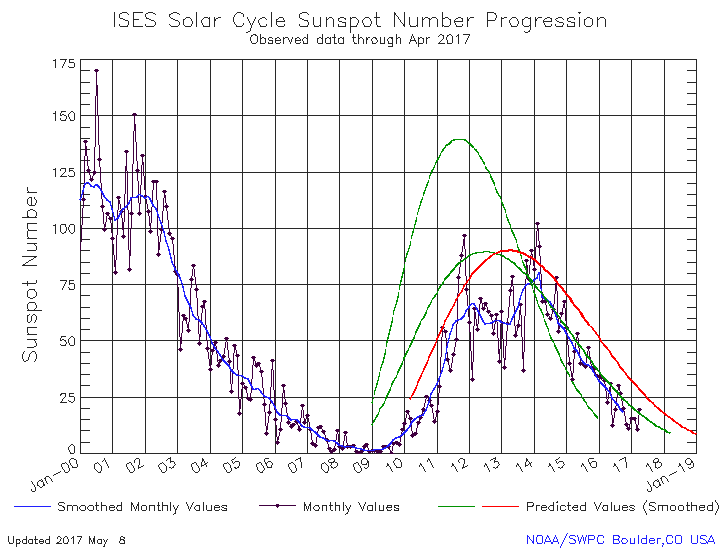
Today NOAA posted its monthly update of the solar cycle, covering sunspot activity for April. It is posted below, with annotations, as I have done now every month since 2010.

April 2017 Solar Cycle graph

The graph above has been modified to show the predictions of the solar science community. The green curves show the community’s two original predictions from April 2007, with half the scientists predicting a very strong maximum and half predicting a weak one. The red curve is their revised May 2009 prediction.

April showed an uptick in sunspot activity, enough to move the numbers back up above the 2007 low prediction. Nonetheless, activity as the cycle has been ramping down has consistently and generally remained below expectation, and does seem heading to an early arrival of solar minimum, sometime in late 2019 or early 2020, about a year early.

I don’t want to sound like a broken record, as I have written this practically every month since I started these updates in 2010, but this short and weak solar maximum suggests the possibility that we might be facing a grand minimum, where there are no significant sunspots for decades. Some solar scientists think this is coming. Others are much more doubtful. Regardless, we can only wait and watch, while also recognizing that weak solar maximums and grand minimums have in the past consistently coincided with global cool weather. The reasons why this has happened are not yet known, but it has happened nonetheless.

1 comment

Speak your mind at Duke Divinity School and get threatened

Fascism in academia: A department chairman at Duke Divinity School in North Carolina objected to the nature and content in a racial re-education training program, and found himself brought up on charges and has since resigned.

The link contains the full correspondence and history that led to the chairman’s resignation. In order to understand the fascist nature of the school’s actions, it is necessary for you to take the time to read it all, including the comments. Essentially, he raised cogent arguments about why he thought the racial training course was a waste of time and inappropriate, and was immediately accused of racism and harassment, and has since resigned.

As one commenter noted,

I worked at a Christian liberal arts college in the late 80s, early 90s, and even then had to put up with this stuff. Not as bad, but it was in the air. I imagine the good Dr. had simply had enough. Unless you live it, you have no idea how horribly oppressive such an atmosphere is, as the ex-student wrote about. 1984 is alive an well at America’s college, and obviously some, seminary campuses. No, bravo to Dr. Griffiths for having the guts to stand up to the totalitarian lefties at his campus.

My only criticism of this chairman is that he resigned. He should have fought it out, making these fascists defend their positions. Instead, by resigning he has ceded control of the school to them.

8 comments

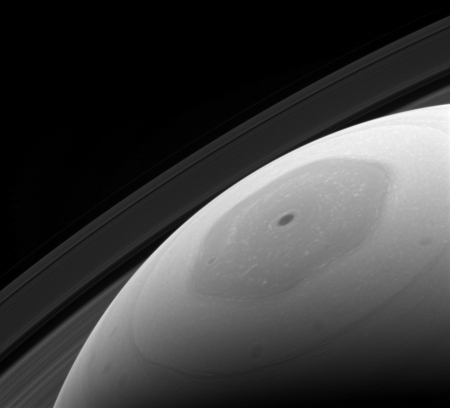
Saturn’s north pole hexagon jet stream

Saturn's north polar hexagon jet stream

Cool image time! The image on the right, reduced and cropped to show here, was taken by Cassini in January as it was preparing to head into its final 22 orbital dives between Saturn and its rings. The image shows the gas giant’s north polar, with all its magnificent features. As the press release notes, the north pole was in shadow for the first part of Cassini’s mission, and only in recent years has finally moved into sunlight so that the spaceship can see and image it.

Although the sunlight falling on the north pole of Saturn is enough to allow us to image and study the region, it does not provide much warmth. In addition to being low in the sky (just like summer at Earth’s poles), the sun is nearly ten times as distant from Saturn as from Earth. This results in the sunlight being only about 1 percent as intense as at our planet.

This view looks toward Saturn from about 31 degrees above the ring plane. The image was taken with the Cassini spacecraft wide-angle camera on Jan. 22, 2017 using a spectral filter which preferentially admits wavelengths of near-infrared light centered at 939 nanometers.

Be sure to look at the full image.

3 comments

NASA may have decided to fly humans on first SLS test flight

Doug Messier at Parabolic Arc has a story today suggesting that there are rumors at NASA that the agency has decided that it will put astronauts in Orion for SLS’s first test flight, now tentatively scheduled for sometime in 2019.

At he notes, this will only be the second time in history humans will have flown on a untested rocket, the first being the space shuttle, where they had no choice as the vehicle needed people to fly it.

NASA’s arguments in favor of this manned test flight will probably rest on noting how much of the rocket is based on previously flown equipment. For example, the upper stage for this flight will be a modified Delta upper stage, a well tested and frequently flown stage. The first stage will be made of side-mounted first stage solid rocket boosters that are essentially upgrades of the shuttle’s solid rocket boosters. And the first stage engines are actual shuttle engines salvaged from the shuttle’s themselves. In addition, NASA will note that Orion will have a launch abort system, though it appears that there will be no test of this system prior to the flight.

These arguments don’t carry much weight. The Delta upper stage will also be modified for this flight, and this will be that version’s first use. Similarly, the solid rocket boosters have been modified as well, and this will be their first flight. And as I noted, the Orion launch abort system will not have been tested in flight.

Finally, and most important, the goal of this test flight is to see if these different parts have been integrated together properly. As a unit, none of them has ever flown together. To put humans on such a flight is very foolish indeed.

Messier sums this up quite well:

The flight might come off just fine. But, I fear that NASA’s concern about keeping the program funded, and Donald Trump’s desire for some space spectacular to boost his re-election chances, could combine to produce something very unfortunate.

I pray that people in the Trump administration put a stop to this silliness, as soon as possible.

8 comments

Trump administration removes members of EPA science advisory board

In a move related to Trump’s effort to change policy at the EPA, the administration yesterday is reported to have forced out as many as a dozen members of EPA’s 18-person Board of Scientific Counselors.

At an April meeting, the Board of Scientific Counselors discussed the importance of climate change research at EPA and “the growing need for information on, and understanding of, climate change and responses to its impacts,” according to an agenda. They also talked about the importance of considering climate change as a stressor in areas of non-climate research.

The Trump administration has already sent signals that it does not value some areas of federal research, in particular climate science and work that could lead to further regulation of the fossil fuel and chemical industries. The board had 18 members, including Richardson, who said he knew of at least one other member fired. Departures could reach a dozen, he said.

There is going to be a lot of pigs squealing about this. The big question will be whether the Trump administration will have the courage to stand up to those squeals.

8 comments

The UAE plan to tow an iceberg from Antarctica for drinking water

The United Arab Emirates (UAE) has a project to tow an iceberg more than 5,500 miles from Antarctica in order to provide that arid nation drinking water for about five years.

The National Advisor Bureau, headquartered in Masdar City, Abu-Dhabi, plans to source the massive blocks of ice from Heard Island, around 600 miles (1000 kilometres) off the coast of mainland Antarctica. It will then transport them around 5,500 miles (8,800 km) to Fujairah, one of the seven emirates which make up the UAE. One iceberg could provide enough for one million people over five years, according to the company.

And the scheme could begin as early as the start of 2018.

25 comments
1 108 109 110 111 112 164