Bad solder joints cause of Russian Proton engine defects

The problem that has forced the Russians to recall all Proton second and third stage engines has been identified as the use of the wrong materials in solder joints.

According to specifications, the structural walls and the nozzle chamber of the gas generator had to be fused together with the help of the solder designated G70NKh, which employs nickel, chromium and manganese alloy (Ni-Cr-Mn). However the investigation revealed that due to mismanagement of the raw material usage at the Voronezh Mechanical Plant, the required alloy had been replaced with the PZhK-1000 solder comprised of palladium, nickel, chromium and silicon (Pd-Ni-Cr-Si). Because the replaced solder did not meet specifications, it could lead to structural disintegration of the nozzle head during the firing of the gas generator.

The discovery of the problem with the solder triggered inspection of other engines and revealed that all RD-0210 and RD-0212 engines from the second and third stages that had been manufactured during 2015 and 2016 had been equipped with defective gas generators. In order to re-certify these engines for flight, each of them would have to be disassembled, the gas generator would have to be removed and replaced, followed by the re-assembly and re-testing of each engine!

The article also notes that the next Angara rocket is also “unfit for flight” due to unspecified defects. It also notes widespread corruption and mismanagement throughout the Russian aerospace industry.

Sadly, the decision by the Putin administration to consolidate their industry into one huge corporation run by the government, and thus eliminate any competition, is only going to make solving this problem more difficult. What Russia needs is competition, with many different companies free to challenge each other for business. It also needs to allow companies to fail and go out of business.

Instead, everything is controlled from above, and thus no competition can happen. Rather than finding a new company to build these engines, the government is going to provide the company “economic aid” in order to modernize it. This is like putting a band-aid on a broken bone.
4 comments

SpaceX recovers fairing of upper stage of Falcon 9

The competition heats up: Even as SpaceX made history yesterday in its successful use and recovery of a used first stage, it also recovered for the first time the fairing that protected the satellite.

For the first time, SpaceX also recovered the payload fairing, the conical shaped structure on top of the rocket that surrounds and protects the spacecraft during launch. The fairing separates from the spacecraft in two sections during the launch sequence — in this case, 3 minutes and 49 seconds after launch — and usually falls into the ocean and breaks into pieces. SpaceX outfitted these two fairing sections with parachutes so they could be recovered, which apparently will become standard practice.

Musk also indicated that they are now going to begin an effort to recover the second stage. “What’s the worst that could happen? It blows up? It would anyway.”

2 comments

SLS faces more delays

Delays by ESA in the construction of the service module for Orion, plus the tornado damage at the Michoud facility in Louisiana, could force NASA to delay the first unmanned test launch of the SLS rocket, presently planned for late in 2018.

NASA is also considering delaying the flight further should the agency decide to make this first unmanned test flight a manned one. They also say they will need more money if they have to put people on the first flight. I guess $43 billion and almost 15 years wasn’t enough.

By the way, it took less than four years to win World War II. From Kennedy’s speech to the Apollo 11 landing was only eight years. One wonders when we, as a nation, will finally wake up and realize that SLS is not a rocket to the Moon, but an never-ending jobs program unable to accomplish anything in space.

12 comments

Practically every Russian Proton rocket engine defective

The investigation of the Russian supply of rocket engines for its Proton rocket has discovered that practically every engine, numbering over seventy, had defects that needed repair.

71 engines, mostly used to power the second and third stages of the Proton rocket, require complete overhauls to remove defects. Arbuzov did not specify what was wrong with the engines. In January, Interfax reported on an investigation into high-quality metals swapped by a plant manager for cheaper alternatives. “Most of the work will be done in 2017, but we understand that some portion will inevitably slip into 2018,” Arbuzov said. “Our main goal is to avoid disrupting the government space program’s launch schedule, or the schedules of the Defense Ministry and commercial customers.”

There is also the possibility that these defects will be found in Soyuz rocket engines as well. Stay tuned.

1 comment

A tour of Vector Space Systems

Jim Cantrell and cars

[UPDATE: I have been informed by Vector’s PR department that they have recently changed the company’s name, dropping “Space Systems” from the title. I can’t really change the title here, but I thought I note this fact for my readers.]

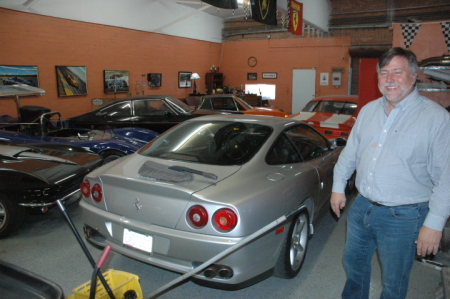
Today I got a quick tour of Vector Space System’s very blue collar but active rocket factory in Tucson, Arizona. My tour guide was Jim Cantrell, the CEO of the company.

Cantrell, shown on the right in front of one of his side businesses fixing and refurbishing race cars and rare luxury sports cars (also located in this factory), started out with a love of race cars, which he still builds and races. As he said to me, “Long endurance car racing is still my thing.”

However, he has also spent his life in the space business. He has worked for government agencies and numerous private businesses, including SpaceX at its very beginning. Vector Space Systems is an effort put together by him and several other people to capture the smallsat market, a market he truly believes is going to explode with activity in the coming years. If things go as he wishes, they hope to launch at least one hundred times a year, from multiple launch sites. Their goal is simplicity and quick turnaround at an inexpensive cost.

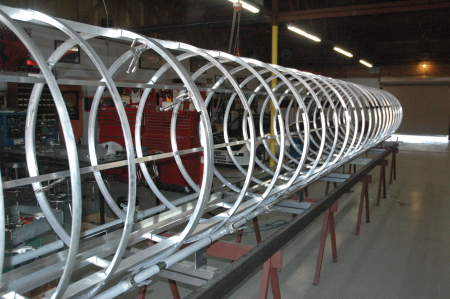
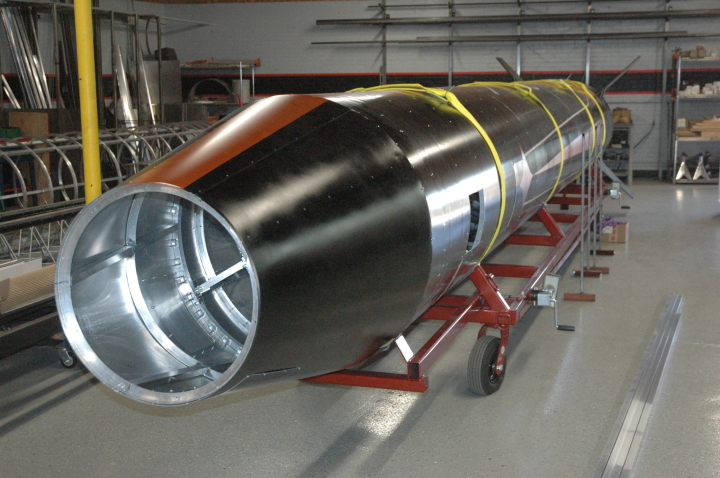
The company is presently in the testing phase leading up to their first orbital launches, which they hope to start in 2018. Right now they are building a series of full scale versions of their Vector-R rocket with a dummy second stage. The idea is to do a string of suborbital test flights, the first of which will fly in about a week from Mohave in California, with the second flying from the Georgia spaceport in Camden County. The image below is the first stage of that first test rocket.

Vector test first stage

Vector first stage engine

second test rocket

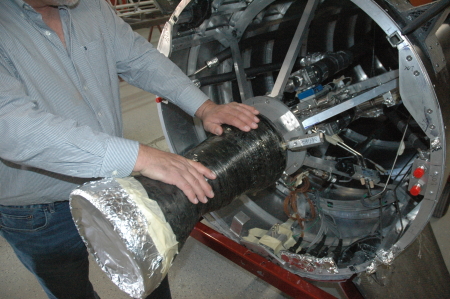
For this flight their main goal is to test the engine, which Cantrell is showing me in the picture to the right. I was astonished at how small and simple the engine was. In fact, the rocket itself was amazingly small. It looked like it could almost fit inside a typical moving truck.

Below and to the right is the first stage for their second test flight, presently being assembled. They hope it will be ready for flight in only a few weeks after the first flight. They plan five suborbital test flights, with the last capable of getting about 90% to orbit. Along the way they will test their avionics, the rocket’s balancing systems, and its computer and tanks. Once these tests are complete they will then move to testing the orbital version in 2018.

Obviously, all this depends on every test flight being successful. But then, even if something goes wrong they will learn something and move on. For example, they recently transported an engineering version of the rocket to the visitor center at Kennedy. As Cantrell explained, “We learned things new just making that move.”

bumper sticker

In the end, I think the bumper sticker to the right, attached to the window of Vector Space System’s office, sums everything up. The people at Vector want to make money in space, but they — like everyone in the space business — also love making rockets and engines and going fast. What better combination from life could you ask for?

6 comments

New theory eliminates need for dark energy

The uncertainty of science: A new theory now shows that dark energy, the apparent acceleration of the universe’s expansion rate on large scales, does not need to exist in order to explain the data that astronomers have obtained.

In the new work, the researchers, led by Phd student Gábor Rácz of Eötvös Loránd University in Hungary, question the existence of dark energy and suggest an alternative explanation. They argue that conventional models of cosmology (the study of the origin and evolution of the universe), rely on approximations that ignore its structure, and where matter is assumed to have a uniform density. “Einstein’s equations of general relativity that describe the expansion of the universe are so complex mathematically, that for a hundred years no solutions accounting for the effect of cosmic structures have been found. We know from very precise supernova observations that the universe is accelerating, but at the same time we rely on coarse approximations to Einstein’s equations which may introduce serious side-effects, such as the need for dark energy, in the models designed to fit the observational data.” explains Dr László Dobos, co-author of the paper, also at Eötvös Loránd University.

In practice, normal and dark matter appear to fill the universe with a foam-like structure, where galaxies are located on the thin walls between bubbles, and are grouped into superclusters. The insides of the bubbles are in contrast almost empty of both kinds of matter. Using a computer simulation to model the effect of gravity on the distribution of millions of particles of dark matter, the scientists reconstructed the evolution of the universe, including the early clumping of matter, and the formation of large scale structure.

Unlike conventional simulations with a smoothly expanding universe, taking the structure into account led to a model where different regions of the cosmos expand at different rate. The average expansion rate though is consistent with present observations, which suggest an overall acceleration.

In other words, the uneven structure of the universe has never been considered in previous models, and once included in the equations the need for dark energy disappears.

8 comments

Less than 1% of all science papers follow scientific method

The uncertainty of science: A survey of the research done for papers published in scientific peer-reviewed journals has found that less than 1% properly follow the scientific method.

Armstrong defined eight criteria for compliance with the scientific method, including full disclosure of methods, data, and other reliable information, conclusions that are consistent with the evidence, valid and simple methods, and valid and reliable data.

According to Armstrong, very little of the forecasting in climate change debate adheres to these criteria. “For example, for disclosure, we were working on polar bear [population] forecasts, and we were asked to review the government’s polar bear forecast. We asked, ‘could you send us the data’ and they said ‘No’… So we had to do it without knowing what the data were.”

According to Armstrong, forecasts from the Intergovernmental Panel on Climate Change (IPCC) violate all eight criteria.

“Why is this all happening? Nobody asks them!” said Armstrong, who says that people who submit papers to journals are not required to follow the scientific method. “You send something to a journal and they don’t tell you what you have to do. They don’t say ‘here’s what science is, here’s how to do it.’”

Worse, the research found that many results came not from data but to confirm something that was politically advantageous or helpful in winning grants.

Digging deeper into their motivations, Armstrong pointed to the wealth of incentives for publishing papers with politically convenient rather than scientific conclusions. “They’re rewarded for doing non-scientific research. One of my favourite examples is testing statistical significance – that’s invalid. It’s been over 100 years we’ve been fighting the fight against that. Even its inventor thought it wasn’t going to amount to anything. You can be rewarded then, for following an invalid [method].”

“They cheat. If you don’t get statistically significant results, then you throw out variables, add variables, [and] eventually you get what you want.” [emphasis mine]

The scientific community and especially the climate field has got to get a handle on this and demand better. Otherwise, we lose the greatest gift science has given to civilization, an unwavering dedication to the truth.

6 comments
1 123 124 125 126 127 164