
John Denver – I Remember You
<An evening pause: Hat tip Danae.
<An evening pause: Hat tip Danae.
The uncertainty of science: New measurements of the universe’s expansion rate are apparently in agreement with some previous measurements but not with others.
The Hubble constant — the rate at which the Universe is expanding — is one of the fundamental quantities describing our Universe. A group of astronomers, the H0LiCOW collaboration, used the NASA/ESA Hubble Space Telescope and other telescopes in space and on the ground to observe five galaxies in order to arrive at an independent measurement of the Hubble constant. The new measurement is completely independent of — but in excellent agreement with — other measurements of the Hubble constant in the local Universe that used Cepheid variable stars and supernovae as points of reference.
…However, the value measured by Suyu and her team, as well as those measured using Cepheids and supernovae, are different from the measurement made by the ESA Planck satellite. But there is an important distinction — Planck measured the Hubble constant for the early Universe by observing the cosmic microwave background. While the value for the Hubble constant determined by Planck fits with our current understanding of the cosmos, the values obtained by the different groups of astronomers for the local Universe are in disagreement with our accepted theoretical model of the Universe.
Both measurements are very precise, but they do not match, suggesting that there are some basic fundamentals here that astronomers simply do not yet understand.
Link here. The author argues, that though some of these individuals have made decisions that some conservatives dislike, their general philosophical and analytical approach to their court decisions make them all strong conservative picks.
I’ve spent the better part of a week researching many of their writings and talking to stalwart constitutionalist leaders about them. All of them are clearly textualist-originalists to a degree Chief Justice Roberts never appeared to be, even when many on the right were applauding Roberts’ 2006 nomination due to his clear sense of one sort of judicial “restraint” and generally conservative political leanings.
Sure, these judges may reach differing conclusions from each other in particular cases, but these will likely be with the infrequency and integrity of, say, the occasional differences between Justice Clarence Thomas and the late Justice Antonin Scalia. What’s important is that each one of them is clear and forthright in applying the same basic method of analyzing each case — namely, by hewing closely to the facts at hand, and carefully considering those facts in light of the exact language of the statutes and/or Constitution (whichever applies) relevant to that case.
All of them do so while clearly operating from a legal-philosophical framework/understanding very much in line with the philosophies so well explained in the seminal Federalist Papers that explained how and why our Constitution was designed as it was.
If that honest decision-making process sometimes leads to individual case results that do not comport to the policy preferences of a subset of conservatives, so be it. The real safeguard for our liberties lies in that analytical process undertaken by those well steeped in a Federalist-paper worldview. The reality is that in the vast majority of cases, the right constitutional approach will lend aid to the right policy results, because the Constitution and conservative policies both tend toward limited government, maximum liberty under straightforward law, and a respect for the realms in which traditional institutions of family and faith are honored and cherished. For every policy disappointment that might result from such an approach to constitutional jurisprudence, surely 15 or 20 policy triumphs will occur. [emphasis in original]
While I agree with the author in general, his discussion of one particular candidate, Thomas Hardiman, did nothing for me. Based on what I read, Hardiman is now my least favored choice among the names Trump is considering.
Regardless, read it all. The article indicates once again that while Trump might have once been a liberal Democrat, his leanings now are increasingly in a conservative direction.
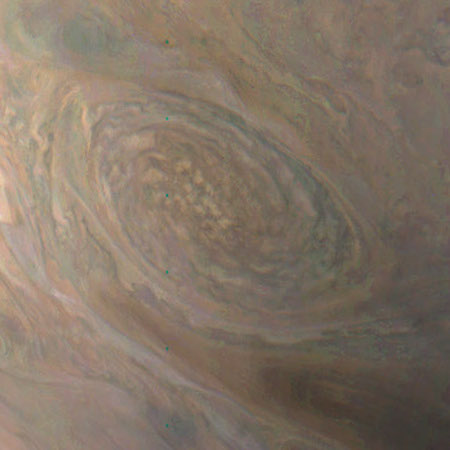
Cool image time! The image on the right, cropped to show here, is focused in on Jupiter’s Little Red Spot, a storm that formed by the merger of three smaller storms about a decade ago. The cropped image comes from a wider view of Jupiter from Juno that is quite amazing.
Note that the Little Red Spot, while only a third the size the more well known Giant Red Spot, is still about the size of the Earth.
This storm is the third largest anticyclonic reddish oval on the planet, which Earth-based observers have tracked for the last 23 years. An anticyclone is a weather phenomenon with large-scale circulation of winds around a central region of high atmospheric pressure. They rotate clockwise in the northern hemisphere, and counterclockwise in the southern hemisphere. The Little Red Spot shows very little color, just a pale brown smudge in the center. The color is very similar to the surroundings, making it difficult to see as it blends in with the clouds nearby. Citizen scientists Gerald Eichstaedt and John Rogers processed the image and drafted the caption.
The competition heats up: India successfully completed today a 50-second static fire test of the upper stage engine for its GSLV rocket.
The rocket’s next launch is set for March.
The first Mars mission by the United Arab Emirates, dubbed Hope, is still be on schedule for its 2020 launch, according to the mission’s project manager.
Omran Sharaf said: “The mission has been on track so far. We’ve completed the PDR — Preliminary Design Review — and hopefully we’ll hold the CDR [Critical Design Review] soon.” His comments came during his presentation on ‘How Could the UAE Get to Mars?’ on the second and final day of the [Project Space] forum, held at Dubai World Trade Centre for the first time. Project Space is held under the patronage of Shaikh Hamdan Bin Mohammad Bin Rashid Al Maktoum, Crown Prince of Dubai. Shaikh Hamdan is the chairman of the Mohammad Bin Rashid Space Centre (MBRSC), organiser of Project Space.
During Wednesday’s talk on EMM, Sharaf added that “the system design has been completed … and we’re starting to work on the engineering models of the mission. So this is the current phase of the mission”.
Like most stories about space coming from the UAE, they spend more time listing the titles of the bigwigs running the project than providing much specific information about the project itself. I remain skeptical they can pull this off.
One of India’s seven GPS satellites is presently out of commission because its on-board atomic clock has malfunctioned.
The remaining satellites in the constellation is still functioning however, and are sufficient. The nature of this failure, so similar to the clock failures that have hit a number of Europe’s Galileo GPS satellites, makes me wonder if there is a connection.
Good news: Engineers have resumed vibration testing of the James Webb Space Telescope after pinpointing and fixing the unexpected movement in one of the restraint mechanisms that hold the telescope’s folded mirrors in place during launch.
Overall, it increasingly looks like Webb is going to get off the ground as presently scheduled, in October 2018.
The competition heats up: Boeing today unveiled the streamlined but snazzy spacesuit it plans to use on its Starliner manned ferry flights to and from ISS.
This tidbit though I think illustrates the new mindset, to make things simpler and cheaper and more focused on their actual purpose.
Boeing’s suit, designed with the Massachusetts-based David Clark Co., weighs about 12 pounds, compared to 30 pounds for NASA’s orange suits formally called the Advanced Crew Escape Suit, or ACES. …The “get us home suit,” as Ferguson called it, couldn’t be used for a spacewalk. It’s intended to provide air and cooling to keep astronauts safe during launch and landings back on land, and during emergencies, like if a micrometeoroid strike caused a loss of cabin pressure.
An evening pause: Performed live on television, 1999.
Hat tip Edward Thelen.
It seems that the so-called clamp down on press releases and announcement by the Trump administration is not that unusual and is actually comparable to what was done when Obama took power.
The memo at the USDA was especially routine, despite the reports.
Similar news came out about a “gag order” for a small branch of the Department of Agriculture, which led to Buzzfeed to report “USDA Scientists Have Been Put On Lockdown Under Trump.” “Starting immediately and until further notice” the Agricultural Research Service “will not release any public-facing documents,” reads the memo obtained by Buzzfeed. The memo was rescinded Tuesday after a media firestorm.
But Trump never ordered the “lockdown.” In fact, the memo to USDA researches was sent by Agriculture Sec. Tom Vilsack, President Obama’s appointee. “This memo is not some sort of creative writing exercise,” Michael Young, acting deputy secretary of the Agriculture Department, told NYT. “This is almost exactly what was issued eight years ago. I just updated it a bit.”
As much as I want such a clamp down, especially for those agencies that have become badly politicized, it does appear that the only thing happening here is a bit of panic by the left, by the media (I repeat myself), and by some federal workers. Essentially, they are squealing like pigs out of fear that they will no longer have their way, and the press is picking up the oinks and running with it.
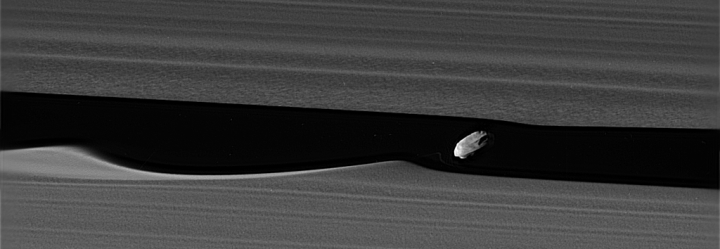
Cool image time! The image above, taken on January 16, 2017 during one of Cassini’s ring-grazing passes as it enters its last year at Saturn, has been reduced and cropped to post here. It shows clearly the waves caused by the gravity of the moon Daphnis as its travels within a gap in the rings of Saturn.
Daphnis (5 miles or 8 kilometers across) orbits within the 42-kilometer (26-mile) wide Keeler Gap. Cassini’s viewing angle causes the gap to appear narrower than it actually is, due to foreshorteneing. The little moon’s gravity raises waves in the edges of the gap in both the horizontal and vertical directions.
The image also shows many details about Daphnis itself, including a ridge at its equator that is thought to be an accumulation of material gathered from the rings.
The strangeness of Saturn’s rings is well illustrated here. Though made up of many solid particles, as a group the rings act almost like liquid. Note for example the ring on the far side of Daphnis. Its edge gets pulled out slightly as the moon goes by, but then the gravity of the rest of the ring pulls it back.
The universe is a wonderful place, as it is. No need to make up stuff (such as faces on Mars or fake civilizations on the Moon), as our imagination is probably insufficient to match the weirdness that is really out there.