
NASA practically eliminates any Starliner flights before ISS retires
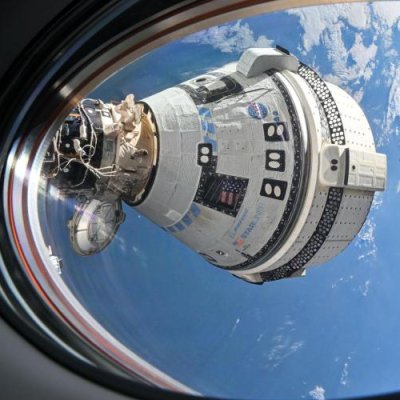
Starliner docked to ISS in 2024.
In a procurement announcement on May 18, 2026, NASA added another three to six crewed flights to ISS to its contract with SpaceX, covering all missions possible through 2030, which in turn practically eliminates the possibility it will buy any manned flights on Boeing’s Starliner capsule.
In a May 18 procurement filing, NASA announced its intent to add six post-certification missions, or PCMs, to SpaceX’s commercial crew contract on a sole-source basis. The agency would order up to three of those missions at the time it added them, formally starting preparations for them.
…Adding six missions to the contract would cover three years of ISS operations, at a rate of one mission every six months. With the currently contracted missions, running through Crew-14, flying through the fall of 2027, the extension would provide coverage through late 2030, when the ISS is slated for retirement. NASA has previously stated the last crewed mission would likely spend a year at the station.
Though it is not stated yet exactly how much SpaceX will earn with these additional missions, based on previous contracts the revenue will likely range from $1 to $2 billion. Overall, SpaceX has probably received somewhere between $4 to $6 billion additional earnings that was supposed to go to Boeing.
Instead, Boeing is now out of the picture entirely, though NASA is being very coy about saying so. It will earn nothing from Starliner, at least in connection with hauling crews or cargo to ISS. And because its contract with NASA was fixed price and the company could not meet its final milestones to get the bulk of its payments, it will have cost the company about $2 billion beyond what NASA had paid it.
It remains unknown whether Boeing wishes to continue the project. NASA officials had suggested earlier this year that it would buy an unmanned cargo mission to ISS to give the company a chance to prove the capsule and get it certified for manned missions. They have since backed off from that plan, scheduling no Boeing missions through the rest of this year.
Though things could still change, it appears Starliner is dead. In history books this Boeing project I think will become the poster boy for the failures of the older big space companies that used to dominate America’s aerospace industry. By the 21st century they didn’t know how to budget, had poor quality control resulting in unreliable products, and designed things that were badly conceived. The result was a bankrupt space industry that was only saved when new companies appeared willing to fill a need these older companies could not.

On Christmas Eve 1968 three Americans became the first humans to visit another world. What they did to celebrate was unexpected and profound, and will be remembered throughout all human history. Genesis: the Story of Apollo 8, Robert Zimmerman's classic history of humanity's first journey to another world, tells that story, and it is now available as both an ebook and an audiobook, both with a foreword by Valerie Anders and a new introduction by Robert Zimmerman.
The print edition can be purchased at Amazon or from any other book seller. If you want an autographed copy the price is $60 for the hardback and $45 for the paperback, plus $8 shipping for each. Go here for purchasing details. The ebook is available everywhere for $5.99 (before discount) at amazon, or direct from my ebook publisher, ebookit. If you buy it from ebookit you don't support the big tech companies and the author gets a bigger cut much sooner.
The audiobook is also available at all these vendors, and is also free with a 30-day trial membership to Audible.
"Not simply about one mission, [Genesis] is also the history of America's quest for the moon... Zimmerman has done a masterful job of tying disparate events together into a solid account of one of America's greatest human triumphs."--San Antonio Express-News
Schadenfreude. I bathe in it. For those of us betrayed by the modern MBA class of parasites who crippled Boeing, I only hope they are suffering financially as much as we suffered emotionally during our tenure.
Sadly, they are all probably doing just fine.
Correction: “The result was a bankrupt space industry that was only saved when new companies appeared willing to fill a need these older companies could not.”
Should read: “The result was a bankrupt space industry that was only saved when SpaceX appeared willing to fill a need these older companies could not.”
If you start to name the other companies in “new companies”, you will realize that this is hardly an exaggeration.
Patrick,
You are correct most likely. Engineers will be laid off instead.
Were it up to me, any suit who fires an engineer should suffer an amputated digit for each one.
It seems to work for the Yakuza.
Anyone would have been met with laughter, six and a half years ago, had they suggested that Boeing’s Starliner would be in this terrible shape. It is sad that back then Boeing and SpaceX were in a race as to which would be first to launch man to space commercially, but Boeing flubbed it, and six years later they still can’t recover. Six years. I just have to shake my head in disbelief.
It says much when the new company is about to launch an IPO to great fanfare and excitement, but no one thinks about the old company as a viable option, anymore.
How are the mighty fallen.
Rather than a feeling of schadenfreude, I cannot decide whether I am more disappointed that Boeing could not recover even after swapping out leaders or more disappointed that we have only one commercial manned spacecraft without a competitor.
Space is hard, but sixty years ago several of the old companies learned how to do it. Today it is the new companies that are beating the learning curve and the old companies have apparently fallen off the curve. When it came to a commercial crew program, NASA chose one wisely but chose the other poorly.
If the new leadership cannot make a difference, is it a leadership problem or are the Boeing workers no longer up to the task?
“ By the 21st century they didn’t know how to budget, had poor quality control resulting in unreliable products, and designed things that were badly conceived.”
Out of context, this sentence could also speak of the Russian space program, another mighty that hath fallen.
Space is hard, but it is not impossible. The mighty showed us the way, then they lost their way and stumbled.
SpaceX’s single most significant innovation is booster reusability, something that only one serious competitor has barely begun to demonstrate, over a decade later!
How can we account for this lack of industry responsiveness? It is especially startling when one considers that booster reuse does not involve any new technological breakthrough, but simply the consistent application of engineering toward a goal previously assumed to be unachievable!
Now, as a single competitor takes the first steps toward booster reusability, SpaceX leaps ahead toward full-vehicle reuse, and ultra-rapid reuse at that! I fear that NASA’s well-intentioned desire for multiple vendors for spaceflight is going to remain unrealized for some years!
To me, real competition means going your own way. Terran R a scaled down clone…same with Stoke’s Nova…Neutron with tweaks.
Kistler or Baikal would have been my guesses as to the first RLV. One rather simple, the other glide-back.
The problem is that investors only want the proven.
Originally that meant expendables
Now it means copying Elon.
In my book, nothing has changed….and this is why rocketry development for its own sake has to be a national priority right up there with defense.
Boeing shareholders are like a dog that won’t take his pill even when coated with wet food. That’s what a syringe is for—that is arsenal method.
People think my idea for a simpler Buran type Shuttle2 is outlandish, so they don’t invest. Self-fulfilling prophecy.
Since I have no initial money like Elon had, I don’t have the chance to prove critics wrong.
Blue Origin is Elon’s only real private competitor, and he just put Starship fins on a wider Falcon clone that is methalox.
Oh! How brave! (slow clap).
Boostback and twinjets look to endure until the Sun goes red giant.
Phooey
I think maybe what is missing is the Wall street, ivy league thinking – let’s improve this part or that – instead of trying to re-engineer stuff and iterate. Elon is the head of the company and enjoys engineering. The head of Boeing and other companies are accountants with MBAs (sorry – not).
You are in the right area as it is funding based, but is it(decisions at top)? Venture capital listens to new ideas. But apparently a large company cannot. This in my opinion is a failure of the middle management philosophy.
It is really a “…….failure of the older big space companies….” or it is a Boeing-specific failure since they’ve been having quality and design issued for several years now?
If one of the other older big space companies tried to build a “Starliner” would they have failed as badly also?
Edward,
I remember when the awards were announced that most people expected Boeing to handily beat SpaceX by years. When it finally flew people people aboard I similarly remember people insisting there were no real problems and anyone objecting was a poseur who knew nothing about space. Ah, hubris.
Ray van Dune,
Most of the incumbents never seriously believed it was possible, and they’re still full of people who think it’s a waste of time and money (I have personally encountered them). Thus, aside from Blue Origin, to get real competitors we needed people both with the new mindset that reuse was possible, and either the resources to start on their own or the moxie to raise the money, which meant they had to come from SpaceX and Blue, which they have. I expect within five years we will have at least six total competitors fielding reusable vehicles, and there may be more within another five years.
Jeff Wright,
I think you’re misunderstanding what competition is about–it isn’t attempting to do things in the most unique fashion possible. Far more often it’s taking an approach that’s proven to work (most things in life fail, be it corporations, social systems, or teenage boys asking teenage girls out on dates) and shifting a few details to do it cheaper, faster, or both. If I want to launch a satellite to orbit, my concern isn’t if a launch provider is doing something entirely different from everyone else; but rather: are their prices in my budget range? Is their vehicle reliable? Can my payload fit within the available mass/volume? I couldn’t care less if they use a boostback burn, winged recovery, storks, or teleportation–though the latter two would be nifty. Think from the perspective of someone buying a flight and you might see your understanding shift.
It sounds like you’re sticking your head in the sand to avoid looking at how the space sector has dramatically changed over the last two decades to justify more state control of spaceflight. This is a losing battle, Jeff; it’s not 1961 anymore, and it never will be again.
Previously you wanted to make other people’s tax dollars pay for your personal preferences, and now you’re talking about investors, which implies the private sector doing it. Which is it?
For now. There are roughly half a dozen more competing vehicles under development, and all should be available before 2030.
I know you’re being hyperbolic, but what matters to commerce is being able to do something repeatedly and affordably. Ideas don’t win out solely because of their appeal, but also how well they can be executed. Think of Nazi Germany in WWII: they leaned hard into the Wunderwaffe, which on paper should have smashed the Allies, while they got smashed by much larger quantities of far more prosaic vehicles pouring from American factories (yes, I know the Allies had many technical innovations of their own, such as the proximity fuze, but the ability to mass-produce rifles, tanks, planes, etc. was key to winning the war).
Saville,
Lockheed built Orion, and it took them most of two decades and tens of billions of dollars to do it, so if you approach this from an affordability and access perspective, they’ve failed about as badly as Boeing.
I think SpaceX has shown two techniques that Boeing/Lockheed/Blue Origin/ULA don’t seem to have followed. The first is that SpaceX is essentially vertically integrated, They make the Falcon 9, they make the Merlin engines they make the Draco thrusters and all of this ultimately is responsible through the SAME hierarchy. Some of Orion’s early problems came from integration problems with the booster and later problems from the thrusters, pieces which Boeing hadn’t made and clearly hadn’t properly specified to sufficient detail., This leads to the second issue. Old Space uses a variant of the Waterfall model of development with each piece developed to its specific requirements and THEN integration tested, This is a step which Boeing (and Lockheed in Orion) tended to short as there was no payout involved, they had met the poorly defined milestones and moved on. SpaceX thends to use a model more akin to the Agile software development model. The full deliverable is built each time increasing capability in iterative steps testing and verifying at each point. Starship/Super Heavy is an example of this with launches made when there were new capabilities or changes to test. This has the disadvantage that if your test items are VERY expensive (e.g. Orion) you need a massive budget to support the recursive development strategy. To some degree NASA did this in the Mercury/Gemini/Apollo days (although not without issues, CF Apollo 1 and Apollo 13) but the money is NOT there to do it that way now and honestly it is time for NASA to return to it’s NACA style roots. It became NASA as part of a strategy to bust the USSR on the rocks of a moon program (and redirect their money from some parts of their military) program. I do not think China will play that race game they seem to be working at a steady pace. Right now their notional heavy lift vehicle (Long March 9) is slated for 2033. It’s got a notional 150T to LEO so maybe 30-50 T to Lunar Transfer orbit? I think Apollo was like 45T to LTO, N1 was aimed at 35T to LTO (and that model left one cosmonaut on orbit and sent one down to the lunar surface and included two spacewalks to transfer the Lunar commander as there was no direct tunnel out of the Soyuz unlike the Apollo LEM pair.
Compare the old US space industry to the Ukrainian drone industry.
Somehow Ukraine built tested and flew their own cruse missile in under 5 years when our old companies can only do the same thing in decades. And only if payed billions first.
Could Boeing build a replacement of the Apollo capsule using all off the shelf components? I don’t think they would even try. They would engineer new bolts just to charge the Government a hundred hours of engineering and another thousand hours of testing.
That seems to pay off with X-37
Jeff Wright,
The X-37 was also a cost-plus project.
Boeing Phantom Works passed on XS-1. There was certainly no novel technical issue with XS-1 so the only conclusion one can come to is that Phantom Works simply didn’t know how to do XS-1 for the fixed amount of money on offer from DARPA.
As it turns out, the non-Phantom Works crew Boeing put to work on Starliner didn’t do enough better on the cost front and botched the engineering as well. Phantom Works would have blown the budget too – probably worse – but it would also have been more likely to produce a technically sound product. So it goes. Mojo, once lost, is devilishly hard to get back.
As Edward says “Space is hard”. This means that only the those who have the management and engineers that recognize AND can execute even get to start the race. Space requires unflinching realization that recognize the requirements, and institute the systems/infrastructure/process to meet the requirements.
Sixty years ago the goal was to beat the Soviets. Yes, we wanted to be pioneers. But also we, the public and the politicians, suddenly realized we were deeply behind in a very hard task and the spoils of that task were not just the claim and prestige of the first in exploration but also the advantages of LEO, geosynchronous and simply the “high ground”. It was imperative, it had to be done, it was existential, and the federal government was wiling to pay for it, support it in any way needed and provide the uneven playing field to assure success. The feds also held the entire market as the only customer – a monopsony (a word I learned here, thank you).
Forty years later, August 2006, (yeah I looked it up) the National Space Policy encouraged commercial space (SpaceX started earlier though -not resolved on that). NASA and the well cultured vendors that codeveloped the Mercury, Gemini, Apollo, Space Shuttle …etc and produced the infrastructure that started the exploitation of LEO et al were now going to be “freed” to produce at will. Hmmm. Getting a rhino that can charge hard and straight to transform into a cheetah is something that requires the same will that conquering space itself required. “But they had already done it” was not enough. They now had to do it without the built up infrastructure that NASA previously required. To win, these companies had to eschew the old heavily bureaucratic company that got them there and start with a fresh sheet of paper. Space was still hard. They should have been able to do this but cutting off your own hard won but now unnecessary parts was hard, too hard for them to achieve.
In the market we have now the requirements are still there, space is still hard and the ante for this selects only those with he rigor and the money to meet it.
The priority for rocketry should be a national priority and the best way to achieve it should be selected. Overwhelmingly the Capitalism In Space approach has shown to provide the fastest results, the most innovative designs, the most repeatable results and the lowest cost. All of these are most probably a national priority anent (another word from here, thanks) maintaining the US position in all aspects of space.
Chris: I took the liberty of providing a link to my policy paper, Capitalism in Space, where you cited the title in your comment.
Note that this 2017 paper is a free pdf download, and its policy recommendations remain quite valid, almost a decade later.
Nate P,
I remember when the awards were announced that most people expected Boeing to handily beat SpaceX by years.
Worse, in this case, “beat” very nearly meant “beat for a sole source contract to Boeing.” Because that is very, very nearly what happened in 2014.
Some here may recall Eric Berger publishing an excerpt of his book REENTRY on Ars Technica a couple years ago, describing the August 6, 2014 meeting at NASA to decide the outcome of the Commercial Crew CCTCap contract award. As Eric has Phil McAlister, the head of the Commercial Crew program, describe it, it took a careful and strenuous objection from him to avert a sole source award to Boeing’s Starliner, firing uncomfortable questions at senior NASA personnel around the table:
https://arstechnica.com/features/2024/09/in-the-room-where-it-happened-when-nasa-nearly-gave-boeing-all-the-crew-funding/
So when you think about the success Crew Dragon has had, and the dismal track record Starliner has had in trying to get operational, think some grateful thoughts in Phil McAlister’s direction. If it weren’t for him, International Space Station (and SpaceX) history would have been very, very different.
P.S. Not that he needs my endorsement, but I think Bob is very likely right that this is the end of the Starliner, certainly where Commercial Crew is concerned.
Notwithstanding that I lack any insight into Starliner’s thruster remediation work, I think politics is the only reason why NASA HQ is being cagey about its status. It’s not that Jared and his senior team don’t know that Starliner is a lemon, and a wholly unnecessary lemon at this point, but rather . . . .the fear of blowback on the Hill driven by belief he has closed the door to any competition with SpaceX for future traffic to ISS because of suspicions of his relationship with Elon Musk and SpaceX.
That fear might still result in a special cargo mission for Starliner as a sort of face-saving gesture for all involved – assuming Boeing even wants it. But with this contract, I think that possibility grows less and less likely with each passing day.
Richard M: Yup, we are in agreement on the reasons why NASA is being coy about this decision.
It also fits with Isaacman’s way of doing things. He cancels Gateway but says only that it is paused so as to not upset people. He ends Starliner but does it obliquely so as to not stir up trouble. He implies he will use the Artemis Accords to establish property rights at our lunar base, without saying so directly now so as to not annoy our international globalists. And he reshapes Artemis itself so as to make it easer down the road to eliminate SLS and Orion, without making the wrong people his enemies.
And by the way, feel free to endorse me anytime. I can always use the plugs. :)
Jeff Wright,
You wrote: “People think my idea for a simpler Buran type Shuttle2 is outlandish, so they don’t invest. Self-fulfilling prophecy.”
Buran was a copy of a disappointing vehicle that was inadequate for both NASA and Russia. Russia was satisfied with flying her usual rockets, because Buran just was not better. Otherwise, they would have used it. The Shuttle was retired because it, too, was not satisfactory. It took the government three decades to admit to it.
Investors don’t invest, because they want to choose winners, not losers. This is why SpaceX’s IPO is expected to be so big. Now that SpaceX is a winner, most investors want a piece of that action.
“To me, real competition means going your own way.”
Competition means innovating improvements in cost, availability (including quantity or speed), quality, service, or a combination. Combinations are difficult to achieve, but somehow SpaceX’s Falcons met all four. Well, that was not a high bar to hurdle. If there are no improvements, then there is no real competition.
____________
Nate P wrote: “When it finally flew people people aboard I similarly remember people insisting there were no real problems and anyone objecting was a poseur who knew nothing about space. Ah, hubris.
To be fair, NASA and Boeing greatly downplayed the problems, and many of us thought that the decision to not use Starliner for the return trip seemed extreme. Once we learned the truth, it was astonishing that the decision was not immediate.
“Most of the incumbents never seriously believed it was possible, and they’re still full of people who think it’s a waste of time and money (I have personally encountered them).”
The failure of the Space Shuttle to be an inexpensive, quickly reusable vehicle soured many in the industry. Before the Shuttle, it was thought that a Saturn V first stage (S-1C) could be redesigned with wings in order to return to launch site for reuse with another Shuttle launch, but after the Shuttle, reusability was seen by many as a pipe dream.
This failure was a traumatic event for those in the launch business.
___________
Chris wrote: “Overwhelmingly the Capitalism In Space approach has shown to provide the fastest results, the most innovative designs, the most repeatable results and the lowest cost.”
I think that the reason we get these results at such a rapid pace is the nature of free market capitalism. Free markets encourage competition, which requires each competitor to make an improvement or innovation that lures customers to his product, often enticing them away from someone else’s product. Enticement comes from innovating a cheaper product or a better quality one or having the availability that the customers desire. Better service can be an inducement to change vendors or suppliers. Once the customer has been seduced to a new supplier, the others innovate ways to entice him back. Innovations come quickly, each one improving the available products.
Under the capitalism approach, more customers come as the price drops, and each of these customers have their own requirements and demands that further refine the products that are available. Capitalist markets necessarily work to satisfy the customer, whereas central-controlled markets run to satisfy the controller, the manufacturer. No wonder the Capitalism In Space approach works so much better than the top-down government-run approach.
Hello Bob,
:)
“It also fits with Isaacman’s way of doing things.”
And if true, it’s possible to maneuver this in a way that costs NASA little to nothing. He could continue to allow Boeing to rework the Starliner thrusters, while putting off for a while any formal contract for this notional cargo flight. Boeing has already gotten all the milestone payments it can get without flying a successful crewed mission, so this work is all on their dime. NASA would only be out the man-hours for its Commercial Crew engineers sitting in on any review meetings or site visits. At some point Boeing might demand clarification, and then they just find a mutually face-saving way to announce the program is being terminated, and by that point everyone has moved on anyway, one hopes. Announce it on a Friday afternoon in the middle of some crisis or a World Series Game 7.
Personally I’d write the thing off now and just ship Calypso to the Smithsonian or some other willing aerospace museum. But if there’s another space company out there with the resources willing to try salvaging Starliner as a competing LEO taxi to commercial space stations in the 2030’s, I’d be happy to see them buy the program off Boeing at cut-rate and take a swing at it.
Ray Van Dune wrote: “SpaceX’s single most significant innovation is booster reusability, something that only one serious competitor has barely begun to demonstrate, over a decade later!”
Reusability may be their most significant technical innovation but I don’t think it’s the “secret sauce” to their success.
What I see in SpaceX that really sets it apart is their sheer ability to produce.
Note: I used Google AI search to find the following numbers. They look plausible, I’ve had good results with this kind of search, but I’d recheck them before using them in court!
My AI buddy tells me Blue Origin has produced “dozens” of BE-4s. Last year they announced that they delivered the 30th BE-4 to ULA.
That’s significant progress for BO but SpaceX has built over 1000 Merlins and over 750 Raptors!
Heck, SpaceX just dumped 39 Raptors in the ocean last week without batting an eyelash.
They are also pumping out Starships and boosters, just completed a brand new launch complex while refurbishing another ( and continuing to build one in Fla), running Falcon 9 ops like clockwork, engineering the lunar stuff…
This allows SpaceX to do more than a dozen disposable test flights, testing different ideas, materials and configurations under real flight conditions.
It’s somewhat ironic that SpaceX is the reuse pioneer, because it can probably build disposable rockets an a lower cost than anybody.
Though I have to give a shout-out to Rocket Lab that has built over 1000 Rutherford engines for Electron (granted it’s a much smaller engine).
To Edward,
I wish the Saturn Shuttle had been selected. Heck, SuperHeavy with similar treatment would not even need to relight or maneuver violently.
But Saturn’s father was V-2…which never sat right with some.
Shuttle’s father….was Super Hustler :)
@Deplorable Dave:
THANK YOU!! AND I hope the london crown is choking on those gold bars looted by kissinger in ’71, while CANCELLING all of the public Apollo moon missions. (remember, McCarthy was “neutralized” via the NYC rabbi’s chartering *OF* the “ABC” news network)
Some of us have ALL the receipts…(AFTER we were “quietly” jailed 17 times after developing the Motorola cable modem with Comcast in 1993, on an SGI ONYX box).
Once the clinton’s arrived, via GHW, it was pretty much over…….