
Mars rover update: January 18, 2017

Curiosity
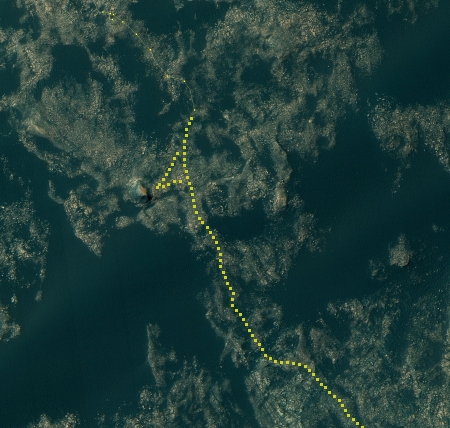
Curiosity's location, Sol 1582

For the overall context of Curiosity’s travels, see Pinpointing Curiosity’s location in Gale Crater.

In the past month, since my last rover update on December 22, 2016, Curiosity has begun moving again, carefully picking its way through the dune-filled flats in the foothills at the base of Mount Sharp. The route taken, shown on the image on the right, corresponds to the easternmost of the possible routes I noted in my November 14, 2016 update. This route is also the most direct route, which I think is smart considering that the rover’s life on Mars certainly uncertain and the higher they can climb the more geological information they will get.

I have also annotated the likely route into the near future, including a possible side trip to the base of the mesa up ahead. It appears to me that they are now a little more than halfway through the flats, with Mt. Sharp directly ahead, as shown by the panorama below, taken near the end of December. The goal is a canyon just out of view to the right of this panorama.
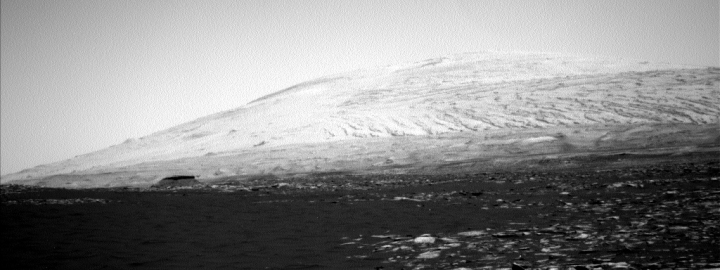
Looking at Mount Sharp

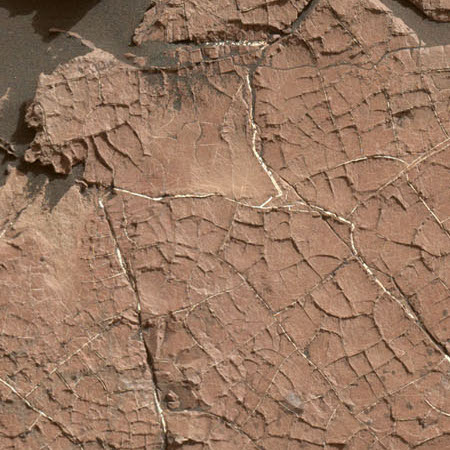
The flats the rover is presently traversing, and visible in the foreground of the panorama above, is strewn with dark sand that often piled into large sand dunes. Where the ground is exposed, it is made up of a scattering of pavement-like rocks. As noted in a press release yesterday, many of these flat rocks have polygonal cracks and boxwork similar to that seen in dried mud here on Earth, suggesting that this area was once wet and then dried. This geology helps confirm the theory of planetary scientists that Gale Crater was once filled with water that slowly evaporated away. As the rover climbs, it leaves the lakebed and begins to move through the lake’s various shores, each one older than the last.

Opportunity

For the overall context of Opportunity’s travels at Endeavour Crater, see Opportunity’s future travels on Mars.
» Read more
0 comments

18 Jewish organizations hit with second wave of bomb threats today

For the second time in two weeks a large number of Jewish institutions throughout the United States were hit with bomb threats today.

It seems to me that this is a form of anti-Semitic harassment. It also looks like the preliminaries to a real bomb attack. Make enough false bomb threats and people will start to not take them serious. That’s when you do it for real, without the warning.

1 comment

Akatsuki discovers a giant wave in Venus’ upper atmosphere

The Japanese Venus probe Akatsuki has discovered a giant persistent wave in the planet’s upper atmosphere that almost spans its entire face.

This week, researchers from Japan Aerospace Exploration Agency (JAXA) published infrared and ultraviolet images of Venus, taken by their Akatsuki orbiter between December 7 and 11, 2015, in Nature Geoscience. Akatsuki’s pictures reveal a curved region roughly 6000 miles long (Venus’ entire diameter is just around 7,500 miles) with a higher temperature than the surrounding atmosphere. How did the curved “smile” fight those high winds to remain in place for all four days of observation?

The answer may lie in a phenomenon very familiar to Earthlings. Gravity waves, not to be confused with gravitational waves, form when gravity pushes and pulls at the seam between two different materials. Waves on the ocean are perhaps the most obvious example—they exist where the sea meets the sky. But gravity waves also show up in the air, where wind flows over mountains to form waves that undulate upward through different layers of the atmosphere.

The mystery here is that scientists do not have a mountain chain that could have caused this giant Venusian wave. Moreover, it was there in 2015 but they haven’t seen it since.

0 comments

Cause of vision problems in space pinpointed?

New research suggests that scientists have pinpointed the cause of the vision problems astronauts experience from long term weightlessness.

The new research showed that intracranial pressure in zero-gravity conditions, such as exists in space, is higher than when people are standing or sitting on Earth, but lower than when people are sleeping on Earth. The researcher’s finding suggests that the constancy of pressure on the back of the eye causes the vision problems astronauts experience over time.

More important, the research has also suggested a possible cure.

“The information from these studies is already leading to novel partnerships with companies to develop tools to simulate the upright posture in space while astronauts sleep, thereby normalizing the circadian variability in intracranial pressure, and hopefully eliminating the remodeling behind the eye,” said Dr. Levine, who holds the Distinguished Professorship in Exercise Sciences.

The researchers have continued studying whether it is possible to lower intracranial pressure by means of a vacuum device that pulls blood away from the head. They previously showed that a negative pressure box that snuggly fits the lower body can lower intracranial pressure when applied for 20-minute periods. They will soon be testing the effect of the lower body negative pressure device on eye remodeling when negative pressure is applied for eight-hour periods. “Astronauts are basically supine the entire time they are in space. The idea is that the astronauts would wear negative pressure clothing or a negative pressure device while they sleep, creating lower intracranial pressure for part of each 24 hours,” said first author Dr. Justin Lawley, Instructor in Internal Medicine at UT Southwestern and a researcher at the IEEM.

4 comments

ELT construction moves forward

The European Southern Observatory (ESO) today signed contracts for the construction of the mirrors and sensor for its Extremely Large Telescope (ELT).

At a ceremony today at ESO’s Headquarters four contracts were signed for major components of the Extremely Large Telescope (ELT) that ESO is building. These were for: the casting of the telescope’s giant secondary and tertiary mirrors, awarded to SCHOTT; the supply of mirror cells to support these two mirrors, awarded to the SENER Group; and the supply of the edge sensors that form a vital part of the ELT’s huge segmented primary mirror control system, awarded to the FAMES consortium. The secondary mirror will be largest ever employed on a telescope and the largest convex mirror ever produced.

The construction of the 39-metre ELT, the largest optical/near-infrared telescope in the world, is moving forward. The giant telescope employs a complex five-mirror optical system that has never been used before and requires optical and mechanical elements that stretch modern technology to its limits.

Meanwhile it remains unclear when and where the Thirty Meter Telescope (TMT) will be built.

0 comments

SpaceX prepares used 1st stage for February launch

The competition heats up: Even as SpaceX moves forward on an intense launch schedule, with launches planned for January 26 and February 8, it has begun preparations for a late February commercial launch that will be the first to reuse a first stage.

The first stage assigned to SES 10’s launch first flew April 8, 2016, with a Dragon supply ship on a logistics launch to the International Space Station. After detaching from the Falcon 9’s second stage, which continued into orbit, the 15-story first stage booster descended to a vertical landing on SpaceX’s offshore platform a few minutes after liftoff, making the first time the company recovered a rocket intact at sea.

The landing on SpaceX’s barge, or drone ship, last April came four months after the first-ever touchdown of a Falcon 9 first stage on land at Cape Canaveral. That vehicle is now on display outside SpaceX’s headquarters in Hawthorne, California.

This pace is calling for a launch every two weeks. It will spectacular if SpaceX can keep that up, but such a pace is not really unprecedented. The Soviets at their height managed it at times quite successfully.

32 comments

Boeing obtains available seats on Soyuz as result of Sea Launch settlement

As part of Boeing’s settlement with Russia over the break-up of their Sea Launch partnership, the company has obtained rights to several manned Soyuz seats that are available because the Russians have cut back on the number of astronauts they are flying to ISS.

In turn, Boeing is offering these seats to NASA.

[John Elbon, vice president and general manager of space exploration at Boeing] said he expects NASA to make enter into negotiations with Boeing about the 2017 and 2018 seats shortly after a Jan. 27 deadline for companies to respond to the sources sought statement, a requirement when a government agency proposes a sole-source procurement. “Assuming that goes well, I think we would sit down and, in relatively short order, negotiate the details of this kind of arrangement,” he said.

He didn’t specify how much Boeing was proposing to charge NASA for the seats. The agency announced an agreement with Roscosmos in August 2015 for six Soyuz seats in 2018 at a total cost of $490 million, or $81.7 million per seat. “It’s a good value for NASA and the taxpayer,” Elbon said of Boeing’s proposed deal with NASA. “We wouldn’t ask them to pay more than they would have been paying before.”

What is happening here is that Boeing is trying to use these Soyuz seats as a way to recoup its losses from Sea Launch. The problem is that NASA doesn’t really need the manned flights in 2017 and 2018. They might need them in 2019, should the manned capsules that SpaceX and Boeing are building get delayed, but I am not sure that this deal will allow them to be used at that time.

1 comment

Curiosity spots cracks formed from drying mud

mud cracks on Mars?

As Curiosity moves across the dust-shrewn dune-filled flats at the base of Mt. Sharp it has recently taken images of surface rocks that have cracks resembling those found from drying mud.

Scientists used NASA’s Curiosity Mars rover in recent weeks to examine slabs of rock cross-hatched with shallow ridges that likely originated as cracks in drying mud. “Mud cracks are the most likely scenario here,” said Curiosity science team member Nathan Stein. He is a graduate student at Caltech in Pasadena, California, who led the investigation of a site called “Old Soaker,” on lower Mount Sharp, Mars.

If this interpretation holds up, these would be the first mud cracks — technically called desiccation cracks — confirmed by the Curiosity mission. They would be evidence that the ancient era when these sediments were deposited included some drying after wetter conditions. Curiosity has found evidence of ancient lakes in older, lower-lying rock layers and also in younger mudstone that is above Old Soaker.

The rover is no longer on the floor the crater, but in the foothills at the base of Mt. Sharp. Thus, what we are likely looking at is evidence of the slow disappearance of the giant lake that scientists think once filled Gale Crater. These mud cracks suggest that the rover is now moving up out of the lake and through its margins.

I plan to do a rover update for both Curiosity and Opportunity tomorrow, so stay tuned.

0 comments
1 153 154 155 156 157 164