
Patricia Janečková: Johann Strauss’ Frühlingsstimmen
An evening pause: Performed live January 7, 2017 in Ostava, Czech Republic.
Hat tip Edward Thelen.
An evening pause: Performed live January 7, 2017 in Ostava, Czech Republic.
Hat tip Edward Thelen.
Using archive data produced by the Wide-field Infrared Explorer telescope (WISE, renamed NEOWISE) astronomers have been able to estimate the surface properties of 122 small asteroids located in the asteroid belt.
“Using archived data from the NEOWISE mission and our previously derived shape models, we were able to create highly detailed thermophysical models of 122 main belt asteroids,” said Hanuš, lead author of the paper. “We now have a better idea of the properties of the surface regolith and show that small asteroids, as well as fast rotating asteroids, have little, if any, dust covering their surfaces.” (Regolith is the term for the broken rocks and dust on the surface.)
It could be difficult for fast-rotating asteroids to retain very fine regolith grains because their low gravity and high spin rates tend to fling small particles off their surfaces and into space. Also, it could be that fast-rotating asteroids do not experience large temperature changes because the sun’s rays are more rapidly distributed across their surfaces. That would reduce or prevent the thermal cracking of an asteroid’s surface material that could cause the generation of fine grains of regolith. [emphasis mine]
If this conclusion holds, it means that mining these asteroids might be much easier. Dust can be a big problem, as it can clog up equipment and interfere with operations. It also acts to hide the underlying material, making it harder to find the good stuff.
Theft by government: U.S. Customs stole $58,000 from a man traveling to Albania, his life savings, though they charged him with no crime.
“This is to notify you that Homeland Security Investigations (HSI) seized the property described below at Cleveland, OH on October 24, 2017: $57,330 in U.S. Currency,” the notice states. “Enforcement activity indicates that the currency was involved in a smuggling/drug trafficking/money laundering operation.”
The first thing the Kazazis noticed was that the dollar amount listed was $770 less than the amount that Kazazi said he took with him. The family said that the cash was all in $100 bills, making it impossible for it to add up to $57,330.
Customs might claim this had to do with “smuggling/drug trafficking/money laundering” but they found no evidence of such when they strip-searched the man, and have followed up with no charges. And that $770 of the cash that appears missing suggests strongly that several Customs agents pocketed the difference, a nice illegal bonus for these despicable thieves.
Civil forfeiture on its face violates the Fifth Amendment of the Bill of Rights, which clearly states that citizens are not to “be deprived of life, liberty, or property, without due process of law; nor shall private property be taken for public use, without just compensation.” These Customs agents, the Custom managers, and everyone else involved with this crime should be fired immediately.
It won’t happen, unfortunately. Our corrupt federal government no longer follows the Constitution. It follows its own corrupt power games, for its own benefit. And the people who should act to stop this, our elected officials, are part of the game.
An analysis of the physical characteristics of astronauts who develop vision problems after long missions in weightlessness has found that heavier body weight increases the risk.
The research team examined data collected by NASA from astronauts who had made long-duration space flights (averaging 165 days). The data included the astronauts’ sex and pre-flight height, weight, waist and chest size, as well as information about post-flight eye changes. The findings were related to body weight, not body mass index. They found that none of the female astronauts analyzed—who weighed less than the males—returned to Earth with symptoms of SANS. To rule out sex differences as a cause for the disparity, the researchers also examined the men’s data separately. “Pre-flight weight, waist circumference and chest circumference were all significantly greater in those who developed either disc edema or choroidal folds. This was still true when only the male cohort was analyzed,” the researchers wrote. “The results from this study show a strong relationship between body weight and the development of ocular changes in space.”
That such small differences in weight can make such a difference suggests again that adding just a small amount of artificial gravity, rather than 1g, might mitigate these issues. No tests of this however have ever been done, mostly because the engineering is complex and expensive. For humans we would need to build a vessel large enough that any rotation would be unnoticed. If the vessel is small it must rotate faster and the body’s inner ear gets confused. However, if we only need to simulate a tiny amount of gravity the spin rate can be reduced, simplifying the engineering.
We’re here to help you! Proposed new FCC regulations on the licensing of smallsats would raise the licensing cost for student-built cubesats so much that universities would likely have to shut down the programs.
In a move that threatens U.S. education in science, technology, engineering and math, and could have repercussions throughout the country’s aerospace industry, the FCC is proposing regulations that may license some educational satellite programs as commercial enterprises. That could force schools to pay a US$135,350 annual fee – plus a $30,000 application fee for the first year – to get the federal license required for a U.S. organization to operate satellite communications.
It would be a dramatic increase in costs. The most common type of small satellite used in education is the U.S.-developed CubeSat. Each is about 10 inches on a side and weighs 2 or 3 pounds. A working CubeSat that can take pictures of the Earth can be developed for only $5,000 in parts. They’re assembled by volunteer students and launched by NASA at no charge to the school or college. Currently, most missions pay under $100 to the FCC for an experimental license, as well as several hundred dollars to the International Telecommunications Union, which coordinates satellite positions and frequencies. [emphasis mine]
If these new and very high licensing fees are correct I find them shocking. As noted in the quote, building a cubesat costs practically nothing, only about $5,000. The new fees thus add gigantic costs to the satellite’s development, and could literally wipe the market out entirely. They certainly will end most university programs that have students build cubesats as a first step towards learning how to build satellites.
These new regulations appear to be part of the Trump administration’s effort to streamline and update the regulatory process for commercial space. It also appears that the FCC has fumbled badly here in its part of this process.
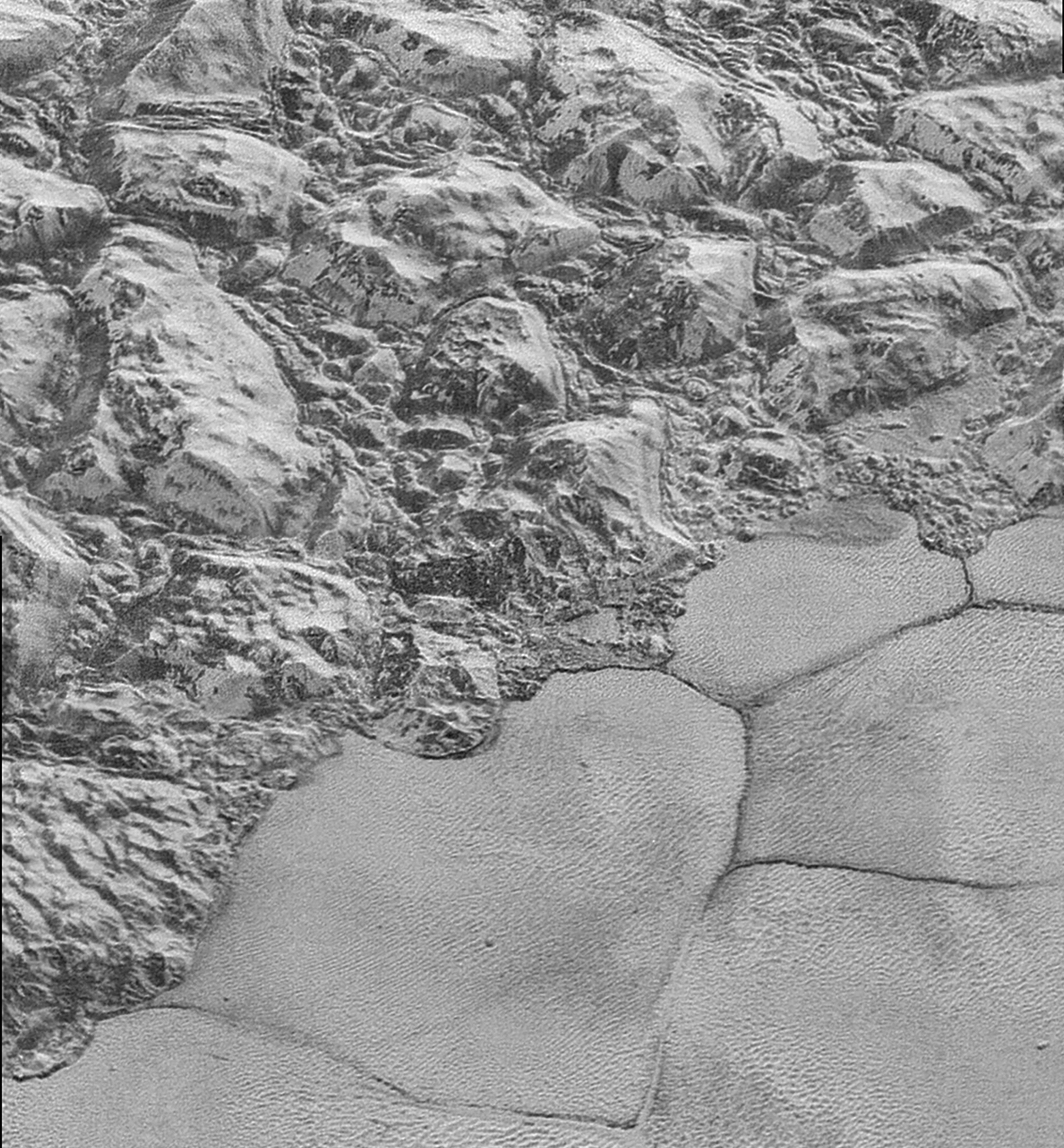
Cool image time! Scientists reviewing images taken by New Horizons when it flew past Pluto in 2015 have discovered what appear to be dunes of methane on the icepack of nitrogen of Sputnik Planitia. The image on the right, cropped to post here, shows these dunes. You can see the full image if you click on it.
Following spatial analysis of the dunes and nearby wind streaks on the planet’s surface, as well as spectral and numerical modelling, scientists believe that sublimation (which converts solid nitrogen directly into a gas) results in sand-sized grains of methane being released into the environment.
These are then transported by Pluto’s moderate winds (which can reach between 30 and 40 kmh), with the border of the ice plain and mountain range providing the perfect location for such regular surface formations to appear.
The scientists also believe the undisturbed morphology of the dunes and their relationship with the underlying glacial ice suggests the features are likely to have been formed within the last 500,000 years, and possibly much more recently.
There remains a lot of uncertainty here. The features do look like dunes in the image, but it is also possible that other phenomenon not yet understood could have caused this pattern on the icepack surface. Also, the resolution of the image is not sufficient to really see detail at this level. A different process on the surface could be fooling our eyes.
Nonetheless, the scientists hypothesis makes sense, and fits the data known. It also demonstrates again that, even billions of miles from the Sun, in as alien an environment we can imagine, the planet Pluto is an active and complex place.