Customs steals $58K, a man’s life savings

Theft by government: U.S. Customs stole $58,000 from a man traveling to Albania, his life savings, though they charged him with no crime.

“This is to notify you that Homeland Security Investigations (HSI) seized the property described below at Cleveland, OH on October 24, 2017: $57,330 in U.S. Currency,” the notice states. “Enforcement activity indicates that the currency was involved in a smuggling/drug trafficking/money laundering operation.”

The first thing the Kazazis noticed was that the dollar amount listed was $770 less than the amount that Kazazi said he took with him. The family said that the cash was all in $100 bills, making it impossible for it to add up to $57,330.

Customs might claim this had to do with “smuggling/drug trafficking/money laundering” but they found no evidence of such when they strip-searched the man, and have followed up with no charges. And that $770 of the cash that appears missing suggests strongly that several Customs agents pocketed the difference, a nice illegal bonus for these despicable thieves.

Civil forfeiture on its face violates the Fifth Amendment of the Bill of Rights, which clearly states that citizens are not to “be deprived of life, liberty, or property, without due process of law; nor shall private property be taken for public use, without just compensation.” These Customs agents, the Custom managers, and everyone else involved with this crime should be fired immediately.

It won’t happen, unfortunately. Our corrupt federal government no longer follows the Constitution. It follows its own corrupt power games, for its own benefit. And the people who should act to stop this, our elected officials, are part of the game.

5 comments

Heavier astronauts more likely to have vision issues in zero-G

An analysis of the physical characteristics of astronauts who develop vision problems after long missions in weightlessness has found that heavier body weight increases the risk.

The research team examined data collected by NASA from astronauts who had made long-duration space flights (averaging 165 days). The data included the astronauts’ sex and pre-flight height, weight, waist and chest size, as well as information about post-flight eye changes. The findings were related to body weight, not body mass index. They found that none of the female astronauts analyzed—who weighed less than the males—returned to Earth with symptoms of SANS. To rule out sex differences as a cause for the disparity, the researchers also examined the men’s data separately. “Pre-flight weight, waist circumference and chest circumference were all significantly greater in those who developed either disc edema or choroidal folds. This was still true when only the male cohort was analyzed,” the researchers wrote. “The results from this study show a strong relationship between body weight and the development of ocular changes in space.”

That such small differences in weight can make such a difference suggests again that adding just a small amount of artificial gravity, rather than 1g, might mitigate these issues. No tests of this however have ever been done, mostly because the engineering is complex and expensive. For humans we would need to build a vessel large enough that any rotation would be unnoticed. If the vessel is small it must rotate faster and the body’s inner ear gets confused. However, if we only need to simulate a tiny amount of gravity the spin rate can be reduced, simplifying the engineering.

1 comment

Proposed new FCC regulations would shut out student cubesats

We’re here to help you! Proposed new FCC regulations on the licensing of smallsats would raise the licensing cost for student-built cubesats so much that universities would likely have to shut down the programs.

In a move that threatens U.S. education in science, technology, engineering and math, and could have repercussions throughout the country’s aerospace industry, the FCC is proposing regulations that may license some educational satellite programs as commercial enterprises. That could force schools to pay a US$135,350 annual fee – plus a $30,000 application fee for the first year – to get the federal license required for a U.S. organization to operate satellite communications.

It would be a dramatic increase in costs. The most common type of small satellite used in education is the U.S.-developed CubeSat. Each is about 10 inches on a side and weighs 2 or 3 pounds. A working CubeSat that can take pictures of the Earth can be developed for only $5,000 in parts. They’re assembled by volunteer students and launched by NASA at no charge to the school or college. Currently, most missions pay under $100 to the FCC for an experimental license, as well as several hundred dollars to the International Telecommunications Union, which coordinates satellite positions and frequencies. [emphasis mine]

If these new and very high licensing fees are correct I find them shocking. As noted in the quote, building a cubesat costs practically nothing, only about $5,000. The new fees thus add gigantic costs to the satellite’s development, and could literally wipe the market out entirely. They certainly will end most university programs that have students build cubesats as a first step towards learning how to build satellites.

These new regulations appear to be part of the Trump administration’s effort to streamline and update the regulatory process for commercial space. It also appears that the FCC has fumbled badly here in its part of this process.

2 comments

Dunes on Pluto?

Dunes on Pluto

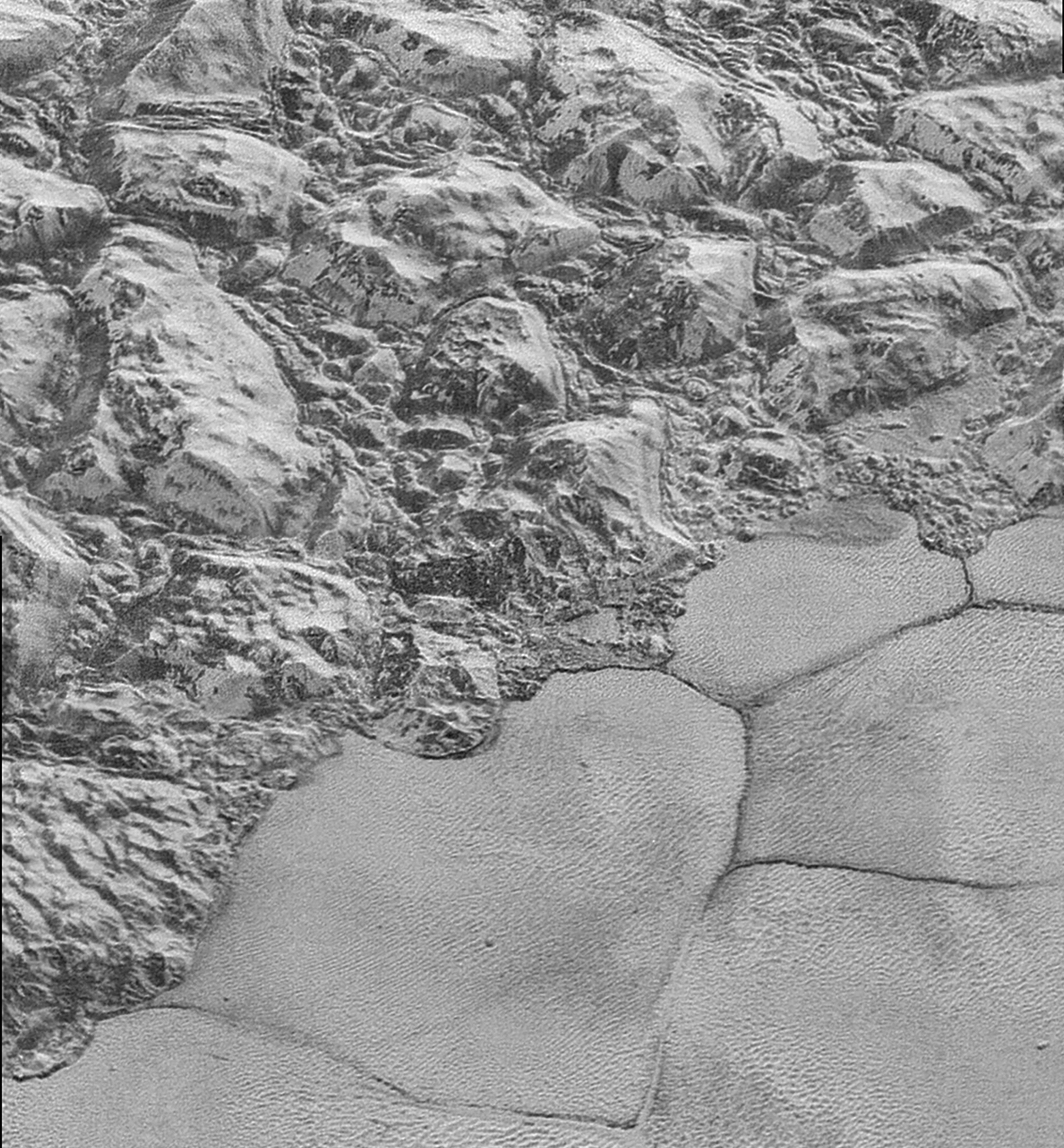
Cool image time! Scientists reviewing images taken by New Horizons when it flew past Pluto in 2015 have discovered what appear to be dunes of methane on the icepack of nitrogen of Sputnik Planitia. The image on the right, cropped to post here, shows these dunes. You can see the full image if you click on it.

Following spatial analysis of the dunes and nearby wind streaks on the planet’s surface, as well as spectral and numerical modelling, scientists believe that sublimation (which converts solid nitrogen directly into a gas) results in sand-sized grains of methane being released into the environment.

These are then transported by Pluto’s moderate winds (which can reach between 30 and 40 kmh), with the border of the ice plain and mountain range providing the perfect location for such regular surface formations to appear.

The scientists also believe the undisturbed morphology of the dunes and their relationship with the underlying glacial ice suggests the features are likely to have been formed within the last 500,000 years, and possibly much more recently.

There remains a lot of uncertainty here. The features do look like dunes in the image, but it is also possible that other phenomenon not yet understood could have caused this pattern on the icepack surface. Also, the resolution of the image is not sufficient to really see detail at this level. A different process on the surface could be fooling our eyes.

Nonetheless, the scientists hypothesis makes sense, and fits the data known. It also demonstrates again that, even billions of miles from the Sun, in as alien an environment we can imagine, the planet Pluto is an active and complex place.

0 comments

Astronomers identify giant exoplanets that might harbor habitable moons

Worlds without end: In reviewing the known exoplanets astronomers have identified more than a hundred giant exoplanets located in the habitable zone that might harbor habitable moons.

The researchers identified 121 giant planets that have orbits within the habitable zones of their stars. At more than three times the radii of the Earth, these gaseous planets are less common than terrestrial planets, but each is expected to host several large moons.

Scientists have speculated that exomoons might provide a favorable environment for life, perhaps even better than Earth. That’s because they receive energy not only from their star, but also from radiation reflected from their planet. Until now, no exomoons have been confirmed.

Using this new database scientists will optimize future instruments on both the ground and in space to look for and study the moons circling these exoplanets.

0 comments

Radio telescope in Greenland sees first “light”

Astronomers have successfully initiated operations of a new radio telescope dish, the first ever located in Greenland.

The Greenland Telescope is a 12-meter radio antenna that was originally built as a prototype for the Atacama Large Millimeter/submillimeter Array (ALMA) North America. Once ALMA was operational in Chile, the telescope was repurposed to Greenland to take advantage of the near-ideal conditions of the Arctic to study the Universe at specific radio frequencies, collaborating with the National Radio Astronomy Observatory (NRAO) and MIT Haystack Observatory.

ASIAA led the effort to refurbish and rebuild the antenna to prepare it for the cold climate of Greenland’s ice sheet. In 2016, the telescope was shipped to the Thule Air Base in Greenland, 1,200 km inside the Arctic Circle, where it was reassembled at this coastal site. ASIAA also built receivers for the antenna. “It is extremely challenging to quickly and successfully set up a new telescope in such a cold environment, where temperatures fall below -30 degrees Celsius,” said Ming-Tang Chen from ASIAA and the Greenland Telescope project manager. “This is now one of the closest radio telescopes to the North Pole.”

They have also linked this radio telescope to others across the globe, helping to increase the resolution of any data these radio telescopes gather as a unit.

1 comment

Max Planck scientists criticize institute for lack of support over animal rights

The coming dark age: The scientists at the Max Planck Society in Germany have written two letters criticizing the institute for its lack of support and its willingness to bow to animal rights protests.

It appears the scientists have followed all the rules, and have acted reasonably, but the longtime director of one of the Society’s main research divisions, Nikos Logothetis, was still indicted for the death of one monkey.

The struggle began in September 2014, when a German television channel aired footage taken by an undercover animal-welfare activist who had infiltrated Logothetis’s lab, purporting to show mistreatment of research monkeys.

Death threats and insults to Logothetis and his family followed — and in 2015, Logothetis decided to wind down his primate lab and replace it with a rodent facility. Events came to a head on 20 February this year, when Logothetis was indicted for allegedly violating animal-protection laws, after an animal-welfare group made complaints to police on the basis of the 2014 footage. Logothetis denies the charges. A trial date has not yet been set.

…The indictment follows contradictory judgements about Logothetis and his work at the MPI-Biocyb. Immediately after the September 2014 documentary was broadcast, an external specialist appointed by the MPS leadership found no welfare violations at MPI-Biocyb. But two months later, the German Animal Welfare Federation, a non-profit organization in Bonn, filed multiple complaints with police about animals at the institute.

In August last year, a local judge in Tubingen dismissed all but one charge; for that charge, allegedly delaying euthanasia in three rhesus monkeys, the judge offered an out-of-court settlement, which Logothetis accepted. But in October, prosecutors in the state capital, Stuttgart, overturned the settlement decision. They pursued the delayed-euthanasia case against Logothetis and two other staff members, who have not been publicly named, leading to their indictment in February.

Logothetis says that the decisions about whether and when to kill the monkeys, which contracted infections after surgery, were appropriate and complied with the law. Veterinary staff attempted to treat the infections, he says, and two of the monkeys recovered. The third was humanely killed when staff decided that it was unlikely to recover.

Despite this history, the Society’s management has removed Logothetis as director. It has also made the research division he headed persona non grata, causing harm to the other researchers who work there.

In response the scientists have submitted two different letters lambasting the actions of the Society, signed by dozens of its scientists.

MPI-Biocyb scientists take issue with the MPS’s decision to impose these sanctions on Logothetis before the case is considered by a court. “We are very upset that the society is failing to uphold the principle of innocence before guilt is proven,” says neuroscientist Hamid Noori, a junior group leader at MPI-Biocyb. “With this attitude, any activist can attack us freely, without consequence.”

Noori is one of four MPI-Biocyb scientists who spoke to Nature about the situation. Their criticisms are echoed in the two letters: the first, sent in December, was signed by 54 scientists; the second, sent in February, was signed by 94, a majority of those who work with animals at MPI-Biocyb, says Noori. The February letter describes “an extremely distressful situation” that “has seriously compromised our working conditions”.

In other words, even though the evidence strongly indicates that Logothetis followed the rules and did not act with malice towards the primates in his care, the Society has caved to the animal rights protesters.

This is the present, and the future. Someone with an ax to grind, usually from the left, will make a complaint, and everyone will bow to them out of cowardly fear, no matter how baseless or unproven the charge. Science research will stop, free speech will end, and an oppressive shadow will fall upon western civilization.

2 comments

Why you got Trump, part 2,398,105

Link here. The author focuses on the “Never Trump” wing of the Republican Party, individuals who have completely abandoned any pretense that they stand for conservative values in their no-holds-barred opposition to Trump, even when he does things they should like.

This quote illustrates however why Trump won, and continues to be popular with the general public:

[T]he main point these [Never Trumpers] whom we have no choice but to refer to as former conservatives miss is that in our political system the choice is still binary. Other conservatives may not like Trump but they understand that the voters preferred him in no small measure because they were sick of the clubby elitism that characterizes the anti-Trump alliance.

Moreover, they understand that, thanks to Trump’s unlikely victory, the choice isn’t between a conservatism tainted by association with Trump and one that isn’t. Rather the choice is between a Trump-led Republican Party that is championing the same issues that the pre-Trump GOP supported and liberals who want a return to the Obama era of high taxes and appeasement of Iran to mention just two key issues on which many Never Trumpers have abandoned their principles. [emphasis mine]

It is that clubby elitism of Washington — and the bankrupt incompetent government it has given us — that most offends the voters who went for Trump. Trump’s actions since his elections, though imperfect for sure, have confirmed the wisdom of this choice. It has also revealed the fake conservatives in the Republican Party who clearly prefer that clubby elitism above any effort that might try to fix the problem.

20 comments

New impact craters on Mars

New impact crater on Mars

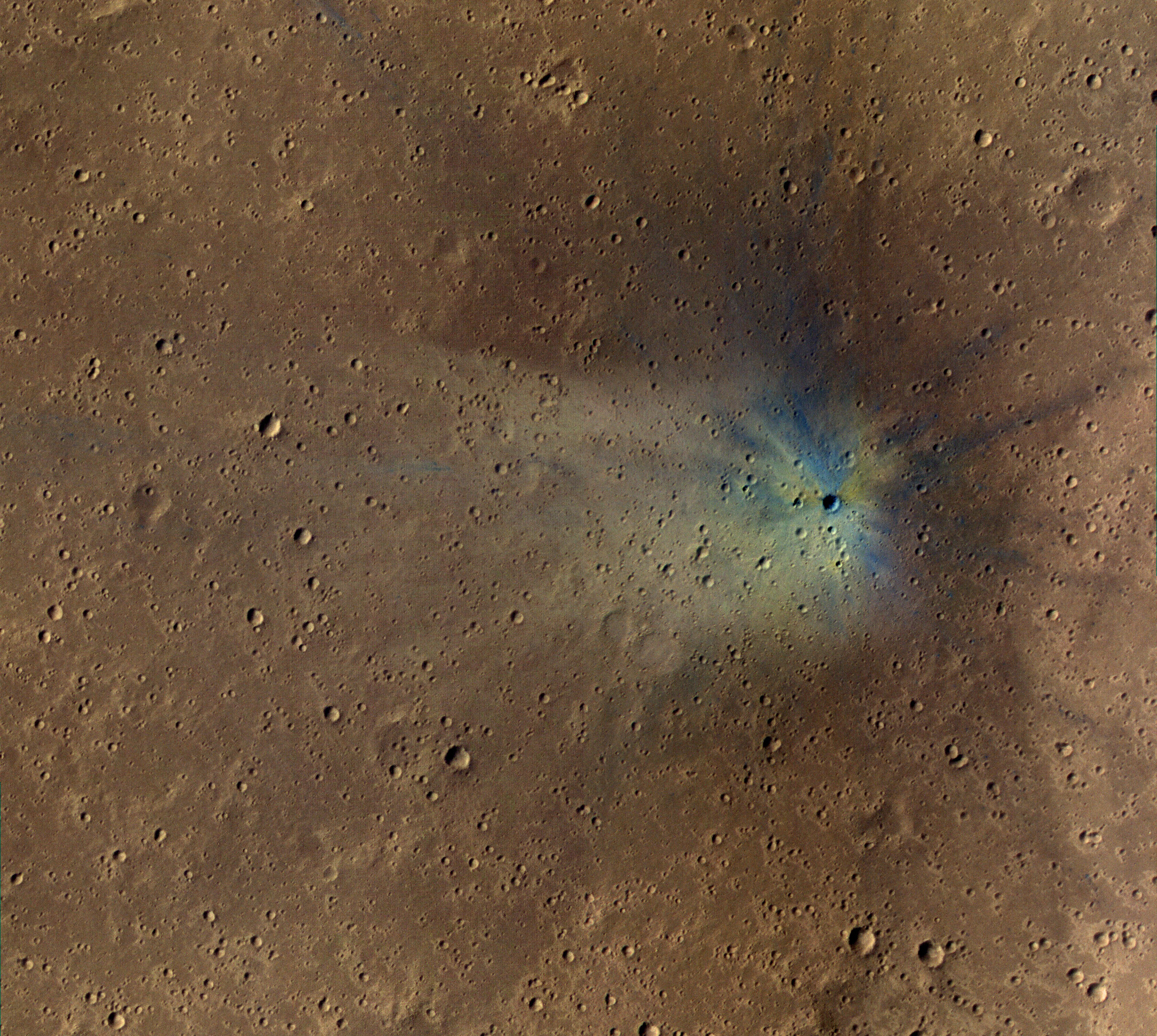
Cool image time! The high resolution camera on Mars Reconnaissance Orbiter (MRO) keeps finding recent impact craters, all of which the science team try to monitor periodically to see how the surface evolves over time. The image on the right, cropped to post here, is one such crater, the image taken in January 2018 and released with as one of the captioned images from this month’s image catalog release. If you click on the image you can see the full picture.

What is notable about this particular impact are the colors.

The new crater and its ejecta have distinctive color patterns. Once the colors have faded in a few decades, this new crater will still be distinctive compared to the secondaries by having a deeper cavity compared to its diameter.

Those colors of course have importance to researchers, as they reveal the different materials found beneath the surface at this location, normally hidden by surface dust and debris.

Nor is this the only impact crater revealed in this month’s image release. Earlier in the month the science team highlighted an image that captured two small impacts. While all three of these impacts are in the general region called Elysium Planitia, they are not particularly close to each other. They are however surrounding the landing site for the InSight lander now heading to Mars. This last link takes you to my January 28, 2018 post detailing some information about this landing site, and also includes another recent crater impact, found at the center of the landing zone.

It is not clear if these recent impacts are related to each other. As noted by Alfred McEwen of the science team, “Often, a bolide breaks apart in the atmosphere and makes a tight cluster of new craters.” It could be that all these recent impacts came from the same bolide, which is why there appear to be a surplus of them in Elysium Planitia.

Then again, our surface survey of Mars is very incomplete. These impacts could simply be marking the normal impact rate for Mars. We will not know until we have completed a detail survey of all recent impacts on Mars, and have been able to date them all.

Who wants to do it?

2 comments
1 93 94 95 96 97 155