Chinese scientists plant seeds bred on Tiangong space station

The new colonial movement: Chinese scientists have now planted on Earth some of the 12,000 seeds that were bred on China’s Tiangong space station for six months and brought back to Earth in April.

The seeds, including alfalfa, oats and fungi, were selected by multiple research institutions last year. They were brought back to Earth by the Shenzhou-13 on April 16. Space breeding refers to the process of exposing seeds to cosmic radiation and microgravity during a spaceflight mission to mutate seed genes and then send them back to Earth to generate new species.

The goal is to see which seeds survive best in the harsh environment of space, which would thus make them better candidates for transport to other planets for planting.

While some of the results of this research will be published, much will not. China tends to keep what it learns close to the vest.

3 comments

U.S. and Japan agree to send Japanese astronaut to Gateway and the Moon

In a deal negotiated for signing this week while President Biden was in Japan, the United States and Japan have agreed to send a Japanese astronaut on a mission to the Lunar Gateway station, as well as begin planning for a Japanese astronaut to land on the Moon, all part of the Artemis program.

The agreement also confirmed the exchange of material from the countries’ two sample return asteroid missions, Hayabusa-2 and OSIRIS-REx.

None of this is a surprise. Not only was Japan one of the first to sign the Artemis Accords, Japanese subcontractors are already providing some of the life support equipment for Gateway.

2 comments

Finding ways to clean ISS and future interplanetary spaceships

Fungi on ISS

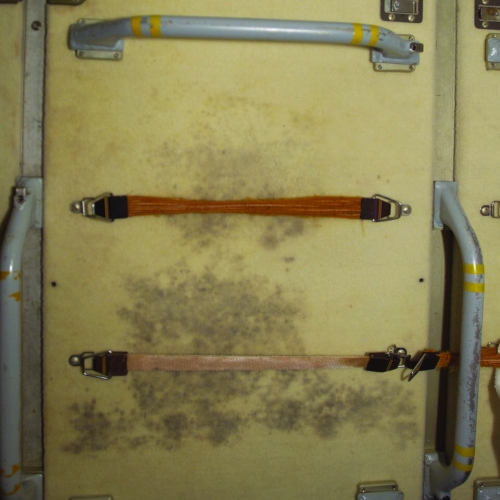
According to multiple studies (see here, here, and here), a whole range of microorganisms, from bacteria (some dangerous) to fungi, have been found prospering on ISS.

The photo to the right shows a typical example of fungi growing on one of ISS’s older surfaces.

A European Space Agency (ESA) project is attempting to developing new coatings that will not only protect surfaces but act to clean them as well.

“With astronauts’ immune systems suppressed by microgravity, the microbial populations of future long-duration space missions will need to be controlled rigorously,” explains ESA material engineer Malgorzata Holynska. “So ESA’s Materials’ Physics and Chemistry Section is collaborating with Istituto Italiano di Tecnologia, IIT, to study antimicrobial materials that could be added to internal cabin surfaces.”

The IIT team has begun work on titanium oxide, also known as ‘titania’, used for example in self-cleaning glass down here on Earth, as well as in hygienic surfaces. When titanium oxide is exposed to ultraviolet light, it breaks down water vapour in the air into ‘free oxygen radicals’, which eat away whatever is on the surface, including bacterial membranes. “Bacteria gets inactivated by the oxidative stress generated by these radicals,” says Mirko Prato of IIT. “This is an advantage because all the microorganisms are affected without exception, so there is no chance that we increase bacterial resistance in the same way as some antibacterial materials.”

The application however is not as simple as painting the surface. Right now they wish to keep this coating as thin as possible (“50 to 100 nanometres, millionths of a millimetre”) so that it could even be applied to clothing, which requires using complex techniques similar to those used to make semi-conductors.

Though hand cleaning would likely be much simpler and cheaper, there are issues. First, it isn’t as easy to scrub a surface by hand in weightlessness. Second, in a closed environment like ISS cleaning materials pose a greater hazard to both the occupants and the equipment. Better if the surfaces of equipment and clothing are designed to stay clean, on their own.

10 comments

Software issues delay Psyche launch seven weeks

Engineers preparing to stack the Psyche probe on top of its Falcon Heavy rocket for an August 1, 2022 launch have been forced to delay that launch at least seven weeks until September 20th at the earliest because of a software issue.

Technicians unboxed the Psyche spacecraft and moved it to a handling fixture for a series of hardware and software tests to make sure the probe survived the cross-country trip from California.

But a technical issue interrupted the test campaign, and will delay the launch of the Psyche mission at least seven weeks.

“An issue is preventing confirmation that the software controlling the spacecraft is functioning as planned,” NASA said in a written statement, responding to questions from Spaceflight Now. “The team is working to identify and correct the issue.”

Assuming no further delays, the spacecraft will still reach Psyche in January 2026.

2 comments

Mars: Are these eroding glaciers or impacts in lava?

Eroding lava or glaciers?
Click for original image.

Cool image time and a mystery! The photo to the right, cropped to post here, was taken on March 29, 2022 by the high resolution camera on Mars Reconnaissance Orbiter (MRO) of an 18-mile-wide crater in the southern cratered highlands of Mars. The full picture, dubbed “Steep Cliff,” was taken apparently to get a good view of the crater’s northern rim. The rim’s steepness suggests that the floor of the crater is significantly filled.

More intriguing however are the scattering of strange depressions about six miles south of the rim. What caused them? The crater’s location is in a part of Mars where it is not unusual to find both glacial features as well as flood plain lava. In fact, the crater’s northeast and southwest rims appear to have been buried by what appears to be flood lava. The northern rim’s shallowness also suggests the crater is well filled with flood lava.

However, the crater is also at 38 degrees south latitude, a latitude where planetary scientists have found lots of glacial features. Much of this crater fill could be glacial.

The overview map below illustrates this mystery.
» Read more

1 comment

Pushback: Professor fired for having opinions wins total victory

University of Central Florida: Hostile to free speech

Bring a gun to a knife fight: In January 2021 (in one of my first blacklist columns and just after Biden assumed power), I described how professor Charles Negy was fired from the teaching job he had had at the University of Central Florida for 22 years, merely because he had stated some obvious facts about BLM and affirmative action on his twitter feed.

The school claimed it did not fire him for these tweets (an obvious lie based on the events), but because of a supposed pattern of inappropriate classroom behavior obtained through anonymous tips, tips instigated by Negy’s tweets that by the way did not match any of the school’s previous assessments of his teaching.

Negy fought back, demanding his case be reviewed by an independent arbitrator, and has now won his case.

In the ruling on Monday, the arbitrator, Ben Falcigno, found that the university had failed to show “just cause” when it fired Dr. Negy because it had not given him a chance to change his conduct in the classroom or, alternatively, to show that he was incapable of changing his behavior.
» Read more

6 comments

SpaceX seeking another $1.725 billion in investment capital

Capitalism in space: SpaceX has begun another private funding round, now asking for $1.725 billion in new investment capital.

The space venture is looking to bring in up to $1.725 billion in new capital, at a price of $70 per share, according to a company-wide email on Friday obtained by CNBC. Notably, SpaceX split its stock price 10-for-1 in February, which reduced the common stock to $56 a share – with the new valuation representing a 25% increase.

When added to past funding rounds — and including the $2.9 billion provided by NASA for turning Starship into a manned lunar lander — SpaceX will have raised approximately $12 billion total for building Starship.

Sounds like a lot, doesn’t it? Well, compared to what NASA has spent for its expendable SLS rocket (about $60 billion), $12 billion is chicken feed, especially because Starship will not be expendable, but entirely reusable.

If this contrast doesn’t illustrate the strength of freedom, competition, and private enterprise over government, I don’t know what does. Government, not caring about making a profit, produces a disposable rocket costing many billions, and takes two decades to do it. Private enterprise in comparison also wants a big rocket, but it also doesn’t look kindly on throwing away its investment with each launch. It instead insists the cost to build it be constrained, as well as the time to do it.

The result: Government accomplishes little and wastes a lot. Private enterprise makes it happen, and quickly for a reasonable cost.

7 comments

Boeing uninterested in finding customers for Starliner outside of NASA?

Capitalism in space: According to a story yesterday, Boeing, ULA, and NASA plan on launching Starliner through the end of the decade on the last few Atlas-5 rockets in existence, which in turn suggests that Boeing is either not looking for any Starliner customers outside of NASA or has none.

With NASA planning to alternate between Boeing’s Starliner and SpaceX’s Crew Dragon for International Space Station crew rotation missions once Starliner is certified, each flying once a year, it implies that Atlas 5 launches of Starliner could continue well into the latter half of the decade. ULA, which has stopped selling Atlas 5 launches, has previously discussed phasing out Atlas 5 in favor of Vulcan Centaur around the middle of the decade.

…Even at a pace of one mission a year, though, and with no other customers for Starliner, the supply of Atlas vehicles would be exhausted before the projected retirement of the ISS in 2030. “We would look, toward the end of the decade, to award other flights, or have other flights potentially for Boeing,” said Steve Stich, NASA commercial crew program manager. “We would look for a new system.” He added NASA would support human-rating a new system “when Boeing and ULA are ready.” [emphasis mine]

The implications of the story is that Boeing is simply not interested in finding other customers for Starliner, nor is it trying to find alternative launch vehicles to replace the Atlas-5. Instead, the company has simply calculated that there are enough Atlas-5s left to complete its obligations to NASA, and that is all it needs. Competing for additional commercial manned space flights does not interest it.

It also appears that only when NASA demands or needs another launch vehicle will Boeing and ULA make an effort to replace Atlas-5.

All in all, this does not speak well for the future of either Boeing or ULA. A lack of competitive spirit will quickly leave you in the dust, especially if a host of new startups exist to grab your market share. Either both companies change their attitudes, or both will die.

17 comments

Mitsubishi develops technology to 3D print cubesat antennas in space using sunlight

Capitalism in space: Mitsubishi this week announced a new technology it had developed that will allow small cubesats to 3D print antennas in space much larger than the satellite itself, using the sun’s ultraviolet radiation to harden the resin.

The full press release can be read here [pdf].

– On-orbit manufacturing eliminates the need for an antenna structure that can withstand vibrations and shocks during launch, which is required for conventional antenna reflectors, making it possible to reduce the weight and thickness of antenna reflectors, thereby contributing to the reduction of satellite weight and launch costs.

– Assuming the use of a 3U CubeSat (100 x 100 x 300 mm) specification, an antenna reflector with a diameter of 165 mm, which is larger than the size of the CubeSat bus, was fabricated in air, and a gain of 23.5 dB was confirmed in the Ku band (13.5 GHz).

Obviously this is still in development, but once viable commercially it will expand the capabilities of cubesats enormously, especially for interplanetary missions which need larger antennas for communications.

8 comments
1 121 122 123 124 125 192