Maxar sale closes and company goes private

With the purchase today for $6.4 billion of the satellite company Maxar by two private investment firms, its stock was removed from the NY stock exchange and is no longer traded publicly.

The company was acquired for $53 per share by the U.S. private equity firm Advent International and minority investor British Columbia Investment Management Corp. in a deal announced in December. โ€œWith the closing of the transaction, Maxar will remain a U.S.-controlled, owned and operated company,โ€ the company said. Maxarโ€™s common stock will also be delisted from the Toronto Stock Exchange.

Maxar started trading on the New York Stock Exchange and the Toronto Stock Exchange in 2017. It officially became a U.S. corporation in 2020 when the company spun off the Canadian subsidiary MDA.

The desire of these private investors to spend so much strongly indicates that Maxar has real value. It also indicates indirectly the strength of the emerging new commercial launch market. These investors clearly believe that this launch market will continue to grow and force the launch price of its satellites to go down.

1 comment

SpaceX launches 56 Starlink satellites into orbit

Using its Falcon 9 rocket, SpaceX tonight successfully placed 56 Starlink satellites into orbit, lifting off from Cape Canaveral.

The first stage completed its seventh flight, landing safely on a drone ship in the Atlantic. The two fairing halves completed their eighth and ninth flights, respectively.

The leaders in the 2023 launch race:

29 SpaceX
16 China
6 Russia
3 Rocket Lab
3 India

American private enterprise now leads China 32 to 16 in the national rankings, and the entire world combined 32 to 28. SpaceX now trails the rest of the world, including American companies, 29 to 31.

5 comments

May 3, 2023 Quick space links

Courtesy of BtB’s stringer Jay.


5 comments

In a Martian cold cauldron, boil and bake

bubbles and boiling ground
Click for original image.

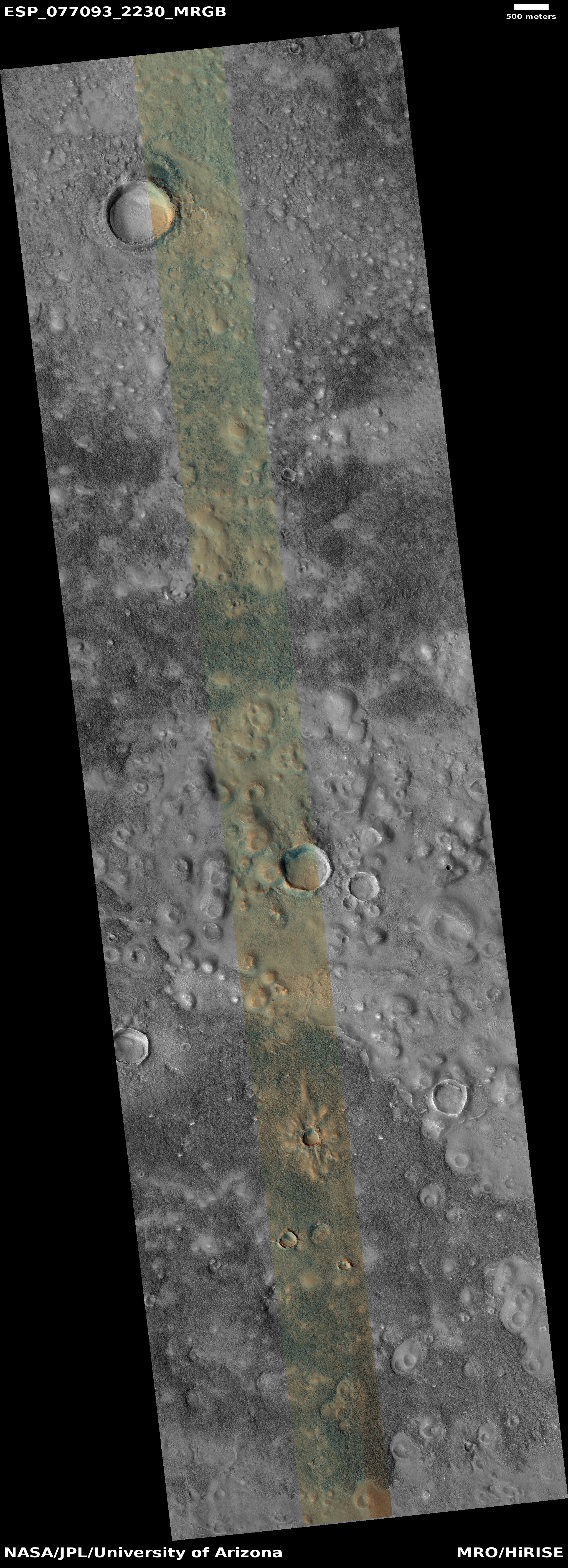
Cool image time! My headline paraphrases slightly the witches’ chant from Shakespeare’s MacBeth, if only to make it more accurately describe the picture to the right, cropped and reduced to post here. Taken on January 5, 2023 by the high resolution camera on Mars Reconnaissance Orbiter (MRO), it shows a patch of mid-latitude terrain in the icy northern lowland plains of Mars.

While some of the craters here were certainly caused by impact, it is also likely that most were instead cryo-volcanic in nature, whereby ice bubbles up from below as changing temperature conditions — none of which need to be very warm — cause it to either melt temporarily into liquid or sublimate directly into a gas. The dark pimplelike hole on the picture’s right edge is a perfect example, with the hole sitting at the top of a cone.
» Read more

0 comments

Pushback: Court rules that PA school district denied parent public documents in “bad faith”

Megan Brock, without question still being targeted by the government
Megan Brock, without question still
being targeted by the government

Bring a gun to a knife fight: When Pennsylvania parent Megan Brock demanded, under her state’s right-to-know law, public documents of the Bucks County health department concerning its decisions to impose Wuhan flu lockdowns and school closures (with the office of open records ruling in her favor), county officials then sued her multiple times to try to prevent her access to the records.

The court has now ruled against the county’s lawsuits, while also ruling that the county had operated in “bad faith” and fined it $1,500, the maximum allowed by law.

After the court conducted an in-camera review of the records, Judge Denise M. Bowman ruled on April 28 that more than half of Brockโ€™s requests, which were made under the stateโ€™s Right-to-Know Law (RTK), had been withheld โ€œin bad faith.โ€ She ordered the county to release certain documents and pay $1,500 in sanctions for each of the two lawsuits brought against Brock, the maximum allowed under RTK.

You can read the ruling here [pdf]. It notes in particular how county officials had even refused to provide the court one of these documents for review, demonstrating clearly its bad faith.
» Read more

3 comments

SuperBIT balloon circling Antarctica snaps more high resolution astronomical pictures

Sombrero Galaxy
Click for full image.

The Super-Pressure Balloon Imaging Telescope (Super-BIT) that has been circling Antarctica for the last two weeks has now obtained two more more high resolution wide-field astronomical pictures.

The picture to the right, cropped to post here, is of Messier 104 (the Sombrero Galaxy). While the telescope cannot zoom in closer than this to such objects, it is able to get much wider and sharp pictures, covering an entire galaxy or nebula that ground-based telescope using adaptive optics (designed to counter the fuzziness caused by the atmosphere) cannot. Adaptive optics only work on very small fields of view, thus making it unable to observe some of the larger nearby astronomical objects like galaxies and nebulae.

If you look at the live stream of the balloon’s track, it has now almost completed its second circuit of Antarctica.

3 comments

Astronomers record moment star eats planet

Animation of a star eating a planet
Click to watch full animation.

Using data from a variety of space- and ground-based telescopes, astronomers now think they have recorded the moment a star similar to our Sun actually swallowed a planet thought to be comparable to Jupiter or smaller.

Once the science team put all the evidence together, they realized the dust they were seeing with NEOWISE [in orbit] was being generated as the planet spiraled into the starโ€™s puffy atmosphere. Like other older stars, the star had begun to expand in size as it aged, bringing it closer to the orbiting planet. As the planet skimmed the surface of the star, it pulled hot gas off the star that then drifted outward and cooled, forming dust. In addition, material from the disintegrating planet blew outward, also forming dust.

What happened next, according to the astronomers, triggered the flare of optical light seen by ZTF [survey telescope in California]. โ€œThe planet plunged into the core of the star and got swallowed whole. As it was doing this, energy was transferred to the star,โ€ De explains. โ€œThe star blew off its outer layers to get rid of the energy. It expanded and brightened, and the brightening is what ZTF registered.โ€

Some of this expanding stellar material then escaped from the star and traveled outward. Like the boiled-off layers of the star and planet that previously drifted outward, this material also cooled to form dust. NEOWISE is detecting the infrared glow of all the newly minted dust.

The picture above is a screen capture from a short artist’s animation created to illustrate what happened. The most amazing aspect of this event is how long the planet skimmed the surface of that star. It appears it did so for several orbits at least.

2 comments

May 2, 2023 Quick space links

Courtesy of BtB’s stringer Jay.


2 comments
1 130 131 132 133 134 196