May 13, 2024 Quick space links

Courtesy of BtB’s stringer Jay. This post is also an open thread. I welcome my readers to post any comments or additional links relating to any space issues, even if unrelated to the links below.


3 comments

The left begins recognizing Biden is going to lose

Frankly, for the Joe Biden campaign these numbers are an absolute disaster
“Frankly, for the Joe Biden campaign these numbers
are an absolute disaster.” Click for full video.

The conservative press this past weekend went gaga over a number of CNN reports that were shockingly negative about Joe Biden’s chances of winning re-election as president.

First CNNโ€™s Fareed Zakaria reviewed the overall situation and bluntly concluded, “The trendlines are not working in Biden’s favor.” Then CNN had several reports outlining Biden’s very bad polling numbers:

The right saw these reports as confirmation from the left — which CNN represents as an operative of the leftist Democratic Party — that the campaign is not going well for Joe Biden, that the momentum right now is for Donald Trump.

What I see is something even more fundamental. The left, for the first time in almost a decade, is accepting the possibility of defeat, and these reports are an almost unprecedented effort by the left to process this possibility.
» Read more

21 comments

A galaxy’s net of dust

A galaxy's net of dust
Click for full image.

Cool image time! The picture to the right, cropped, reduced, and sharpened to post here, was taken by the Hubble Space Telescope of the central part of galaxy NGC 4753, 60 million light years away and known as a lenticular galaxy because of its elongated elliptical shape and ill-defined spiral arms. It is believed we looking at this galaxy edge-on.

You can see a wider image of NGC 4753 here, released in January and taken by the Gemini South telescope in Chile. According to that press release, the brown dust lanes that seem to form a wavy net in the foreground are created by a process called differential precession:

Precession occurs when a rotating object’s axis of rotation changes orientation, like a spinning top that wobbles as it loses momentum. And differential means that the rate of precession varies depending on the radius. In the case of a dusty accretion disk orbiting a galactic nucleus, the rate of precession is faster toward the center and slower near the edges. This varying, wobble-like motion results from the angle at which NGC 4753 and its former dwarf companion collided and is the cause of the strongly twisted dust lanes we see wrapped around the galaxyโ€™s luminous nucleus today.

Once again, the limitation of only observing this object from one angle makes it very difficult to untangle what it really looks like. Therefore, these conclusions carry a great deal of uncertainty.

1 comment

A detailed look, using satellite imagery, of North Korea’s coastal spaceport

North Korea

Link here. The article, written by analysts at the Center for Strategic and International Studies in Washington, describes in detail the work being done in the past few years at North Korea’s Sohae spaceport on that nation’s western coast, as shown on the map to the right.

This work allowed North Korea to complete its first successful orbital satellite launch of its Chollima-1 rocket in November, after two previous failures.

As North Korea releases almost no information, the analysis depended entirely on high resolution orbital data.

While construction of the coastal launch pad is largely complete and work on refurbishing the original launch pad is largely suspended, work is now concentrated on constructing a large new processing/assembly building and an associated underground facility. Several smaller construction projects are also being pursued.

Overall it appears that North Korea is very serious about developing a full spaceport for both satellite and missile launches.

0 comments

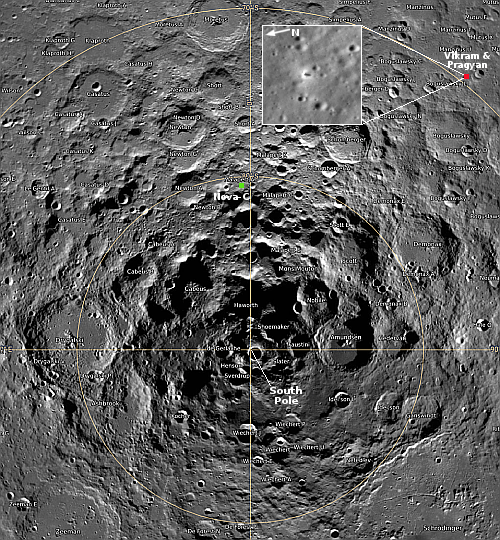
ISRO to land its Chandayaan-4 lunar sample return mission near where Chandrayaan-3 landed


Click for interactive map. To see the original
image, go here.

India’s space agency ISRO announced on May 11, 2024 that the landing site for its Chandayaan-4 lunar sample return mission will be in the same area where its Chandrayaan-3’s Vikram lander touched down, carrying the Pragyan rover.

The map to the right shows that location, at about 69 degrees south latitude. The mission will require two launches, and will have five components, a propulsion module, a transfer module, a lander module, an ascender module and a re-entry module. The two rockets will use India’s LVM-3 and PSLV rockets.

The actual mission concept, including which modules will be launched with which rocket as well as whether they will dock in Earth or lunar orbit, has not yet been released. This most recent tweet however mentioned that the lander will only operate for one lunar day, which means it will land, grab its samples quickly, and send the ascender capsule up, all within an Earth week.

A launch timeline for the mission also remains unclear.

0 comments

SpaceX launches 23 more Starlink satellites

SpaceX tonight successfully launched 23 Starlink satellites, its Falcon 9 rocket lifting off from Cape Canaveral.

This was the 50th successful launch by SpaceX this year, in only a little more that five months. Reaching the company’s goal of 150 launches in 2024 (six of which were planned to be Starship/Superheavy test launches) remains a challenge, but if the company reaches even 80% of that goal (120) it will have set a record for launches greater than what the entire world achieved for every year of the space age until 2020.

This was also the 15th launch of the rocket’s first stage, landing successfully on a drone ship in the Atlantic.

The leaders in the 2024 launch race:

50 SpaceX
21 China
6 Russia
5 Rocket Lab

American private enterprise now leads the world combined in successful launches, 57 to 33. SpaceX by itself now leads the rest of the world, including other American companies, 50 to 40.

4 comments

China today launches “experimental” satellite

China today successfully launched what it called an “experimental” satellite designed to “monitor the space environment”, its Long March 2C rocket lifting off from its Jiuquan spaceport in the northwest of China.

The state-run press provided no other information. Nor did it tell us where the rocket’s lower stages, which use toxic hypergolic fuels, crashed inside China.

The leaders in the 2024 launch race:

49 SpaceX
21 China
6 Russia
5 Rocket Lab

American private enterprise still leads the world combined in successful launches, 56 to 33. SpaceX by itself now leads the rest of the world, including other American companies, 49 to 40.

0 comments

Significant water found in samples from China’s Chang’e-5 Moon mission

According to a new paper published in late April, scientists analyzing the samples returned from the Moon by China’s Chang’e-5 Moon mission in 2021 have found more water embedded in the topsoil than expected. From the paper’s conclusions:

[O]ur results indicate that a considerable [solar wind]-derived water is stored within at least the uppermost meter (down to 0.8 meters) of the regolith beneath the lunar surface. This type of water represents a valuable potential resource for future in situ exploration of the Moon, as it not only has higher contents than indigenous water (up to several wt.% vs. <50 ppm) but could also be extracted by heating.

We are still not talking about a lot of water, but this result suggests there is more than earlier reports from Chang’e-5’s samples. This result also could explain the hydrogen signature across much of the Moon’s surface by Chandrayaan-1.

7 comments

Serbia joins China’s lunar base project

Serbia this week signed an agreement with China to become the eleventh nation to join its International Lunar Research Station (ILRS) lunar base project.

China’s project now has eleven partner nations (Azerbaijan, Belarus, Egypt, Nicaragua, Pakistan, Russia, Serbia, South Africa, Thailand, Turkey, and Venezuela) and eleven academic or governmental bureaucracies.

Except for China and Russia, the other partners are very minor players in space, and will likely contribute relatively little to the lunar base other than providing China some shallow positive PR.

Nonetheless, the two competing alliances in settling the solar system are becoming clear. On one side you have the alliance led by the U.S. under the Artemis Accords, while on the other you have an alliance led by China, under its lunar base project. Both right now appear only interested in establishing government power in space.

In the middle will be ordinary people, dreaming of building new societies to live in on other worlds. Sadly it increasingly appears they will be crushed between these two big government alliances. Though the U.S. alliance was initially established to foster private property and ownership so that those settlers could have as free and as prosperous a life as the Americans who settled the United States, it no longer seems interested in that goal.

4 comments

FAA and Air Force initiate new environmental impact statements for Starship/Superheavy launchpads in Florida

We’re here to help you! Really! Late yesterday, in a typical Friday story dump just before the weekend to reduce any notice, the FAA announced it has begun a new environmental impact statement (EIS) of SpaceX’s Starship/Superheavy launchpad infrastructure being built in Florida, working in parallel with a similar environmental impact statement now being conducted by the Air Force.

The EIS will be the second environmental review involving SpaceXโ€™s plans to use LC-39A for Starship launches. NASA completed an environmental assessment (EA) in 2019 of the companyโ€™s plans at the time to build launch infrastructure at LC-39A for Starship, finding it would have no significant impact. At the time SpaceX was planning up to 24 Starship launches from that pad annually. A new EIS, the FAA concluded, is needed because of changes in the design of Starship and its operations since the 2019 assessment.

The FAA claims a new assessment is needed because SpaceX is now planning as many as 44 launches. The Air Force has not said why its new assessment is needed. That EIS, which began in March, covers a launchpad previously used by the Saturn-1B and Delta-4 rockets from 1964 to 2022, another pad use by the Air Force’s Titan rocket from 1965 to 2005, as well as a new pad, dubbed SLC-50.

LC-39A meanwhile has been used for launches since the 1960s. The Saturn-5, the space shuttle, and the Falcon 9 all launched from this pad.

The dishonest absurdity of these impact statements can not be overstated. There is zero reason to do new assessments. All the pads have been in use for decades, with all kinds of rockets, some comparable to Superheavy/Starship. The environment and the wildlife refuge at Cape Canaveral have both thrived.

Moreover, to force completely new impact statements because the design and plans for Superheavy/Starship have changed somewhat (but not fundamentally) is even more stupid. This is a new rocket, being developed day-by-day and launch-by-launch. Will the FAA and the Air Force require new EIS’s every time SpaceX changes anything? It seems so.

This is clearly lawfare against Elon Musk and SpaceX by the White House and the administration state. It doesn’t like Musk, and it is now searching at all times for ways to block or damage him.

I confidently predict that neither statement will be completed by the end of 2025. Based on the timeline of most EIS’s, which when politics are involved are almost always slowed by the legal action of activists, the earliest either will be approved will be mid-2026, though likely later.

What is not clear is whether the FAA and Air Force will stop all work while this red tape is being unwound. If so, then the first operational launches of Superheavy and Starship cannot happen out of Cape Canaveral until well into 2027, which means NASA entire Artemis program will be seriously delayed. My previous prediction that the first manned lunar landing can’t happen before 2030 is becoming increasingly too conservative.

And remember this: If Joe Biden and the Democrats remain in power after November, all bets are off. At that point they are certain to ramp up the lawfare against those they see as political enemies, even if their targets are doing great things for the nation and the American people.


11 comments
1 121 122 123 124 125 191