New orbital image of Curiosity on Mount Sharp

Curiosity on Mount Sharp
Click for original image.

Though this is not the first time Curiosity has been spotted from orbit by Mars Reconnaissance Orbiter (MRO), the image to the right, reduced and sharpened to post here, might be the coolest, because it shows clearly the mountainous terrain within which the rover presently travels. The cliff on the picture’s right is 400-foot-high Kukenan.

NASA’s Curiosity Mars rover appears as a dark speck in this image captured from directly overhead by the agency’s Mars Reconnaissance Orbiter, or MRO. The orbiter is equipped with a camera capable of viewing objects the size of a dinner table on the Red Planet’s surface.

The camera, called the High-Resolution Imaging Science Experiment (HiRISE), has viewed spacecraft on the surface many times before. Here, it captured Curiosity driving up a steep slope on Dec. 29, 2023, the 4,051st Martian day, or sol, of the rover’s mission.

At present the Curiosity team is using the rover to analyze the material produced from the rover’s 40th drill hole, and thus it has not moved significantly for several weeks.


0 comments

More orbital tugs reach orbit

When SpaceX launches a large number of smallsats and payloads on a Falcon 9 launch, as it did on March 5 from Vandenberg in California, it routinely takes several days or even months for the results from each payload or smallsat to trickle in. Two reports today illustrate the growing cottage industry of orbital tugs.

First, a company named Apex has successfuly demonstrated its first service module for satellites, designed to provide the basic services needed for satellites so that companies can focus on designing their primary mission rather than reinventing a basic satellite each time. The module was launched on March 5th, and has been operating as expected. The company hopes to begin mass producing this service module in a new factory later this year.

Second, a new orbital tug company from France, Exotrail, has successfully deployed a cubesat from its first tug. That tug was launched on a Falcon 9 smallsat launch in November, and has been testing operations since. After releasing that cubesat for Airbus’s defense division, the tug is continuing operations, acting as the service module for a second payload from Belgium that is testing its own gyros and reaction wheels for controling smallsat orientation.

These companies are small, and are focused on very specific technologies needed by smallsats to operate efficiently in space. As such, their achievements are generally more mundane and less exciting that a SpaceX Starship/Superheavy test launch, by many magnitudes. Nonetheless, their success, not only technically but financially, suggests a growing maturity to the in-orbit space industry, which will also lay the groundwork for much more sophisticated operations in the future beyond Earth orbit. The people that build these tugs will move on to build vessels that can go to the planets and do things that are presently impossible or too difficult, and do it at low cost and very quickly.

4 comments

Is the Saxavord spaceport in the UK about to finally get approved for launches?

Proposed spaceports surrounding Norwegian Sea
Proposed spaceports surrounding Norwegian Sea.

According to the head of the Saxavord spaceport in the UK, it is finally poised to get all the necessary approvals from the government of the United Kingdom that will allow the first launches before the end of this year.

Following on from the CAA licence being granted just before Christmas, management at SaxaVord Spaceport is confident it will receive its ‘range licence’ later this month to finally become a “fully-fledged spaceport”. This second licence, also issued by the Civil Aviation Authority (CAA), allows rockets launched from SaxaVord to use the airspace.

Sounds great, eh? Except that the spaceport is still waiting approval from a local commission of its plan for allowing spectators to watch launches. In addition, no launch license has yet been issued to any rocket company. The German company Rocket Factory Augsburg (RFA) is planning to take over one specific launchpad at Saxavord where it hopes to do as many as ten launches per year, with the first test launch later this year. The UK’s Civil Aviation Authority (CAA) has not yet issued that license.

Another rocket startup, ABL, is also waiting CAA approvals. Its first test launch (which failed in January 2023) was conducted in Alaska, with a second launch planned there in the next month or so. If successful the company hopes to launch regularly from Saxavord, assuming the CAA gives it approval.

Saxavord submitted its license applications to the CAA in November 2022, with the hope launches could begin in 2023. It took the CAA however more than a year to issue the spaceport license, and it still has not issued the range license, nor has it issued RFA any launch licenses yet. For these companies to prosper the government approval process has got to be streamlined.

0 comments

Harp & VolfgangTwins – Paint It Black

An evening pause: The music is great, but I generally dislike these music videos that put the performers in some beautiful place that is also a place where it is absolutely impossible to record a performance. They then do lip synch and editing to hide the fact that the performance is faked. Ugh.

Still, as I said, the music is great, and the scenery is beautiful.

Hat tip Diane Zimmerman.

9 comments

Another helicopter mission under development for Mars?

Another helicopter mission for Mars?
Click for original image.

Today’s cool image to the right, cropped to post here, is probably on its own one of the more boring cool images I have posted over the years, a generally featureless plain with some ripple dunes within a few low hollows.

What makes this picture cool however is the label for the image: “Sample Landing and Traverse Hazards at Possible Helicopter Landing Site.” The picture was taken on January 23, 2024 by the high resolution camera on Mars Reconnaissance Orbiter (MRO), with the obvious goal of seeing whether this location can serve as a landing site for a helicopter mission to Mars.

The site is relatively uninteresting because the first goal is to find a safe place to land, but to do so near a location where there is rough geology which only a helicopter can explore. And it appears, from the overview map below, that is exactly what this location is.
» Read more

2 comments

Amazingly Justice actually charges two leftist activists with felonies for defacing the display case holding the Constitution

Security guards watch as vandals of the Constitution preach their message
Rotunda security guards do nothing so that these
vandals of the Constitution can preach their message.
Click for video.

In a move that is astonishing considering the political favorism of the left by the Biden administration’s Justice Department, that agency has now charged the two leftist activists who defaced the display case holding the Constitution with felonies.

On Friday, the Department of Justice charged Donald Zepeda of Maryland and Jackson Green of Utah with felony destruction of government property, according to Fox News. Zepeda and Green have been accused of dumping red powder on the case that displayed the historic document. The incident occurred on Feb 14 and the DOJ said their stunt caused more than $50,000 worth of damages.

It is not clear what penalities these two thugs face should they be convicted. For all we know, Justice is merely prosecuting them now for effect, and will allow them to skip with light charges when the case comes to court.

Nor should be we surprised if these vandals end up walking free. » Read more

5 comments

March 4, 2024 Zimmerman/Space Show podcast

David Livingston has now posted my two-hour appearance on the Space Show last night, with the podcast available for download here.

Despite some technical issues halfway through (which David has edited out of the podcast), the show was fun, especially because of a lot of very good questions from listeners. The second half of the show was devoted to discussing my book Conscious Choice, which David Livingston had read and wanted to highlight. His endorsement of the book was much appreciated. As he noted (I am paraphrasing), it you are interested in the problem of establishing space settlements, you must read this book, because it deals with things beyond engineering that are as if not more important.

0 comments

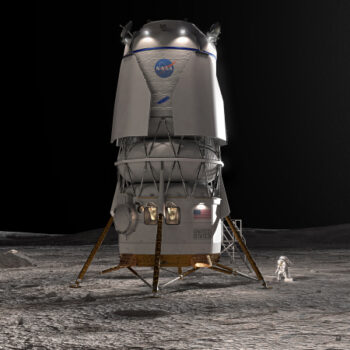
Blue Origin is targeting a first unmanned landing of its manned lunar lander in 2025

Blue Origin's Blue Moon manned lunar lander
An early visualization of Blue Moon

According to one Blue Origin official, the company is now targeting its first unmanned landing of its manned lunar lander, Blue Moon, for sometime in 2025, far sooner than previously expected.

Jeff Bezos’ Blue Origin space venture is aiming to send an uncrewed lander to the surface of the moon in the next 12 to 16 months, according to the executive in charge of the development program. John Couluris, senior vice president for lunar permanence at Blue Origin, provided an update on the company’s moon lander program on CBS’ “60 Minutes” news program on Sunday. “We’re expecting to land on the moon between 12 and 16 months from today,” Couluris said. “I understand I’m saying that publicly, but that’s what our team is aiming towards.”

Blue Moon is shown in the graphic to the right. Though being built to provide NASA a second manned lander in addtion to SpaceX’s Starship, this first mission will simply bring cargo to the surface, as a test of the lander itself.

If Blue Origin can keep even somewhat close to this schedule, we will likely have two manned moon landers doing test flights at almost the same time.

A sidebar: Note the lander’s height, as well as the narrow footprint of its landing legs. New graphics of this lander from Blue Origin show the same high center of gravity with an even narrower footprint for the legs. One wonders why. Wouldn’t it make sense to have those legs deploy outward more?

This issue applies also to SpaceX’s Starship, which will also have a high center of gravity. When SpaceX’s rockets land on Earth (both Falcon 9 boosters and Starship), most of their fuel is gone so the bulk of the mass is near the bottom where the engines are, even though the boosters stand very high. On the Moon however these vehicles will be landing heavily loaded, with cargo and fuel. This raises a stability question that was illustrated sadly by the tipping over recently of Intuitive Machines Odysseus lander.

I am not an engineer, so I admit that my off the cuff analysis here is very questionable. Nonetheless, one wonders.

24 comments

Scientists: Europa produces oxygen on its surface, but less than expected

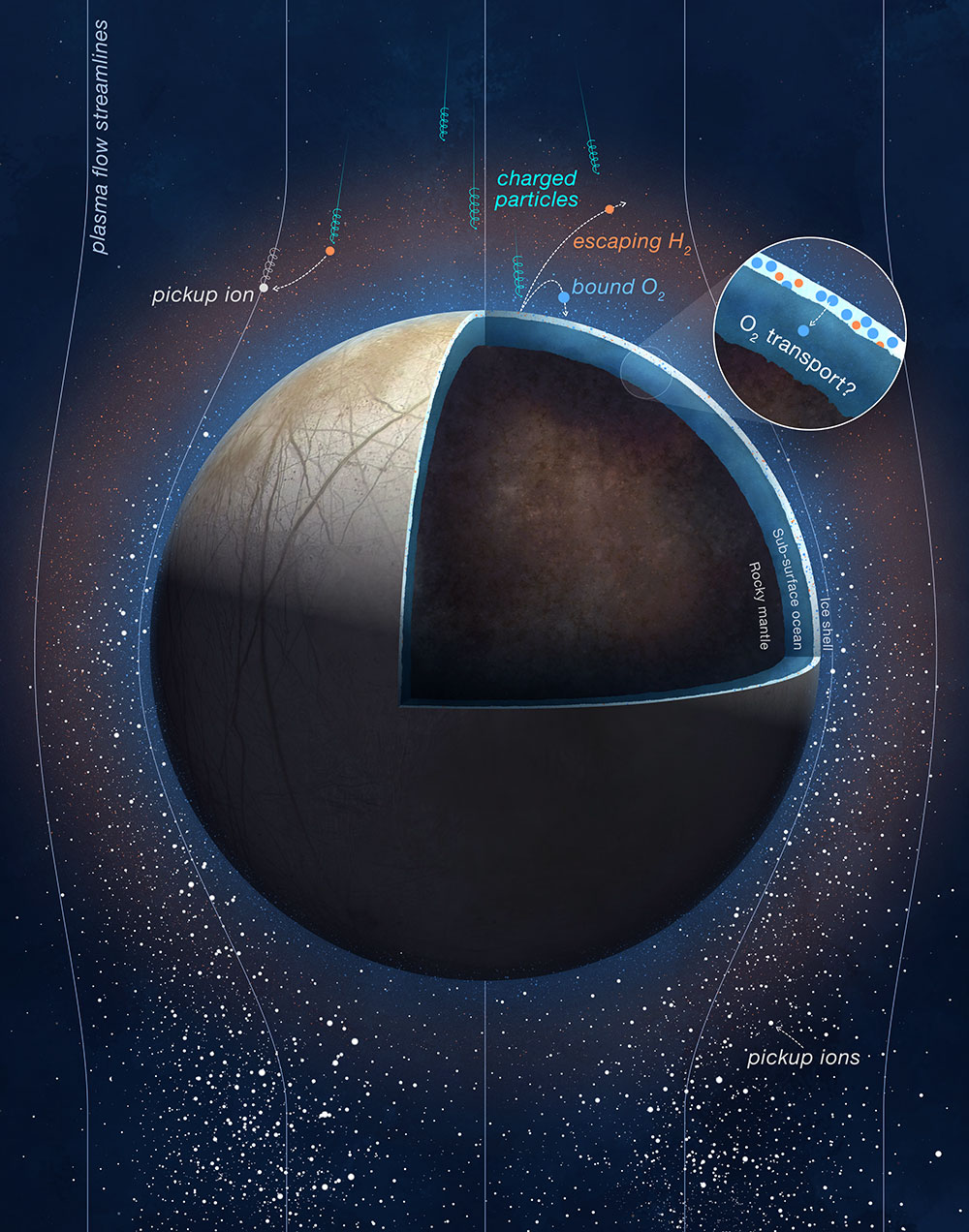
Graphic of Europa
Click for original image.

The uncertainty of science: Scientists using data from a 2022 flyby of the Jupiter moon Europa by the orbiter Juno have determined that the moon produces about 1,000 tons of oxygen every 24 hours on its surface, a large amount but less than most predictions based on previous indirect observations.

The paper’s authors estimate the amount of oxygen produced to be around 26 pounds every second (12 kilograms per second). Previous estimates range from a few pounds to over 2,000 pounds per second (over 1,000 kilograms per second). Scientists believe that some of the oxygen produced in this manner could work its way into the moon’s subsurface ocean as a possible source of metabolic energy.

You can read the paper here. The graphic shows the basic process, as presently theorized. What remains unknown is how or even if that oxygen is transported downward to the theorized underground ocean of liquid water. That the amount created is on the very low end of previous estimates suggests that there will be less free oxygen to support life in that ocean than expected.

2 comments

SpaceX almost completes dress rehearsal countdown of Starship/Superheavy

According to a tweet from SpaceX, the company yesterday conduceted a dress rehearsal countdown of Starship/Superheavy, ending the rehearsal at T-10 seconds so that no static fire test of Superheavy’s engines occurred.

Starship completed its rehearsal for launch, loading more than 10 million pounds of propellant on Starship and Super Heavy and taking the flight-like countdown to T-10 seconds.

Prior to all its launches SpaceX routinely does this kind of rehearsal, but always ends them at T-0 and a short engine burst. That it did not do so here suggests either some issue prevented it, or the company was doing tests of its propellant loading procedures. Either way, it is likely another dress rehearsal countdown will be required before the actual test flight can occur.

I also suspect the FAA is involved in this in some way, demanding certain actions by SpaceX before the agency issues the launch license. At the moment there is no word when that license will be issued, though Elon Musk keeps saying on X that it is coming “soon.”

2 comments

Australian rocket startup gets government approval for its spaceport

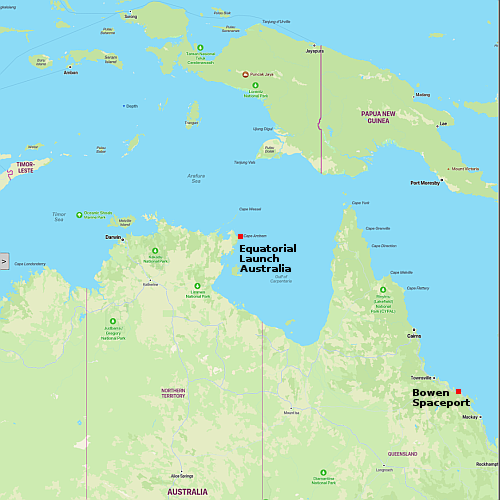
Proposed Australian commercial spaceports

The Australian rocket startup Gilmour Space has now received a spaceport licence from the Australian government, allowing launches to occur from its Bowen spaceport on the northeast coast of Australia, as shown on the map to the right.

The company describes the approval from [Ed Husic Federal Minister for Industry and Science], who is also the minister in charge of the Australian Space Agency, as a vote of confidence in Gilmour’s technical capability, paving the way for the launch of Australia’s first sovereign-made rockets, ‘bridging Country to Sky’. Gilmour Space has also secured approval from the Department of Climate Change, Energy, the Environment and Water, enabling the operation of the spaceport at Abbot Point.

Not all is unicorns and rainbows however. First, it appears Gilmour began negotiating for this approval two years ago, so the government took a looong time to say yes. The other spaceport on the map has been awaiting for a launch license for about the same length of time, and has still not gotten it.

Gilmour also wants to do its first test launch of its Eris rocket in the next few months, but it is still awaiting its launch license from the Australian Space Agency. We are therefore about to find out whether Australia’s government can issue that permit in the next few months, or will instead emulate Great Britain, and bog things down with endless red tape.

0 comments

JPL requests proposals from the private sector for Mars exploration

Capitalism in space: JPL, which is the lead agency running NASA’s very troubled Mars Sample Return (MSR) mission, has now issued a request for proposals from the private sector for doing a variety of Mars missions.

NASA’s Jet Propulsion Laboratory issued a request for proposals Jan. 29 for “commercial service studies” for future robotic Mars mission concepts. The studies, with a value of $200,000 or $300,000, would be carried out over 12 weeks. The studies are intended to examine four specific design reference missions to explore commercial opportunities to support Mars exploration: delivery of small payloads of up to 20 kilograms to Mars orbit, delivery of large payloads of up to 1,250 kilograms to Mars orbit, services to provide high-resolution imaging of the Martian surface and communications relay services between Mars and Earth.

Missions to provide imaging or communications from Mars orbit could quite easily be provided by numerous private companies. Delivering payloads to the Martian service is exactly what SpaceX proposes with Starship, and is also what several lunar lander companies have now been doing.

Up until now, JPL has always built everything in-house, or if it didn’t it designed and managed everything very closely. The result with MSR is a project that is now poorly managed, vastly over budget and behind schedule, and very likely to fail. This proposal suggests JPL is now recognizing that private enterprise might be able to do it better, as NASA has now proven with its shift from being the builder to becoming merely a customer.

If so, this proposal might be indicating the first step at JPL and NASA in imposing a major change in MSR itself, coming as it does just days after the release of an inspector general report about that project’s many problems.

3 comments
1 156 157 158 159 160 191