New calculations now say asteroid 2024 YR4 will almost certainly not hit the Earth in 2032

According to an announcement from NASA yesterday, the chances of asteroid 2024 YR4 hitting the Earth in 2032 is now reduced to 0.004%, meaning that it almost certainly not a threat at that time.

There remains a 1.7% chance it will instead impact the Moon in 2032.

These refined calculations were likely achieved by looking not at the asteroid itself (it is now too far away), but at places where it might have been visible to ground-based telescopes in the past, assuming it had an orbit that will hit the Earth in 2032. Since those past observations did not see it, those orbits are thus eliminated, and the threat goes down.

Of course, the uncertainty remains. It also remains important that we obtain more detailed information about this asteroid, because it is still a potential threat to the Earth.

0 comments

More changes in NASA’s upper management

NASA yesterday announced more changes in its upper management, almost all related to its manned Artemis program.

NASA announced today that Johnson Space Center Director Vanessa Wyche is now Acting Associate Administrator, succeeding Jim Free who retired over the weekend. Cathy Koerner, who has been leading the mission directorate that manages the Artemis program, will retire this Friday. Her Deputy, Lori Glaze, will take over on an acting basis.

These are not major changes. The new appointees, Wyche and Glaze, have been upper managers for a long time within NASA’s manned management structure that has created the present Artemis program.

These changes are also tentative depending on what Jared Isaacman decides to do once he is confirmed by the Senate as the actual administrator, replacing Janet Petro, who was named last week as the acting administrator. If Isaacman and Trump decide on canceling SLS and restructuring the entire Artemis program, both might also decide it needs an entirely new management staff.

I must also note the lack of any men in this list. NASA’s DEI effort for decades as apparently left no guys in that upper management, or if they are there, it continues to push them aside to support DEI racial and sex quotas, even though it now does not use those terms.

7 comments

February 24, 2025 Quick space links

Courtesy of BtB’s stringer Jay. This post is also an open thread. I welcome my readers to post any comments or additional links relating to any space issues, even if unrelated to the links below.

2 comments

Bumpy frozen lava on Mars

Bumpy frozen lava on Mars
Click for original image.

Cool picture time! The photo to the right, cropped, reduced, and sharpened to post here, was taken on September 30, 2024 by the high resolution camera on Mars Reconnaissance Orbiter (MRO). Labeled simply as a “terrain sample,” it was most likely taken not as part of any specific research project but to fill a gap in the schedule in order to maintain the camera’s temperature.

The image is fascinating nonetheless, as the landscape is typically alien for Mars. What caused the many random ridges and knobs? Why are there oblong areas that are smooth and have no ridges? And why is there dark material inside that crater that appears to have been blown out to the northeast? If you click on the image to see the full image, not all the craters look this way. One has a similar dark feature, but others are as bland as the entire terrain.

The overview map below only increases these mysteries, even if it does provide some further data.
» Read more

0 comments

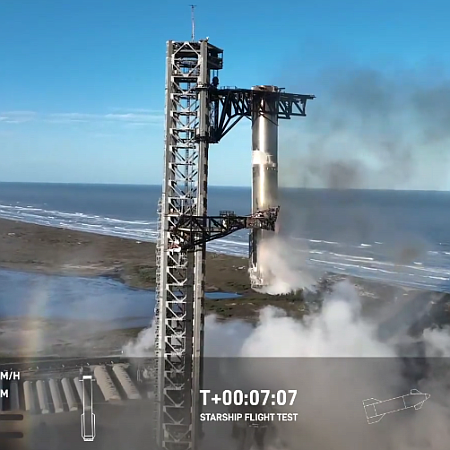
SpaceX now targeting February 28, 2025 for 8th Starship/Superheavy test orbital flight

Superheavy captured for the second time
Superheavy captured for the second time,
on January 16, 2025

SpaceX today announced it will attempt the eighth Starship/Superheavy test orbital flight this coming Friday, February 28, 2025, with a launch window beginning at 5 pm (Central). From the company’s website update:

The upcoming flight will target objectives not reached on the previous test, including Starship’s first payload deployment and multiple reentry experiments geared towards returning the upper stage to the launch site for catch. The flight also includes the launch, return, and catch of the Super Heavy booster.

The company also published today a detailed report on its investigation into the loss of Starship soon after stage separation in the 7th test flight.
» Read more

4 comments

Hubble takes a close look at one tiny part of the Veil Nebula

A small section of the Veil Nebula
Click for original image.

Cool image time! The picture to the right, reduced and sharpened to post here, was taken by the Hubble Space Telescope of just one very tiny section of the supernova remnant known as the Veil Nebula, located about 2,400 light years away.

The white dot on the inset (showing the entire Veil Nebula) marks the area covered by this closeup, focused on the one bright section of nebula in the Veil’s southwest quadrant. From the caption:

This nebula is the remnant of a star roughly 20 times as massive as the Sun that exploded about 10 000 years ago. … This view combines images taken in three different filters by Hubble’s Wide Field Camera 3 instrument, highlighting emission from hydrogen, sulphur and oxygen atoms. This image shows just a small fraction of the Veil Nebula; if you could see the entire nebula without the aid of a telescope, it would be as wide as six full Moons placed side by side.

Astronomers have been using Hubble to take periodic pictures of the Veil Nebular since 1994 in order to track changes as these gaseous gossamer strands evolve over time.

2 comments

Close-up of Blue Ghost’s landing zone on the Moon

Close-up of Blue Ghost's landing zone
Click for original image.

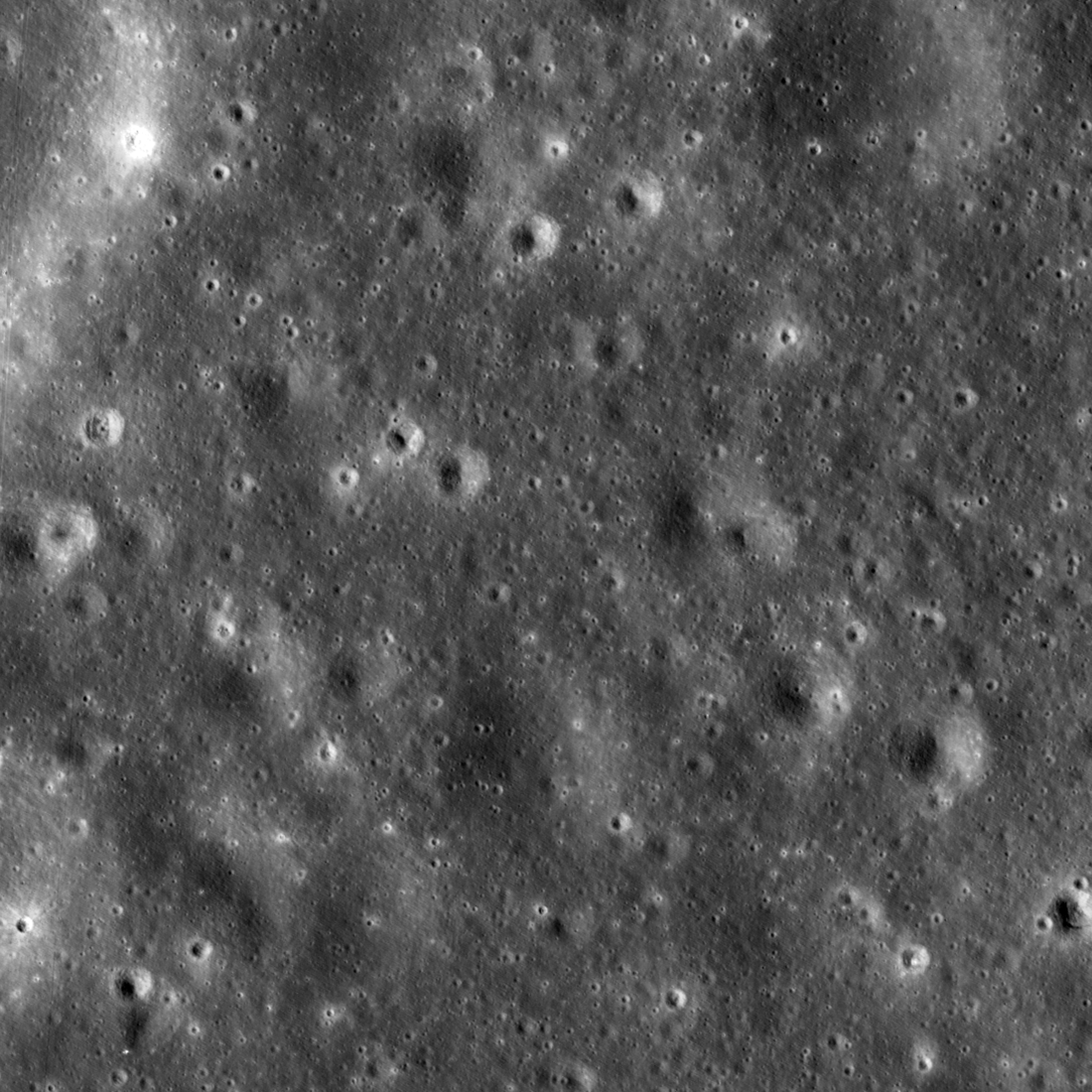
The science team for Lunar Reconnaissance Orbiter (LRO) on February 21, 2025 posted the picture to the right, reduced and sharpened to post here, showing in close-up the March 2, 2025 landing zone for Firefly’s Blue Ghost lunar lander.

The Blue Ghost landing region (image center, 18.56°N, 61.81°E) is heavily cratered due its ancient age (>3 billion years). … The landing region is near a large volcanic cone, Mons Latreille, which formed billions of years ago as part of the massive outpouring of basaltic magma that filled much of the Crisium basin.

Despite the many craters, there are plenty of smooth spots in this landscape. The real challenge for the lander is finding its way to them.

For a map showing this location on the Moon, go here.

0 comments

Eutelsat-Oneweb uses its satellite constellations to test technology for phone-to-satellite capabilities

The communications company Eutelsat-Oneweb announced today that it has successfully tested the technology that would allow smartphones to use its satellite constellations as orbiting cell towers in order to eliminate dead zones in their ground-based systems.

Based on the press release, it is unclear whether the tests actually included a cell phone.

The trial used Eutelsat OneWeb satellites, with the MediaTek NR NTN test chipset, and NR NTN test gNB provided by ITRI, implementing the 3GPP Release 17 specifications. Sharp, Rhode & Schwarz provided the antenna array and test equipment and the LEO satellites, built by Airbus, carry transponders, with Ku-band service link, Ka-band feeder link, and adopt the “Earth-moving beams” concept. During the trial, the 5G user terminal successfully connected to the 5G core via the satellite link and exchanged traffic. [emphasis mine]

That user terminal might have been a smart phone, or it could have been an engineering test terminal.

Either way, Eutelsat-Oneweb appears to be aggressively trying to enter the competition for cell-to-satellite business, competing with the systems already operational from Starlink and AST SpaceMobile.

0 comments

Thales Alenia completes the habitable module for Lunar Gateway

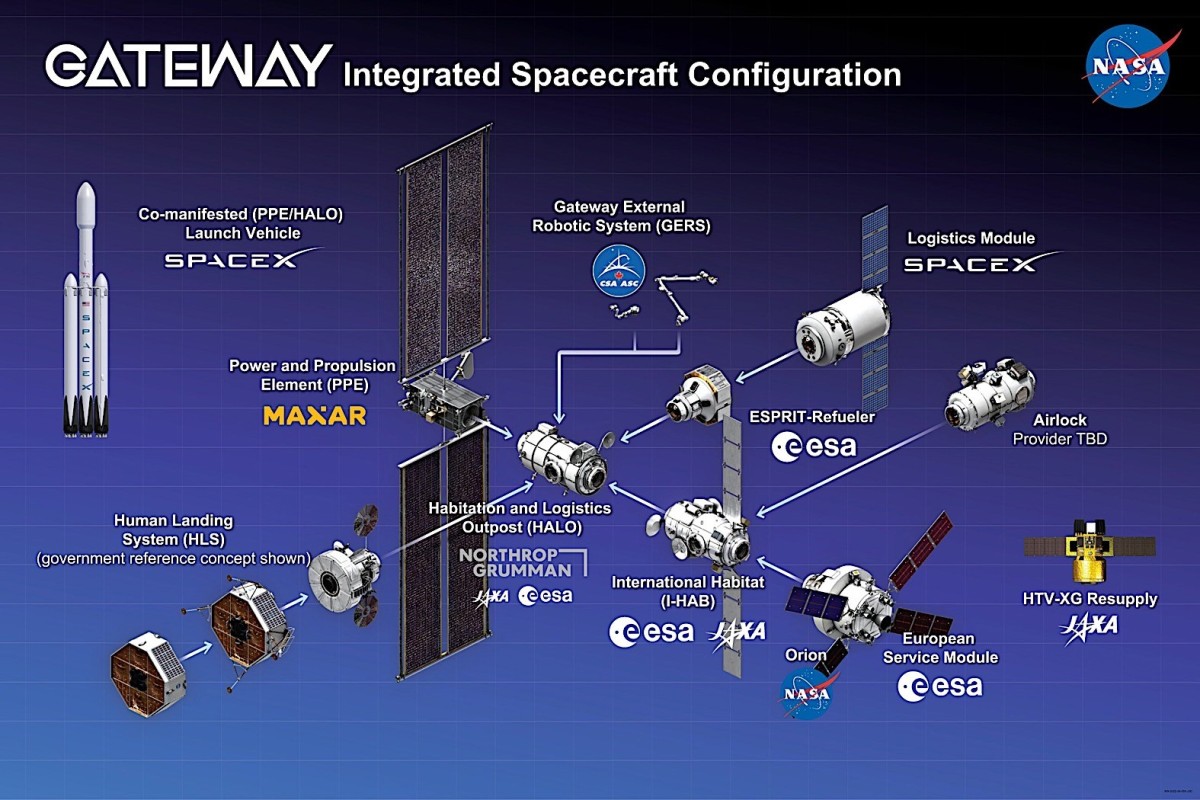
Lunar Gateway
The Italian company Thales Alenia last week announced it has completed construction and testing of the hull for the habitable module for Lunar Gateway, and is now preparing it for shipment to the U.S. for final outfitting.

HALO’s (Habitation and Logistics Outpost) primary structure is ready to be packaged for shipment to the United States. After successfully completing a series of environmental tests in Thales Alenia Space’s plant of Turin, Italy, HALO’s pressurized structure, built by our company, will be delivered to Gilbert, Arizona, where prime contractor Northrop Grumman will complete its outfitting ahead of launch to lunar orbit with Gateway’s Power and Propulsion Element.

Thales Alenia also builds the hull for Northrop Grumman’s Cygnus capsule, from which HALO was based. HALO is longer however, and has three docking ports for the attachment of Gateway’s other modules.

The press release at the link appears mostly designed to tout Gateway and Thales Alenia’s major contribution to it, which also includes building the airlock for the United Arab Emirates. The company also has European Space Agency contracts to build a lunar lander for delivering cargo to the Moon as well as a habitat for use on the Moon. All of these projects are presently threatened with major changes should the Trump administration decides to cancel SLS, Orion, and Lunar Gateway.

12 comments

Rocket startup Interstellar receives another grant from Japan

The Rocket startup Interstellar announced on February 21, 2025 that Japan’s program to encourage commercial space has awarded it a new $9.3 million grant, bringing the total amount the company has received to approximately $53 million.

The SBIR is a 3 phased governmental program aimed to promote the implementation of advanced technologies developed by startups in Japan. Interstellar was selected in September 2023 under the space section focused on the “Development and Demonstration of Private Launch Vehicles” were the company received up to ¥2 billion [$13.3 million] in funding for Phase 1. After passing the review for Phase 2 in September 2024, another maximum of ¥4.6 billion [$30.8 million] were awarded.

In addition, in early January Toyota invested $44 million in this startup.

This story indicates that the Japanese government is finally moving to encourage private commercial space. It had announced this grant program in late 2023, but its bureaucracy had initially seemed reluctant to issue grants. This appears to be finally changing.

Interstellar is in itself an interesting story. Five years ago it appeared to be aggressively building its Zero rocket. It then disappeared. I figured its investment capital had dried up and the company had shut down. It seems it has now been reborn.

0 comments

Gilmour announces target date for first launch of its Eris rocket

Australian commercial spaceports
Australia’s commercial spaceports. Click for original map.

The rocket startup Gilmour Space today announced that it is targeting March 15, 2025 for the first orbital test of its Eris rocket, lifting off from its private Bowen spaceport on the east coast of Australia.

The news follows final airspace approvals from the Civil Aviation Safety Authority (CASA) and Airservices Australia, clearing the last regulatory hurdle before launch. It also marks the culmination of years of innovative R&D and manufacturing by the Gold Coast-based company, which developed the Eris launch vehicle and Bowen Orbital Spaceport in North Queensland.

Gilmour Space made history in March last year when its Bowen spaceport was granted the first orbital launch facility licence in Australia, and when it secured the country’s first Australian Launch Permit for Eris TestFlight 1 in November. Now, with airspace arrangements finalised and mandatory notice given to the Australian Space Agency, the company is preparing for liftoff.

Obtaining its permits from Australia’s government has taken years. The company first hoped to launch in 2022, but the red tape stymied that possibility.

If successful however this company’s achievement will be multifold. It will not only beat into orbit numerous other startups in the U.S. and Europe, it will give Australia its own orbital rocket built in Australia. For a country whose government never had much interest in joining the world’s space power — and appeared for the past three years determined to squelch this private company — Gilmour’s achievement will be significant. If anything, its success could force that government to change its ways

4 comments
1 153 154 155 156 157 182