Sunspot update: Sunspot activity continued its decline in January

Another month has passed, meaning it is time for another update on the Sun’s sunspot cycle, based on NOAA’s monthly graph tracking that activity but annotated by me with additional information.

In January the decline in sunspot activity on the hemisphere facing Earth since August 2024 continued, with the number of sunspots dropping to a level not seen since May 2023, when the Sun’s was ramping up from solar minimum to solar maximum.
» Read more

5 comments

The uncertainty of science: Scientists now say eating eggs reduces your chances of a heart attack

I wish they’d make up their minds: For decades scientists — and the U.S. government — claimed with absolute certainty that eating eggs increased your risk of a heart attack because of the egg’s cholesterol content.

Now they say “Never mind.”

The researchers analyzed data from 8,756 Australian and American adults aged 70-plus who participated in the ASPirin in Reducing Events in the Elderly (ASPREE) study and one of its sub-studies, the ASPREE Longitudinal Study of Older Persons (ALSOP) study. As part of the latter study, participants self-reported their total egg intake, which was categorized as never/infrequently (never or one-to-two times a month), weekly (one-to-six times a week), and daily (daily or several times a day). The association between egg intake and all-cause and cause-specific mortality โ€“ in this case, cardiovascular disease and cancer โ€“ was assessed after adjusting for sociodemographic, health-related and clinical factors, and overall diet quality. The follow-up period was close to six years.

Participants who fell into the weekly category of egg consumption, that is, they consumed one to six eggs per week, had a 29% lower risk of dying from cardiovascular disease and a 17% lower risk of dying from any cause compared to those participants who ate eggs never or infrequently. There was no statistically significant association between egg consumption and deaths due to cancer.

The study found that eating eggs with a high quality diet reduced the risk of heart disease even more. It also found that eating eggs has the same exact benefit even for those who already had high levels of cholesterol.

In other words, our lovely government and the American Heart Association had been handing out guidelines for decades based on nothing more than very uncertain science, and doing it with an air of arrogant certainty that should make everyone want to vomit.

I should note that the results above are uncertain as well. It is based merely on a correlation of eating eggs and lower heart disease, and we must remind ourselves that correlation does not prove causation. The study says nothing about how eating eggs might lower your risk of heart disease, and the correlation might very well be unrelated entirely.

17 comments

New Mexico’s Spaceport America loses another customer

New Mexico’s Spaceport America, first established in the early 2000s with the expectation it would soon see hundreds of suborbital Virgin Galactic tourist flights per year — launches that never happened — has now lost another customer

In an announcement made late Friday (Jan. 31, 2025) evening, the Experimental Sounding Rocket Association (ESRA) will be holding its annual Intercollegiate Rocket Engineering Competition (IREC) at the Midland International Air & Space Port in Midland, Texas, from June 9-14, 2025.

The announcement marks the first venue change for the IREC since the 2017 competition.

For seven years beginning in 2017 and concluding in 2024, ESRA along with the New Mexico Spaceport Authority (NMSA) partnered and jointly held IREC at Spaceport America. During that time, the IREC rebranded as the Spaceport America Cup (SAC) and grew significantly. The growth period of over a half-decade culminated with the 2024 Spaceport America Cup which featured the largest number of competing teams and launches (122) of any previous competition.

No reason for the shift to Texas was mentioned.

The Spaceport America boondoggle has ended up costing New Mexico taxpayers millions, with little to show for it. This change will only increase the losses, and raises more questions about whether that state government should continue pouring money into this black hole. No orbital rocket companies have any interest in launching from there, and Virgin Galactic won’t be launching again for at least a year, and when (or if) it resumes launches it will be doing only a small number of flights. Thus the spaceport’s customer base is very small, and shrinking.

5 comments

Rocket Lab wins another multi-launch contract

Rocket Lab today announced it has won a four-launch contract with a Japanese company, the Institute for Q-shu Pioneers of Space, Inc. (iQPS), to launch its Earth-imaging satellites.

The multi-launch contract, signed in July 2024 [but apparently not publicly announced till now], includes three dedicated missions for launch in 2025 from Rocket Lab Launch Complex 1 in New Zealand, with a fourth launch scheduled for 2026. Each mission will carry a single satellite to form part of iQPSโ€™ planned constellation of 36 synthetic aperture radar (SAR) satellites that are capable of collecting images through cloud and at night with a high resolution of less than a meter.

Rocket Lab previously completed one launch for iQPS in 2023, signing the contract and launching within four months.

Though the company has not yet announced officially the number of launches it hopes to fly in 2025, it appears the number will exceed the 14 orbital launches it completed in 2024. Before adding the three 2025 iQPS launches above, Rocket Lab had 18 Electron launches listed for 2025 at the rocketlaunch.live website, as well as the first launch of the company’s new Neutron rocket. Altogether that adds up to a total of 22 launches.

0 comments

ISRO considering doing more docking tests with Spadex satellites

India’s space agency ISRO has delayed the undocking of its two Spadex satellites as it considers a plan to do more docking tests.

The original plan was to have the chase satellite complete only one docking with the target vehicle, after which the two satellites would separate and spend the next two years doing different work. That plan is being reconsidered.

[Isro chairman V.] Narayanan said in Sriharikota that they have to think of the money involved in such projects and utilise it to the maximum. โ€œNow we are in the process of reviewing when to do the undocking, the power connections and when to totally separate them again and dock again. All these processes are going on. We do not want to undock and leave it,โ€ the Isro chairman said.

โ€œWe have loaded five kg of propellant on both the satellites. The propellant is needed for docking and undocking exercises. Currently we have 60 to 70 per cent of the propellant (as of January 29) remaining in the spacecraft. There are going to be a lot of experiments in the docking, undocking, power connection exercises and it is not a one time exercise,โ€ he said.

Sources at ISRO also suggest there may be issues with the docking that still need analysis.

0 comments

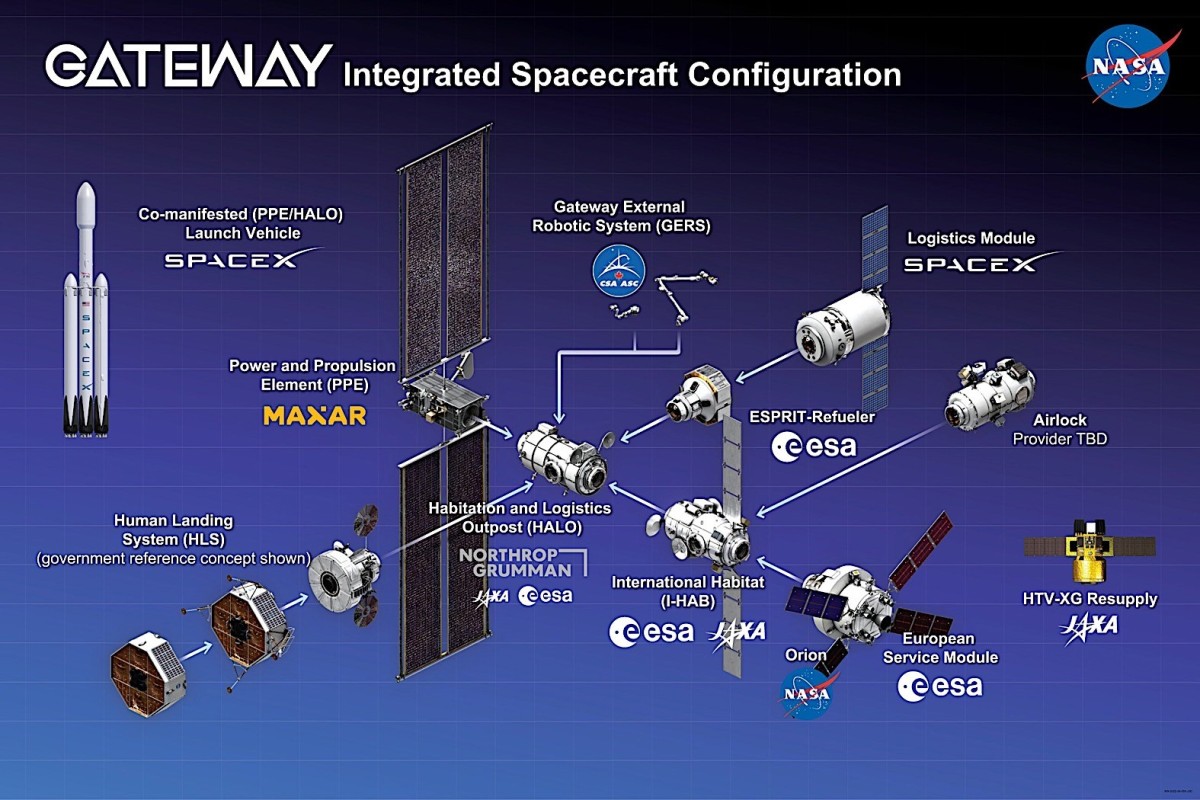
UAE hires Thales-Alenia to build its airlock for Lunar Gateway

The European space company Thales-Alenia today announced that it won the contract from the United Arab Emirates (UAE) to build its airlock for Lunar Gateway.

It was expected, that after the UAE signed its agreement with NASA in early January to build this airlock in exchange for one astronaut flight to Lunar Gateway, that it would also have to hire someone to build it since that country does not have the capability. Initial reports suggested it was negotiating with Boeing to build the airlock, but not surprisingly the UAE ended up going elsewhere, considering Boeing’s present troubles. Either the UAE decided Boeing was too great a risk and too expensive, or Boeing’s new upper management decided to beg off.

As noted here, Thales Alenia now has contracts to build four major components of Lunar Gateway: the hull of NASA’s habitation module, Europe’s habitation module, the refueling/telecommunications module, and now the airlock. While the graphic below shows that other Gateway components are being built by others, the graphic also shows that NASA has past off many modules to other countries. These deals could make it easier politically for the Trump administration to cancel Lunar Gateway. Thales-Alenia’s dominant position in building the station in Europe would make transferring ownership to Europe simpler, with U.S. participation secondary. The European Space Agency for example could pick up the cost for the modules being built by SpaceX and others.

Lunar Gateway

9 comments

SpaceX launches two high resolution Earth imaging reconnaissance satellites

SpaceX tonight successfully launched Maxar’s last two of six high resolution Earth imaging reconnaissance satellites of its Worldview constellation, its Falcon 9 rocket lifting off from the Kennedy Space Center in Florida.

SpaceX placed the entire Worldview constellation in orbit over three launches. The first stage on today’s launch completed its fourth flight, landing back at Cape Canaveral, while the rocket’s two fairing halves completed their 21st and 23rd flights respectively.

This was also SpaceX’s second launch today.

The 2025 launch race:

16 SpaceX
6 China
1 Blue Origin
1 India
1 Japan

0 comments

Gullies on crater wall

Gullies on Mars
Click for full image.

Cool image time! The picture to the right, cropped, reduced, and sharpened to post here, was taken on August 8, 2024 by the high resolution camera on Mars Reconnaissance Orbiter (MRO).

The picture’s research focus is the gullies, which the scientists’ describe as “perched pole-facing gullies on ancient crater wall.” Perched means the start and end of each gully is on that crater wall, linked neither to the top or bottom of the wall itself. That the gully starts below the top means whatever caused it came from within the wall itself, not from the plateau above. That it ends before the crater floor means the process that cut the gully out was not powerful enough to reach the bottom.

That the gullies are on the interior north wall of this unnamed 25-mile-wide crater means they get less sunlight year round, something that must play a part in causing the gullies.
» Read more

0 comments

Astronomers find galaxy with nine rings

The Bullseye Galaxy
Click for original image.

Using both the Hubble Space Telescope as well as the Keck telescope in Hawaii, astronomers have discovered a galaxy with nine rings, something never seen before.

The gargantuan galaxy LEDA 1313424 is rippling with nine star-filled rings after an โ€œarrowโ€ โ€” a far smaller blue dwarf galaxy โ€” shot through its heart. Astronomers using Hubble identified eight visible rings, more than previously detected by any telescope in any galaxy, and confirmed a ninth using data from the W. M. Keck Observatory in Hawaii. Previous observations of other galaxies show a maximum of two or three rings.

More information from Keck can be found here.

Keck Observatory and Hubbleโ€™s follow-up observations helped the researchers prove which galaxy plunged through the center of the Bullseye โ€” a blue dwarf galaxy to its center-left. This relatively tiny interloper traveled like a dart through the core of the Bullseye about 50 million years ago, leaving rings in its wake like ripples in a pond. A thin trail of gas now links the pair, though they are currently separated by 130,000 light-years.

The Hubble picture is to the right, cropped, reduced, and sharpened to post here. The small blue dwarf galaxy to the left is believed to be the galaxy that plowed through LEDA 1313424 to create the rings. LEDA is itself thought to be two and a half times the size of the Milky Way, making one of the larger known galaxies.

2 comments

NASA calls for the private sector to launch VIPER to the Moon

As a follow-up of its August request for suggestions on how to save its cancelled VIPER rover mission to the Moon, NASA has now issued a request for actual proposals from the private sector for flying the mission, due on March 3, 2025.

The Announcement for Partnership Proposal contains proposal instructions and evaluation criteria for a new Lunar Volatiles Science Partnership. Responses are due Monday, March 3. After evaluating submissions, any selections by the agency will require respondents to submit a second, more detailed, proposal. NASA is expected to make a decision on the VIPER mission this summer.

…As part of an agreement, NASA would contribute the existing VIPER rover as-is. Potential partners would need to arrange for the integration and successful landing of the rover on the Moon, conduct a science/exploration campaign, and disseminate VIPER-generated science data. The partner may not disassemble the rover and use its instruments or parts separately from the VIPER mission. NASAโ€™s selection approach will favor proposals that enable data from the missionโ€™s science instruments to be shared openly with anyone who wishes to use it.

Expect a number of companies to tout their proposals in press releases in the coming weeks.

3 comments
1 163 164 165 166 167 182