
Blue Ghost completes first main mid-course correction engine burn

Firefly’s Blue Ghost lunar lander has not only successfully completed its first major engine burn, raising its Earth orbit as it slowly moves towards the Moon, but successfully used a joint NASA-Italian instrument to pinpoint its location using Earth-orbiting GPS-type satellites.

Jointly developed by NASA and the Italian Space Agency, the Lunar GNSS Receiver Experiment (LuGRE) technology demonstration acquired Global Navigation Satellite System (GNSS) signals, and calculated a navigation fix at nearly 52 Earth radii: more than 205,674 miles (331,000 kilometers) from Earth’s surface. This achievement suggests that Earth-based GNSS constellations can be used for navigation at nearly 90% of the distance to the Moon, an Earth-Moon signal distance record. It also demonstrates the power of using multiple GNSS constellations together, such as GPS and Galileo, to perform navigation.

These results suggest that if all lunar orbiters had this instrument on board, they could all pinpoint their positions precisely and thus eliminate the chance of collision. It also suggests that it might not be necessary, at least immediately, to build a separate GPS-type constellation around the Moon. Earth’s systems could do the job.

Blue Ghost will spend 25 days in Earth orbit, when it will transfer to lunar orbit for several more weeks before attempting a landing.
0 comments

Fast radio burst unexpectedly traced to dead and old elliptical galaxy

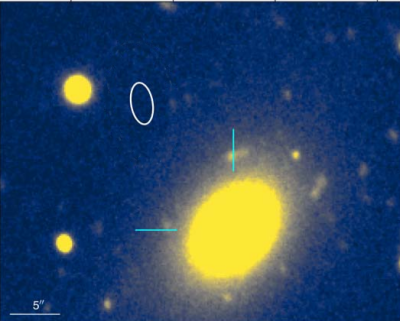
Location of Fast Radio Burst
Figure 4 from this paper [pdf].

The uncertainty of science: Using several radio telescopes working in tandem, astronomers have been able to identify the source galaxy of a fast radio burst (FRB) that repeatedly erupted throughout 2024, and discovered it came from a dead and old elliptical galaxy, not a younger galaxy as predicted.

[W]hile most FRBs originate well within their galaxies, the team traced FRB 20240209A to the outskirts of its home — 130,000 lightyears from the galaxy’s center where few other stars exist. “Among the FRB population, this FRB is located the furthest from the center of its host galaxy,” said Vishwangi Shah, a graduate student at McGill, who led the effort to pinpoint the FRB’s origins. “This is both surprising and exciting, as FRBs are expected to originate inside galaxies, often in star-forming regions. The location of this FRB so far outside its host galaxy raises questions as to how such energetic events can occur in regions where no new stars are forming.”

The small ellipse to the upper left of the giant elliptical galaxy (in yellow) marks the location of the FRB relative to its galaxy. Why it is so far outside remains a puzzle. The scientists consider two options: First, that the magnetar was once inside the galaxy but was kicked out at some point, and second, it simply could be inside a globular cluster that is too small to detect at this distance, two billion light years away.

Both explanations have problems and really don’t work.

1 comment

Finland signs Artemis Accords

Finland today became the 53rd nation to sign the Artemis Accords. Based on the official statement from Wille Rydman, Finland’s minister of economic affairs, it appears Finland sees the accords as a way to encourage its own private space sector:

“Finland has been part of the space exploration community for decades with innovations and technology produced by Finnish companies and research institutions,” said Rydman. “The signing of the Artemis Accords is in line with Finland’s newly updated space strategy that highlights the importance of international cooperation and of strengthening partnerships with the Unites States and other allies. We aim for this cooperation to open great opportunities for the Finnish space sector in the new era of space exploration and in the Artemis program.”

The NASA press release still appears to focus on strengthening the Outer Space treaty, but I suspect that this Biden-imposed goal will change now that Trump is president. The original purpose of the accords as created during Trump’s first term was to work around the Outer Space treaty’s limitations on private ownership in space. Expect a return to that goal.

The full list of nations now part of this American space alliance: Angola, Argentina, Armenia, Australia, Austria, Bahrain, Belgium, Brazil, Bulgaria, Canada, Chile, Colombia, Cyprus, Czech Republic, Denmark, Dominican Republic, Ecuador, Estonia, Finland, France, Germany, Greece, Iceland, India, Israel, Italy, Japan, Liechtenstein, Lithuania, Luxembourg, Mexico, the Netherlands, New Zealand, Nigeria, Panama, Peru, Poland, Romania, Rwanda, Saudi Arabia, Singapore, Slovakia, Slovenia, South Korea, Spain, Sweden, Switzerland, Thailand, the United Kingdom, the United Arab Emirates, the Ukraine, the United States and Uruguay.

1 comment

To my readers

I feel obliged to explain, if vaguely, the reason my posting has been relatively light the past few weeks. I have been struggling with health issues that have sucked all the energy out of me. Things have been improving, but for the rest of this week and next Diane will be recovering from knee surgery, and this will require my time above that of the website.

I will continue to report the news stories, including launches, that I think important, but essays might have to wait until things get back to normal at the Zimmerman household.

My apologizes to my loyal readers. I am not making excuses, merely explaining what is going on.

34 comments

South Korea’s space bureaucracy attempts to encourage private sector development

South Korea’s space agency, the Korea Aerospace Administration, has announced a new effort to encourage that country’s private sector in developing rockets and satellites.

[A] plan will be established to link the National Space Council, the highest policy decision-making body overseeing government space policy, with the Aerospace Development Policy Review Committee. Systems will also be established for workforce training in aerospace and the designation of a space development mission center.

To establish an aerospace economic ecosystem, the participation of the private sector in the development and utilization of launch vehicles and satellites will be expanded. In the aviation sector, future aircraft technologies, including urban air mobility (UAM), will be secured, and localization of aircraft materials and components will be supported. To encourage smooth research and development (R&D) investments in aerospace corporations, the aerospace fund will be revitalized with improvements to regulations and support for overseas expansion.

Overall, a lot of this sounds like meaningless bureaucratic gobbledygook. The goal might be to expand the private sector, but the program still has the space agency running everything, from its new government-built Nuri rocket to its other satellite development programs.

Nonetheless, the desire to encourage the private sector is good. It could simply be that South Korea’s private sector is not mature enough yet to take the lead, and the agency by this announcement is working to push it forward.

1 comment

General Atomics successfully tests fuels to be used in an in-space nuclear propulsion system

The company General Atomics announced yesterday that it has successfully tested the fuels it wants to use in an in-space nuclear propulsion system for transporting ships to the Moon and beyond much faster and more efficiently than is presently possible with chemical engines.

[General Atomics] executed several high-impact tests at NASA’s MSFC in Huntsville, AL. The nuclear fuel was tested with hot hydrogen flow through the samples and subjected to six thermal cycles that rapidly ramped-up to a peak temperature of 2600 K (Kelvin) or 4220° Fahrenheit. Each cycle included a 20-minute hold at peak performance to demonstrate the effectiveness of shielding the fuel material from erosion and degradation by the hot hydrogen. Additional tests were performed with varying protective features to provide further data on how different material enhancements improve performance under reactor-like conditions.

It has been known since the 1960s the nuclear propulsion is more efficient that chemical engines. It can burn for longer time periods at higher levels, thus making it possible to get to other planets more quickly, in some cases bypassing the need to depend on orbital mechanics.

The problem however has been political. Getting these nuclear engines into orbit has been too much of a political hot potato. The fear of such engines and radioactivity, largely irrational, has made it impossible to get them built. NASA is now trying again.

17 comments

Japan’s government wants its private sector to do all its future space station work, not its space agency JAXA

In a major shift of power away from its government, the Japanese science and technology ministry is presently drafting a policy that would have that country’s private sector lead all work that Japan does on any of the future commercial private space stations being built, not its space agency JAXA as has been done now for decades.

The draft policy specifies how Japan will be involved with the next space station. According to the draft, “the private sector will have such responsibilities as managing [the new space station], and JAXA will support its use.”

JAXA is currently responsible to the management and maintenance of the ISS and serves as the point of contact for its commercial use. However, the government will select a Japanese private-sector company to be the point of contact for the next space station. When JAXA, research institutes or other companies plan to use the ISS, they will have to contact the next station’s point of contact.

While Japan wants to have one of its own modules on one of the commercial stations, as it presently has on ISS, it appears the government does not want JAXA to lead this project. Instead, it wants Japan’s private sector to run the show by working out its own deals with the private commercial stations. At present the Japanese company Mitsui is partnering with Axiom on its station, so this is likely the first station where a deal could be worked out.

It seems that Japan is trying to poke its private sector out of its doldrums. Right now that sector seems unable to take any action on its own. It sits and waits for guidance from the government before acting, and even then acts timidly, waiting to see if the government approves of each step. What the Japanese government now wants instead is some independent action, not linked to government policy.

3 comments

Trump picks Janet Petro of Kennedy to be acting NASA administrator, not Jim Free of headquarters

In a surprise move, the Trump administration announced yesterday that the expected person to take over as acting administrator of NASA until Jared Isaacman is approved by the Senate would not be Jim Free. the present associate administrator at NASA headquarters, but Janet Petro, who is presently director of the Kennedy Space Center.

NASA had so much assumed Free had the job that it had already listed him as acting administrator today on the NASA webpage.

There has of course been speculation as to why Trump made this unexpected choice. My guess is that Trump wants to reduce significantly the size of NASA headquarters, and thus wants someone from outside to run it for the present. Petro has been at Kennedy since 2007. Before that she was in the private sector.

Free has been a working out of DC for several years, and thus has stronger ties to the workforce there.

The decision also makes it clear to the NASA bureaucracy who is in charge. Decisions will no longer be made by that bureaucracy without strong input from Trump.

8 comments

Anna Lapwood – Hans Zimmer’s Cornfield Chase & Saint-Saëns’ Sinfonie #3 Organ finale

An evening pause: Performed live 2024. Seem celebratory enough for Inauguration Day.

Hat tip Alton Blevins, who also needs to clean out his full inbox so that he can receive emails. It has been full now for several weeks, and all emails to him thus bounce.

2 comments
1 170 171 172 173 174 182