
Cicely Parnas & Annie Jacobs-Perkin – Barber of Seville
An evening pause: You can tell they are not only utterly focused on what they are doing, they are having a great deal of fun as they do it.
Hat tip Alton Blevins.
An evening pause: You can tell they are not only utterly focused on what they are doing, they are having a great deal of fun as they do it.
Hat tip Alton Blevins.
Courtesy of BtB’s stringer Jay. This post is also an open thread. I welcome my readers to post any comments or additional links relating to any space issues, even if unrelated to the links below.

Click for original image.
Cool image time! The picture to the right, cropped, reduced, and sharpened to post here, was taken on July 31, 2024 by the high resolution camera on Mars Reconnaissance Orbiter (MRO). Labeled simply as a “terrain sample” by the camera team, it was likely taken not as part of any specific research project but to fill a gap in the camera’s schedule in order to maintain its proper operating temperature.
In this case the camera team picked a spot in the northern lowland plains at 39 degrees north latitude. What they got was another great piece of evidence of the existence of a lot of near surface ice on Mars, so much so at this location that the craters have become distorted and blobby. The ice in the ground is unstable enough that nothing here can really hold its shape from season to season and from decade to decade.
As I have noted repeatedly in the past six years, MRO data is proving that Mars is not a dry desert like the Sahara, but an icy desert like Antarctica. Except for the planet’s dry tropics below 30 degrees latitude, Mars appears to have a lot of frozen water available relatively near the surface.
» Read more
SpaceX has delayed its planned seventh test flight of its Starship/Superheavy rocket one day, from today to tomorrow, with the one-hour launch window now beginning at 4 pm (Central) on January 16, 2025.
It appears high winds and rain today were the main factor in the delay. Tomorrow will be better, with the weather continuing to improve over the next few days. We should not be surprised thus if the launch gets delayed one more time for weather.
India’s Spadex mission, launched to test autonomous unmanned docking procedures necessary for many of that country’s future space plans, now faces a possible two month delay in orbit before the final docking can take place.
On January 11, 2025 the chase vehicle completed its closest proximity maneuver, getting within three meters of the target vehicle, after which it backed away as planned. ISRO engineers are presently analyzing the data before proceeding with the actual docking.
The problem is that this docking must occur by January 20, 2025. After that the lighting conditions will not allow another attempt until March.
It seems ISRO is not concerned about this situation, and would rather get things right, even if it means that delay.
Though nothing is certain yet as the fires still rage, it appears that the facilities of JPL, including its Deep Space Network mission control that manages communications with all of America’s interplanetary probes have survived the Los Angeles fires that have destroy large swaths of that city.
The fires required a full evacuation of the facility, leaving that mission control unoccupied for the first time in sixty years. It appears however that the organization used work-arounds to maintain contact and operations with those probes.
How long the facility will remain in this state remains unclear. Some of the fires remain uncontrolled, and until that happens, there can be no return to any sense of normalcy in LA.
The startup Varda, which specializes in flying a returnable orbiting capsule for customers, is now flying its second mission, this time for the Air Force Research Lab (AFRL) testing hypersonic technologies.
The payload is known as OSPREE (Optical Sensing of Plasmas in the Reentry Environment), a spectrometer designed to collect atmospheric data during the capsule’s high-speed descent. The information will help refine thermal protection systems, sensor designs, and aerodynamics for hypersonic vehicles.
Unlike Varda’s first mission, the goal is not to stay in orbit to manufacture pharmaceuticals in weightlessness. Instead, the goal is to use Varda’s capsule during re-entry to do this research. Thus, the capsule will only stay in orbit for a few weeks before returning to Earth, this time at the Southern Launch commercial spaceport site in southern Australia.
The capsule was launched yesterday morning on SpaceX’s Transporter mission, which placed 131 different payloads in orbit.
Overall this entire mission illustrates the advantage of private ownership and competition. Varda has discovered an entirely unexpected income source and customer for its capsules, and it is eager to take advantage of that. Similarly, the Air Force is getting its hypersonic research done now for a fraction of the cost, using Varda as well as Rocket Lab’s HASTE improvisation, using its Electron rocket’s first stage to conduct suborbital hypersonic tests.
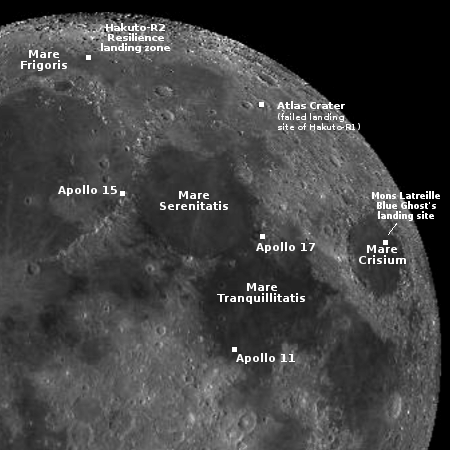
Landing sites for both Firefly’s Blue Ghost and
Ispace’s Resilience
SpaceX tonight successfully launched two different private commercial lunar landers, its Falcon 9 rocket lifting off from the Kennedy Space Center in Florida.
The prime payload was Firefly’s Blue Ghost lunar lander, flying ten science payloads to the Moon for NASA. It will take about six weeks to get to lunar orbit. The second payload was Resilience or Hakuto-R2, built by the Japanese startup Ispace on that company’s second attempt to land on the Moon. It is taking a longer route to the Moon, 4 to 5 months. The map to the right shows the landing locations for both landers. It also shows the first landing zone for Ispace’s first lander, Hakuto-R1, inside Atlas Crater. In that case the software misread the spacecraft’s altitude. It was still three kilometers above the ground when that software thought it was just off the surface and shut down its engines. The spacecraft thus crashed.
For context, the map also shows the landing sites of three Apollo missions.
Both spacecraft were correctly deployed into their planned orbits.
The first stage successfully completed its fifth flight, landing on a drone ship in the Atlantic.
The 2025 launch race:
8 SpaceX
2 China
Right now SpaceX’s launch pace exceeds once every two days. If it can even come close to maintaining that pace, it will easily match its goal of 180 launches in 2025.
I have embedded below the live stream of tonight’s launch by SpaceX of its Falcon 9 rocket from Kennedy, carrying a dual lunar lander payload, Firefly’s Blue Ghost and Ispace’s Resilience, scheduled for 1:11 am (Eastern).
Blue Ghost will take 45 days to reach the Moon, when it will land in Mare Crisium on the eastern edge of the Moon’s visible hemisphere.
Resilience will take a much longer route, not arriving at the Moon for four to five months. It will then attempt to land in Mare Frigoris in the high northern latitudes of the visible hemisphere. If successful it will also deploy its own mini-rover dubbed Tenacious.
» Read more
Embedded below the fold in two parts.
To listen to all of John Batchelor’s podcasts, go here.
» Read more
An evening pause: The song apparently is from the Doctor Who television series, but as I have never been a fan, I do not know the context.
Hat tip James Street.
Courtesy of BtB’s stringer Jay. This post is also an open thread. I welcome my readers to post any comments or additional links relating to any space issues, even if unrelated to the links below.