
January 21, 2026 Zimmerman/Batchelor podcast
Embedded below the fold.
To listen to all of John Batchelor’s podcasts, go here.
» Read more
Embedded below the fold.
To listen to all of John Batchelor’s podcasts, go here.
» Read more
An evening pause: Watching the creation of a classic song. From 1967.
Hat tip Cotour.

Go here and here for the original images.
It appears the solar conjunction that has blocked all communications with the rovers and orbiters for the past three weeks around Mars has now fully ended, with the first new images appearing today from both Curiosity and Perseverance.
The two images to the right were downloaded today. The top image was taken on January 20, 2026 by Curiosity’s front hazard avoidance camera. It appears to be looking uphill in the direction the rover is soon to travel, climbing Mount Sharp. If you look closely you can see the mountain’s higher ranges on the horizon, just to the right of the rover itself.
The bottom picture was actually taken on January 15, 2026 by Perseverance, but was only downloaded today. Both science teams had programmed their rovers to take images throughout the conjunction, scheduled for download when communications resumed.
The picture was taken by Perseverance’s left high resolution camera located on top of the rover’s mast. It looks down at the ground near the rover at the pebbles and rocks that strewn the relatively smooth surface of the terrain west of Jezero crater.
Neither image is particularly ground-breaking. What is important however is that both images prove the rovers are functioning as expected. Expect a lot more data to arrive in the next few days, all gathered during three weeks of blackout.
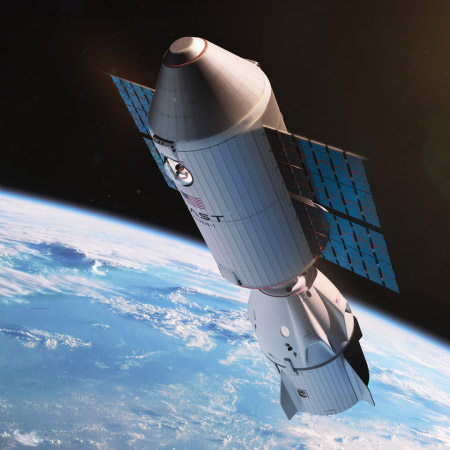
Artist rendering of Haven-1 with docked
Dragon capsule
According to Vast’s CEO, Max Haot, the launch of its single module Haven-1 space station has now been pushed back to the first quarter of ’27.
Last Saturday (January 10) we reached the key milestone of fully completing the primary structure, and some of the secondary structure; all of the acceptance testing occurred in November as well. Now we are starting clean room integration, which starts with TCS (thermal control system), propulsion, interior shells, and then moving on to avionics. And then final close out, which we expect will be done by the fall, and then we have on the books with NASA a full test campaign at the end of the year at Plum Brook. Then the launch in Q1 next year.
Until recently the company had been targeting a launch in the first half of 2026. This is a delay of almost a full year, and suggests the previous launch date has not been a serious target for quite some time.
Haot at the article at the link provides some new details about the manned missions to the station. It will launch unmanned, and after check-out in orbit that could last two weeks or longer, a professional SpaceX Dragon crew will fly a two-week mission there to do further check-outs.
After this up to three more two-week missions are planned, with Vast already having a deposit for the first. It also is willing to do more during Haven-1’s three year lifespan.
More and more it appears to me that in my rankings below of the five commercial space stations presently under development, the top three space stations are practically tied. And of the five stations, three are hoping to begin launching modules in the ’27-’28 time frame.
» Read more
Courtesy of BtB’s stringer Jay. This post is also an open thread. I welcome my readers to post any comments or additional links relating to any space issues, even if unrelated to the links below.
I am posting this early because I am busy this morning dealing with a scheduled family medical procedure. Nothing critical, but I will be out of the office for a good portion of the day. I plan to catch up in the afternoon.
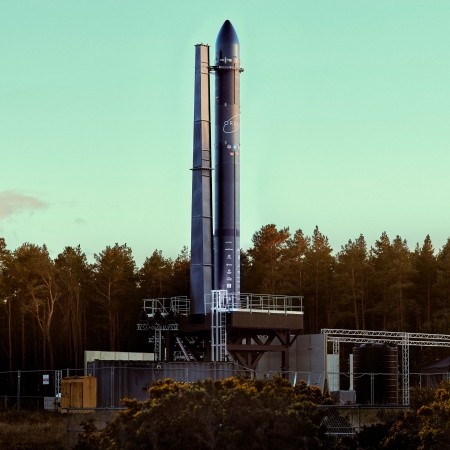
The prototype of Orbex’s never-launched Prime rocket,
on the launchpad in 2022
In what appears to be a direct consequence of British red tape blocking Orbex from launching in the past four years, it is now in negotiations to sell its assets to the French startup The Exploration Company.
On 21 January, Orbex published a brief press release stating that a letter of intent had been signed and that negotiations had begun. The company added that all details about the transaction remain confidential at this stage. A statement from Orbex CEO Phil Chambers suggests that the company’s financial position factored into its decision to pursue a buyer. “Our Series D fundraising could have led us in many directions,” said Chambers. “We believe this opportunity plays to the strengths of both businesses, and we look forward to sharing more when the time is right.”
Let me translate: In 2022 Orbex had set up a factory close to the proposed Sutherland spaceport on the north coast of Scotland, had signed a 50 year lease with that facility to launch its Prime rocket there, had built a launch platform and tested a prototype of the rocket, and was poised to do its first launch. All it needed was license approvals from the United Kingdom’s Civil Aviation Authority (CAA).
And then it waited, and waited, and waited, and waited. By 2024 it gave up on Sutherland, because the authorities (local and national) kept rejecting its spaceport license for environmental and political reasons. It switched its launch site to the SaxaVord spaceport on the Shetland Islands, pushing back that first launch to 2026. Along the way the UK gave it a $25 million grant, likely to keep the company above water because the UK was blocking its ability to launch.
All for naught. It is very clear Orbex has run out of cash waiting, and is now looking to salvage its work by selling everything to the French company, which so far has focused on building a cargo capsule to supply the upcoming commercial space stations.
If the sale goes through, do not be surprised if Orbex’s assets exit the UK entirely. And at that point, the CAA’s red tape can be given credit for destroying a second rocket company, following Virgin Orbit.

JAXA yesterday released the preliminary results of its investigation into upper stage failure during the December 2025 launch of its H3 rocket.
Previously the agency had indicated it believed the cause was linked to the separation of the rocket’s payload fairings. This new report changes that conclusion:
After liftoff, the No. 8 H3 rocket sustained damage to the section where the Michibiki No. 5 positioning satellite was mounted, when the satellite cover, called fairing, was separated.
In addition, the fuel tubing of the rocket’s second-stage engine was damaged, presumably causing combustion to stop earlier than planned, JAXA said in a progress report on its investigation into the failure at a meeting of a subgroup of a science ministry panel.
As the section was damaged, the satellite was no longer attached to the second stage of the rocket. The satellite fell off when the first stage separated.
In other words, as the fairings released, the satellite apparently deployed, damaging the fuel feed to the upper stage engine. It is as yet unclear whether the deployment system worked as intended, but did so prematurely, or if it failed entirely, allowing the satellite to fall away once the fairings separated.
At the moment Japan has no launch capability. Both of JAXA’s rockets, the H3 and the Epsilon-S are grounded due to launch failures. Meanwhile, the country has only recently begun to develop private launch companies, none of which are ready to launch.
An evening pause: Performed live 1982, with a truly great sax solo by Mark Rivera.
Hat tip Ferris Akel.
Courtesy of BtB’s stringer Jay. This post is also an open thread. I welcome my readers to post any comments or additional links relating to any space issues, even if unrelated to the links below.
I will be appearing with David Livingston on the Space Show tonight at 7 pm (Pacific). This will be a Zoom presentation, so if you wish to participate or ask questions, this is the announcement David sent out today:
You can listen and participate with us in our program tonight with Bob Zimmerman by using one of the following two Zoom phone numbers. Bob will be talking about his recent Op-Ed on Artemis and safety plus numerous other timely and important space topics.
One tap mobile
+1-253-200468,,81561774534# US
+1-253-21-8782,,81561774534# US (Tacoma)
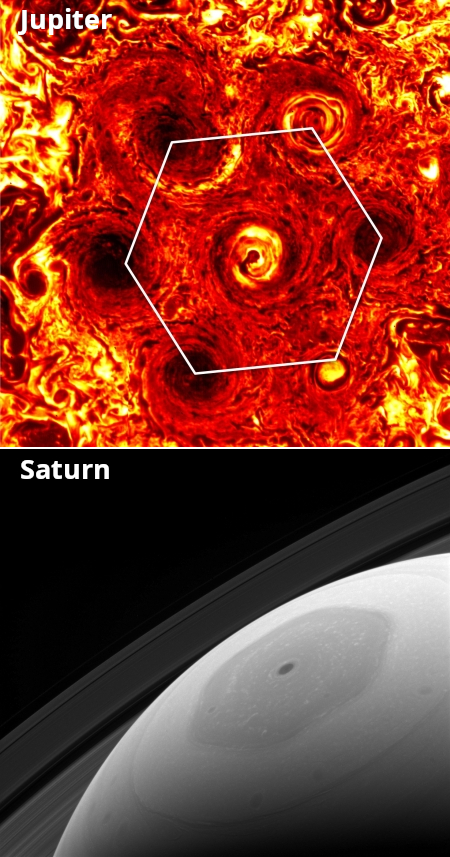
The uncertainty of science: In attempting to explain why the polar vortexes of Jupiter and Saturn are so different, scientists running large computer simulations have found that the difference could be because Jupiter’s interior is “softer” than Saturn’s.
The two images to the right illustrate the different polar vortexes of both planets. Jupiter’s (top) is made up of multiple chaotic small storms that form a hexagon-like ring around the pole. Saturn’s (bottom) is a single very coherent hexagon-shaped storm.
Over multiple different simulations, they observed that some scenarios evolved to form a single large polar vortex, like Saturn, whereas others formed multiple smaller vortices, like Jupiter. After analyzing the combinations of parameters and variables in each scenario and how they related to the final outcome, they landed on a single mechanism to explain whether a single or multiple vortices evolve: As random fluid motions start to coalesce into individual vortices, the size to which a vortex can grow is limited by how soft the bottom of the vortex is. The softer, or lighter the gas is that is rotating at the bottom of a vortex, the smaller the vortex is in the end, allowing for multiple smaller-scale vortices to coexist at a planet’s pole, similar to those on Jupiter.
Conversely, the harder or denser a vortex bottom is, the larger the system can grow, to a size where eventually it can follow the planet’s curvature as a single, planetary-scale vortex, like the one on Saturn.
If this mechanism is indeed what is at play on both gas giants, it would suggest that Jupiter could be made of softer, lighter material, while Saturn may harbor heavier stuff in its interior.
This conclusion however runs completely counter to what we should expect. Jupiter has a much great mass, and one would assume from this that its interior would therefore be denser and thus harder.
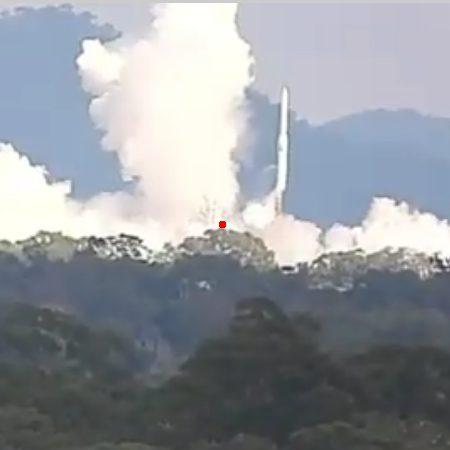
Gilmour’s Eris rocket falling sideways from launchpad
(indicated by red dot) in July 2025. Click for much better
video.
The Australian rocket startup Gilmour Space, whose one orbital test launch in 2025 failed, has now raised an additional A$217 million ($145 million American) in investment capital, in addition to the A$142 million it had previously raised.
The Series E round was jointly led by the National Reconstruction Fund Corporation (NRFC) and Hostplus, with participation from Future Fund, Blackbird, Funds SA, HESTA, NGS Super, Main Sequence, QIC, and Brighter Super.
…Proceeds from the raise will be used to support continued development and qualification of its Eris orbital launch vehicle, scale rocket and satellite manufacturing, expand test and launch infrastructure, and grow the company’s workforce to meet global demand for space launch services.
The National Reconstruction Fund Corporation is a government agency with a A$15 billion budget tasked to help finance new industries. It contributed A$75 million in this fund raising round.
The other major contributor was Hostplus, which matched that contribution.
Though the company has said it will attempt a second orbital test launch in 2026, no dates have been announced.

