
Continuing our tour of Uranus’ five biggest moons: Ariel
In preparing my cool image last week focused on the best Voyager-2 image of Uranus’ moon Miranda, I came to a realization that was somewhat startling. Voyager-2 is the only time a human spacecraft has gotten close to Uranus, and it was only close for a few days. Thus, the data and images it obtained of the gas giant and its moons is remarkable more sparse than I had ever realized.
You see, when these images were first released in 1986 they were exciting because they gave us that first look. Suddenly, a light was shined on something that had always been shrouded in darkness. It was a flood of data that needed processing.
It is now forty years later. No spacecraft has been there since, and thus we have gotten no more close-up information about Uranus or its moons. Data from Hubble and Webb has helped increase our knowledge of the planet itself, but of the moons nothing really new has been gleaned from this distance.
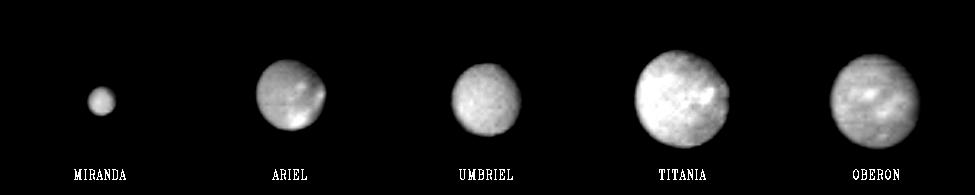
And so, to highlight how little we know, for the rest of this week I am going give my readers a tour of the few images Voyager-2 gave us of Uranus’ five biggest moons, the five that early astronomers had discovered prior to the space age and shown in the five pictures above, taken by Voyager-2 as it was approaching Uranus from a distance of about three million miles. They are, in order going from closest to farthest from Uranus, Miranda, Ariel, Umbriel, Titania and Oberon, with the images above designed to show their approximate relative sizes.
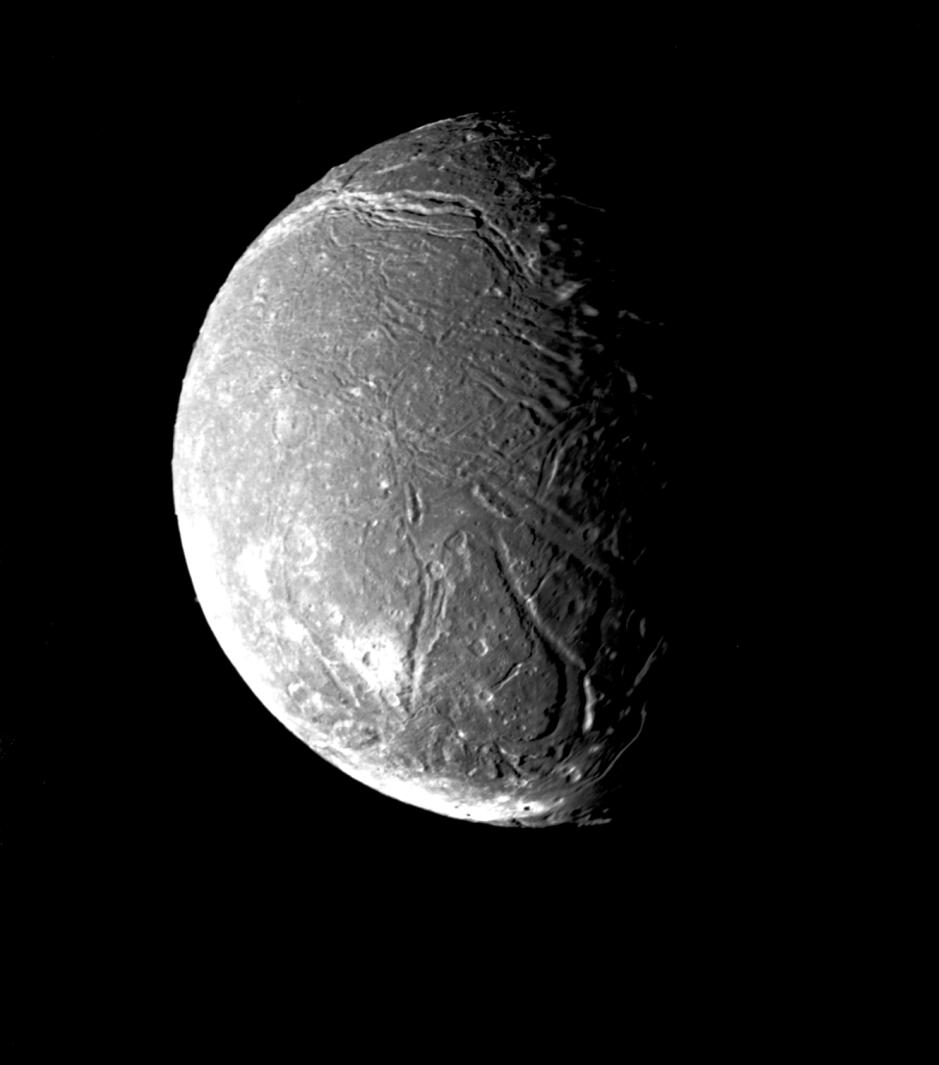
I already highlighted the strange, patchwork surface of Miranda last week, the smallest of these moons. Below is a mosaic made from the four highest resolution images of 720-mile-wide Ariel, the next out from Uranus, taken from a distance of about 80,000 miles.
Click for original image.
The image to the right has been cropped, reduced, and sharpened to post here. From NASA’s the May 5, 1999 press release:
Much of Ariel’s surface is densely pitted with craters 5 to 10 km (3 to 6 mi) across. These craters are close to the threshold of detection in this picture. Numerous valleys and fault scarps crisscross the highly pitted terrain. Voyager scientists believe the valleys have formed over down-dropped fault blocks (graben); apparently, extensive faulting has occurred as a result of expansion and stretching of Ariel’s crust. The largest fault valleys, near the terminator at right, as well as a smooth region near the center of this image, have been partly filled with deposits that are younger and less heavily cratered than the pitted terrain. Narrow, somewhat sinuous scarps and valleys have been formed, in turn, in these young deposits. It is not yet clear whether these sinuous features have been formed by faulting or by the flow of fluids.
Voyager-2 took a few other pictures, but none enhance significantly what this mosaic shows. The image is tantalizing, suggesting a complex geology that we can only guess at.
Like Miranda, however, Voyager-2 was only able to image one hemisphere of this moon, because the other side was in darkness during the spacecraft’s short fly-by. Though scientists have culled a lot of information from this sparse data, the truth is we will never really understand the geology of Ariel until we can get a global map of the entire planet.
Tomorrow, we move outward to Umbriel.

On Christmas Eve 1968 three Americans became the first humans to visit another world. What they did to celebrate was unexpected and profound, and will be remembered throughout all human history. Genesis: the Story of Apollo 8, Robert Zimmerman's classic history of humanity's first journey to another world, tells that story, and it is now available as both an ebook and an audiobook, both with a foreword by Valerie Anders and a new introduction by Robert Zimmerman.
The print edition can be purchased at Amazon or from any other book seller. If you want an autographed copy the price is $60 for the hardback and $45 for the paperback, plus $8 shipping for each. Go here for purchasing details. The ebook is available everywhere for $5.99 (before discount) at amazon, or direct from my ebook publisher, ebookit. If you buy it from ebookit you don't support the big tech companies and the author gets a bigger cut much sooner.
The audiobook is also available at all these vendors, and is also free with a 30-day trial membership to Audible.
"Not simply about one mission, [Genesis] is also the history of America's quest for the moon... Zimmerman has done a masterful job of tying disparate events together into a solid account of one of America's greatest human triumphs."--San Antonio Express-News
I wonder if there will be a return to Uranus or Neptune systems in my lifetime.
”I wonder if there will be a return to Uranus or Neptune systems in my lifetime.”
The Uranus Orbiter and Probe mission is planned to be the next flagship planetary mission after Mars Sample Return.
mkent: I don’t think you answered the question. From my perspective and age, I doubt seriously any Uranus or Neptune mission will launch and reach either planet before 2040, which likely puts it beyond my life expectancy.
Unless it has nothing to do with NASA and some private mission gets mounted.