
Growing damage to the wheels of the Curiosity Mars rover
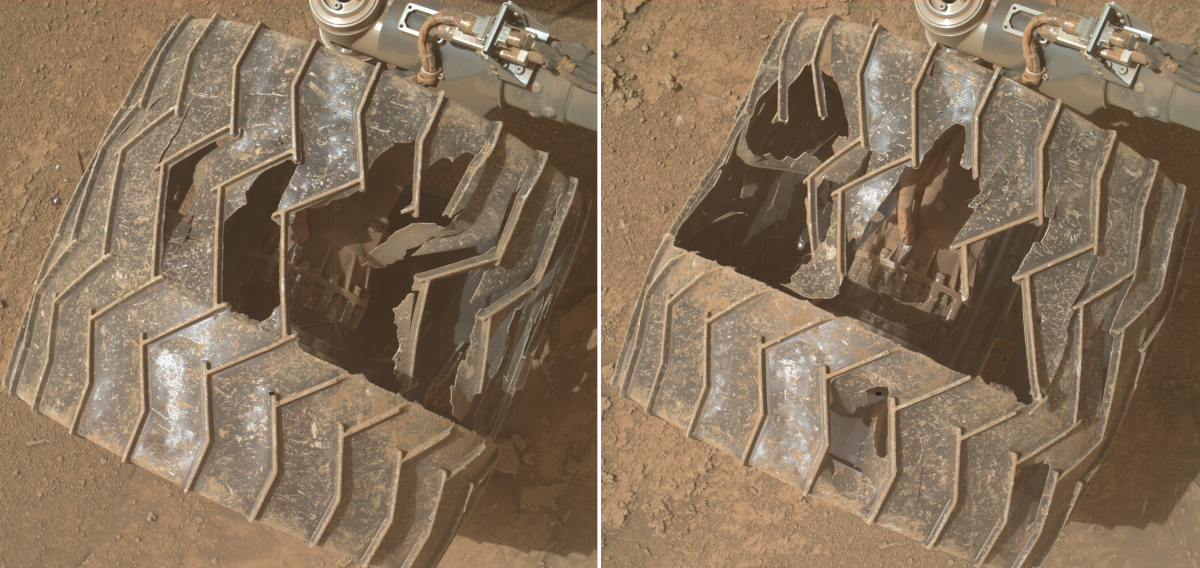
Images cropped and reduced to post here. For the original images go here and here.

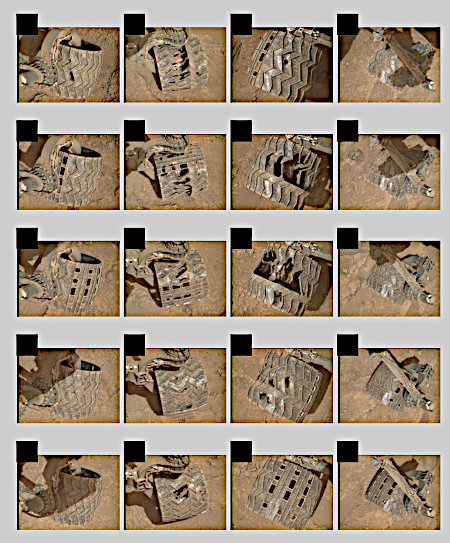
Every few months or so the Curiosity science team uses one of the rover’s cameras to do a survey of the rover’s wheels to track their condition. Since early in the mission they had found the wheels were not holding up as well as expected as they rolled over the rough terrain in Gale Crater and on Mount Sharp, and so they take great care in how they move the rover as well as review the wheels regularly.
A year ago it had appeared that the damage to one particular wheel had increased, to a point where its outer section might even break off.
Yesterday the science team did another survey, as shown in the picture to the right.
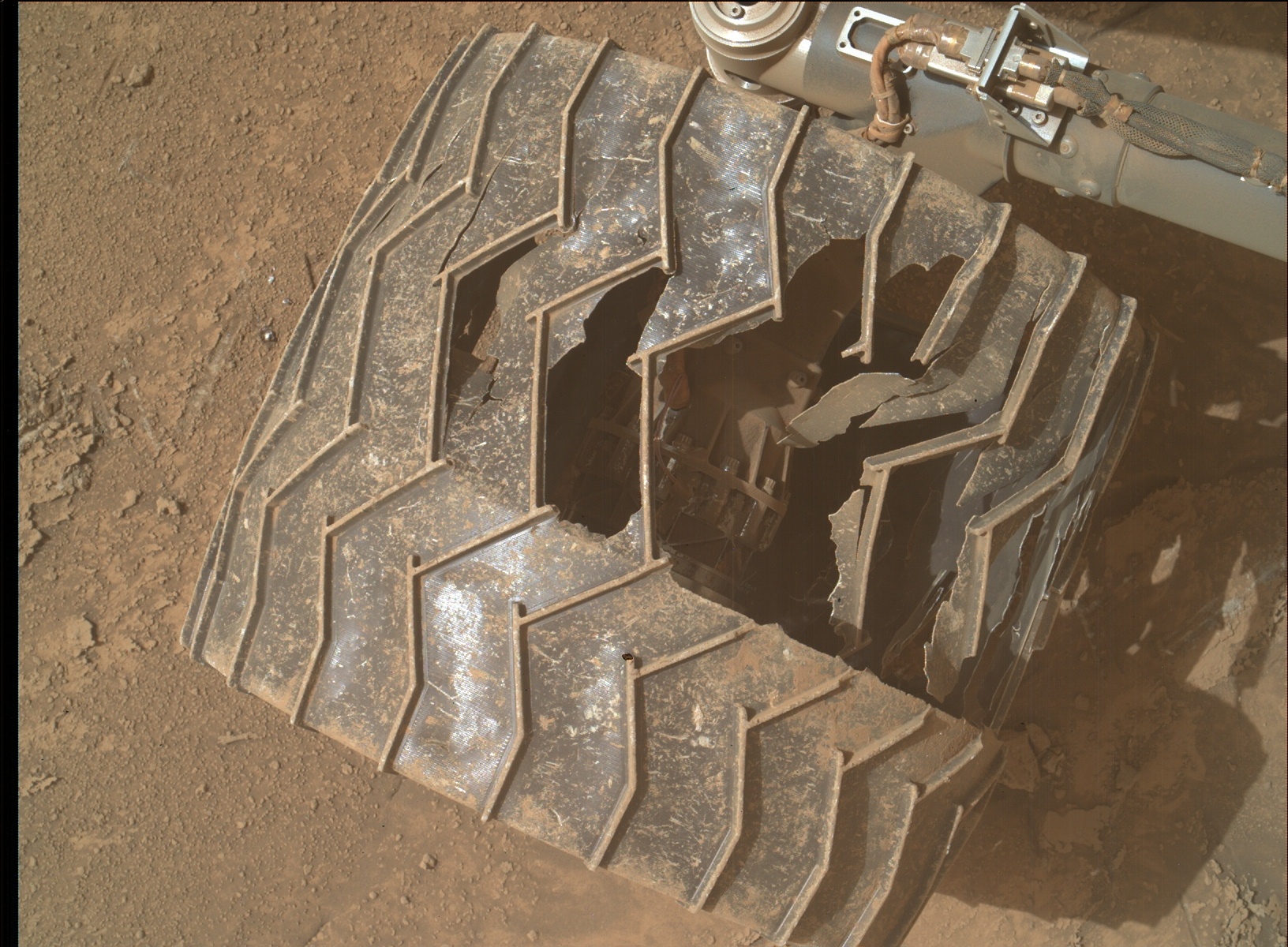
The two photos above (found here and here) focus on one particular wheel of that survey, which I suspect is the same wheel that was the focus of last year’s post. After taking the first image on the left the team moved Curiosity so that the other side of the wheel could be photographed. As you can see, the damage is extensive, so much so that it is possible the wheel could collapse entirely in the not-to-distant future.
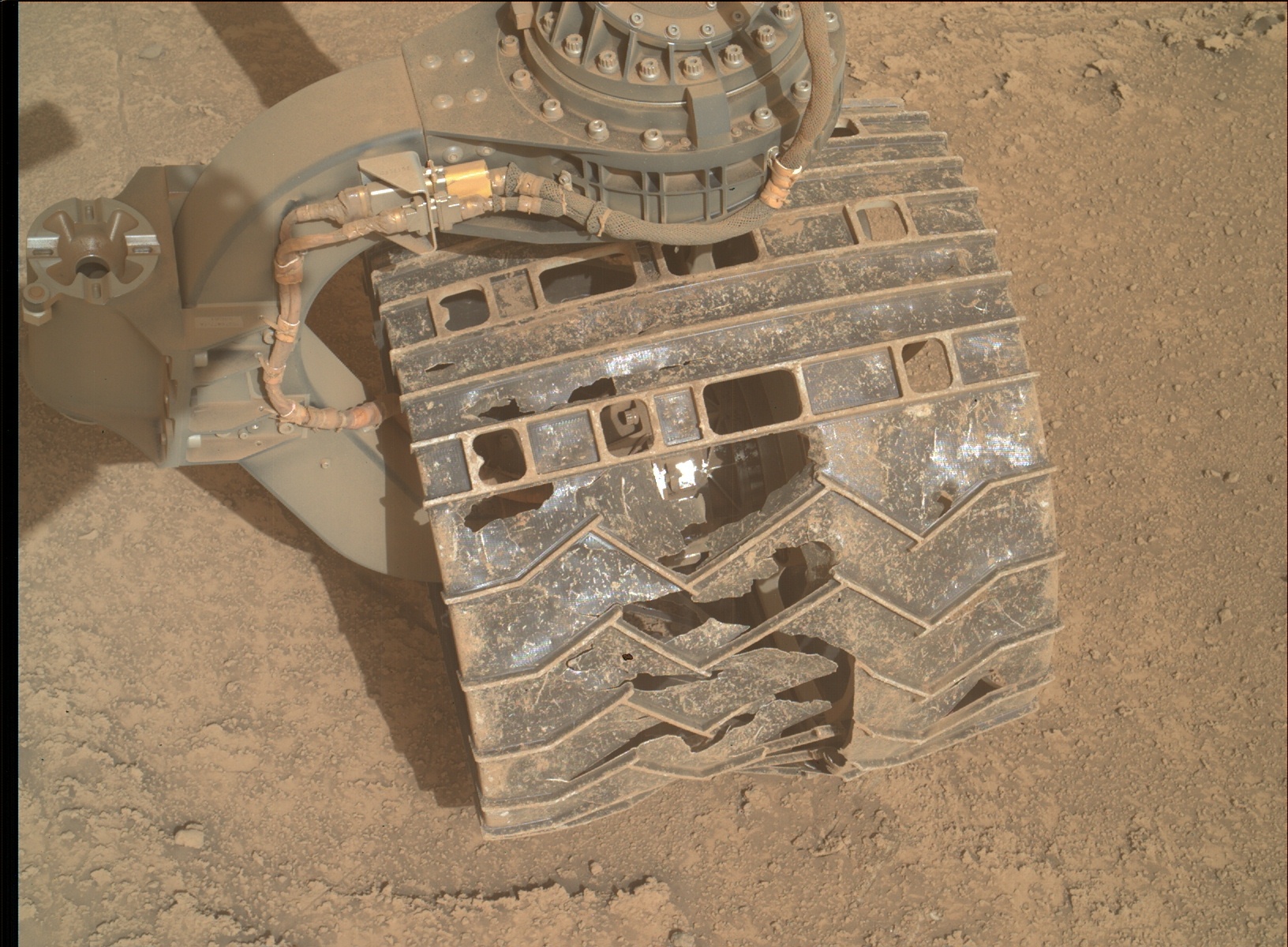
It also looks like another wheel is beginning to see similar damage (see here and here), though not yet as extreme.

The good news is that Curiosity has six wheels, and that it can continue to travel even with the loss of one or maybe two wheels. It also appears that future terrain might not be so rocky.
The bad news is that this wheel damage is likely the one problem that will likely end the mission, possibly sooner than anyone would like. And from these photographs, that end might be sooner rather than later.

On Christmas Eve 1968 three Americans became the first humans to visit another world. What they did to celebrate was unexpected and profound, and will be remembered throughout all human history. Genesis: the Story of Apollo 8, Robert Zimmerman's classic history of humanity's first journey to another world, tells that story, and it is now available as both an ebook and an audiobook, both with a foreword by Valerie Anders and a new introduction by Robert Zimmerman.
The print edition can be purchased at Amazon or from any other book seller. If you want an autographed copy the price is $60 for the hardback and $45 for the paperback, plus $8 shipping for each. Go here for purchasing details. The ebook is available everywhere for $5.99 (before discount) at amazon, or direct from my ebook publisher, ebookit. If you buy it from ebookit you don't support the big tech companies and the author gets a bigger cut much sooner.
The audiobook is also available at all these vendors, and is also free with a 30-day trial membership to Audible.
"Not simply about one mission, [Genesis] is also the history of America's quest for the moon... Zimmerman has done a masterful job of tying disparate events together into a solid account of one of America's greatest human triumphs."--San Antonio Express-News
Out of all the things that could go wrong. No bearings clogged by dust. No communication failures. No radiation damaged chips. Wheels. On the bright side, it’s well (well, well) past its expected lifetime.
_Something_ is always going to be the weakest link. It’s interesting how often people, even very knowledgeable people, guess wrong.
Mark Sizer listed some of the expected failures, and that’s probably why they have not yet failed; someone thought about them. Very knowledgeable people are experts in narrow fields, and are guided by experience. No one had walked the ground, so no one had a granular terrain picture. You places your bets and takes your chances. Coming up on 14 years isn’t too shabby.
“Coming up on 14 years isn’t too shabby.”
Yeah. NASA has definitely gotten its money’s worth out of Curiosity.
And the lessons learned from Curiosity’s experience informed design changes to the wheels on Perseverance, which has fared better as a result.