
Starship/Superheavy launch scrubbed at T-40 seconds
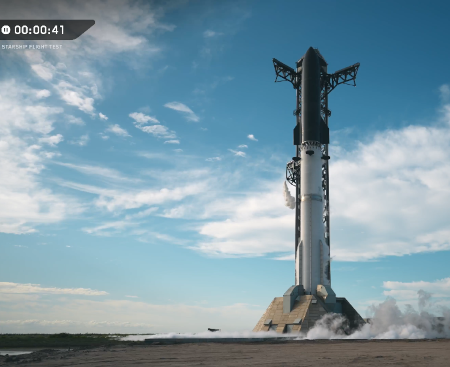
Starship at that hold today
Though SpaceX mission controllers tried several times to restart the countdown when it went into an automatic hold at T-40 seconds due to some technical issues, they eventually decided to scrub the Starship/Superheavy launch today.
At present they expect to try again tomorrow, with a launch window opening at 5:30 pm (central). Expect updates later today or tomorrow.
One trivia fact noted during today’s broadcast. With its new more powerful Raptor-3 engines, Superheavy produces about 18 million pounds of thrust at launch. That is more than twice that of either the Saturn-5 rocket (seven million pounds) or the SLS rocket (8.8 million pounds). And remember, everything about Starship/Superheavy is intended to be reused, with Superheavy already proving its ability to do so.

On Christmas Eve 1968 three Americans became the first humans to visit another world. What they did to celebrate was unexpected and profound, and will be remembered throughout all human history. Genesis: the Story of Apollo 8, Robert Zimmerman's classic history of humanity's first journey to another world, tells that story, and it is now available as both an ebook and an audiobook, both with a foreword by Valerie Anders and a new introduction by Robert Zimmerman.
The print edition can be purchased at Amazon or from any other book seller. If you want an autographed copy the price is $60 for the hardback and $45 for the paperback, plus $8 shipping for each. Go here for purchasing details. The ebook is available everywhere for $5.99 (before discount) at amazon, or direct from my ebook publisher, ebookit. If you buy it from ebookit you don't support the big tech companies and the author gets a bigger cut much sooner.
The audiobook is also available at all these vendors, and is also free with a 30-day trial membership to Audible.
"Not simply about one mission, [Genesis] is also the history of America's quest for the moon... Zimmerman has done a masterful job of tying disparate events together into a solid account of one of America's greatest human triumphs."--San Antonio Express-News
According to Elon a hydraulically operated pin locking the tower arm in place failed to retract.
https://x.com/elonmusk/status/2057609682865254695?s=20
Using super-chilled propellant as it does, a Starship stack doesn’t have a lot of latitude for handling glitches during countdown. The ground controller team worked through about a half-dozen such, but didn’t succeed in clearing the last of them before having to call it a day for thermodynamic reasons. I expect even more than the usual quantity of midnight oil to be burned today and tomorrow. If the launch doesn’t happen tomorrow, it can’t be retried before next Tuesday, the 26th, owing to the Memorial Day weekend and SpaceX’s contractual inability to close the beach during those 72 hours.
I was probably the only one glued to the computer anxiously watching the countdown reset to 41 then 40 seconds
I have read several times that with the
– lower overall mass of the v3 stages
– and the higher thrust / weight ratio of the v3 engines
– and the synchronized ignition of all 33 first stage engines, the Starship will quite noticeably leap off the pad!
I still recall hearing the same thing about the first Shuttle launch, Columbia. And it did not disappoint!!
I’m curious about the “synchronized ignition” of all 1st stage engines, that is new for v3. Why wasn’t it done before? What’s new now?
David Bakin: I am not an engineer, but it is my understanding there were two reasons it wasn’t done on early versions of Superheavy:
1. The plumbing as designed didn’t allow it. They have reworked things to simplify and allow for this.
2. I think they thought if the engines fired all at once it might shake everything apart. Staging the firing was a way to avoid this.
Others readers are more educated on these matters than I, and can correct or add to this.
Ray Van Dune:
Fairly early in the Shuttle program, there was a side-by-side launch comparison between Shuttle and the Apollo Saturn V. Shuttle cleared the tower before Apollo was fairly off the pad.
More information on the simultaneous start: The internal plumbing, particularly around the enormous transfer tube and landing header tanks, means that the initial shock of going from no fuel movement to 33 engines at full throttle can be handled now, whereas in the previous design it would probably have burst things.
A second consideration is that they were looking for ways to minimize launch impact on the flame trench diverter and such, and it was a lot easier to deal with the single condition of all engines running than the variable conditions of a staged ignition.
Both of these things were mentioned in the article SpaceX has up on their site describing V3 and what changed. https://www.spacex.com/updates#starship-v3
The staged-ignition startup of first stage engines on v1-v2 Starship was only by a matter of milliseconds between groups of engines, ostensibly to reduce the shocks to the system plumbing, as Bob suggests.
As far as the shuttle, the real change in liftoff acceleration was due to the use of large solid-fuel boosters for the first time in a manned vehicle! I recall being shocked when I first learned of that!
One of the first two-man crew was asked about fact that the solids were not controllable in any way once ignited. He remarked to the effect that “Yeah, once the solids ignite, we are definitely going somewhere, and going there very fast!”
Elon had a reply to Eric Berger right before the launch attempt last night to emphasize that even a failure of Flight 12 would not be a real setback:
“There is a large pipeline of V3 ships and boosters in the factory. The delay from last launch was due to the almost total redesign of the primary structure, engines, electronics and launch tower from V2.
Failure today will not affect schedule by more than a month or so.”
Of course, it would not be a great note to kick off his IPO, but I’m sure he’s well aware of that. They really do seem to have gone the extra mile to maximize the odds of success on this one.
What is the advantage of full simultaneous ignition vs sequenced ignition?
“Fire all of your guns at once and explode into space”
No launch due to a pin reminds me of a very old poem beginning with….
For the want of a nail, the shoe was lost…
– Cheers –
Chris–
Hilarious! Almost spewed my coffee all over my keyboard.
re Chris: I can see a two disadvantages in sequenced ignition. First you need to be careful to keep the thrust balanced. If for some reason you end up with the thrust not aligned with the main axis you end up with torquing of the structure that might cause issues. The second issue is there will be a brief period (milliseconds?) where you have to have restraints to keep things from prematurely leaving the pad. I think you already have those issues though. The main thing is the tubes of the rockets tend to be rather surprisingly delicate as keeping mass/weight down is critical. I have heard some of the early ICBM/s had to be stored (Atlas? R7?) with gas in the propellant tanks because without it the rigidity of the structure would be compromised,
BillB-Well get someone out there with a sledge hammer. He’ll have plenty of time to get to cover. ‘Once you drive the pin free, run like the devil is on your tail’
Hello Colonel,
There’s been video posted of a big team of guys working hard on the disconnect up in the tower for quite a while last night, and it looks like they’re confident the fix worked. No word on whether sledge hammers were in the kit.
Then again, I think they’ve moved past the sledgehammer phase of the program . . .
It’s becoming clearer now just how ad hoc and experimental most of the architecture and systems were on the old Pad 1 launch complex. In a lot of ways it fared worse than Elon and his engineers expected, and there were a number of capabilities they wanted which they just couldn’t incorporate into it at that time. Then again, they could argue that it worked just well enough to get the data they needed, with 11 test flights, which is impressive in its own way. Everything about the V3 rocket and the new pad and ground systems just looks . . . so much more professional and well thought-out. It really looks like something designed to be *operational*, and likely to achieve it, too.
David Bakin asked: “I’m curious about the “synchronized ignition” of all 1st stage engines, that is new for v3. Why wasn’t it done before? What’s new now?”
Before, engines were started in a staggered order that did not hammer the structure too much all at once,* reducing the vibration on the structure. If all the engines light at the same time, the resulting force puts a great sudden stress on the structure. For many multi-engine launch vehicles, the timing of the start of the main engines is slightly staggered in order to prevent a single jarring ignition transient being imposed on the launch vehicle.
I think that Robert and the others are correct about what is new now. Apparently, they have made the structure in such a way that it can tolerate that enormous sudden shock. They already did a static fire test, presumably they did this simultaneous ignition test at that time, so I think we can be assured that the propellant flows and the ignition transient are not too much for the booster.
Another possibility is that SpaceX is testing this concept of staggering the ignition by igniting all the engines simultaneously, although this seems late in development to do such fundamental testing. Tests of long established rules of thumb have been common during the Starship development.** For instance, on the first launch, they tested the idea of the flat horizontal blast deflector. I’m sure that they were hoping that a flat, concrete launch pad would work on Mars. The concern that rocket scientists and engineers have had for decades is the the acoustic pressure waves needed to be deflected to the side rather than be allowed to bounce back toward the rocket, where the pressure waves could cause damage to the vehicle. There is a lot of acoustic energy in the roar of rocket engines, and it is believed that this energy is best directed away from the launching rocket. SpaceX learned that the world’s largest blow torch was too harsh on that launch pad design, and I don’t know how many troubles that the booster had, during that launch, were caused by acoustic damage and how much was caused by flying chunks of concrete.
Staggered ignition has a benefit, but the downside is that propellants are consumed as the rest of the engines come up to full thrust. The simultaneous ignition of all the Super Heavy engines could save several tons of propellants, allowing for the booster to burn perhaps an extra second, and allowing for more payload mass delivered to orbit.
SpaceX is currently doing battle with the rocket equation, trying to find ways to increase the payload to orbit while retaining enough propellants to return and land the booster and the spacecraft. An extra second of thrust at 4G*** results in an extra 40 meters per second of speed at stage separation. This is ½% of orbital speed, which may not sound like much, but it is a small victory in that battle with the rocket equation.
__________
* To put things into perspective, there are tremendous forces involved in these large launch vehicles.
Super Heavy has 7.5 million pounds of propellants burned in 150 seconds, an average of 50,000 pounds burned per second (25 tons per second). The expected thrust is between 18 to 22 million pounds. Fully fueled, the stack should be almost 12 million pounds, so the liftoff acceleration should be around ½G. Whoops, make that: ½G! Add the exclamation mark.
Saturn V’s unthrottleable (to coin a word) F1 engines each burned almost a ton of RP1 (kerosine) per second and almost two tons of liquid oxygen, generating 1½ million pounds of thrust. All five burned almost 15 tons every second, generating a thrust of 7½ million pounds.
** When an engineer is asked why he is doing something a certain way, his answer had better not be, “because we have always done it that way.” The engineer needs to know more than just how to do something a certain way, he needs to know why he does it that way.
*** During launch, the acceleration starts around, say, ⅓G just off the launch pad, but with the consumption of the propellants the acceleration works its way up to around 4G at stage separation. The upper stage again starts at a lower acceleration — less thrust from the reduced number of engines on the upper stage — and then works up to a high acceleration as it consumes propellants and approaches orbital speed.
Was the simultaneous engine fire a test for the structure in place on the pad, a prototype, that could not be simulated?
Edward notes that Static fire test that presumably executed a full, all thrust on test – simultaneous (alright I’ll type it out) burn. Perhaps they didn’t do that in the static test and in SpaceX form they wanted to test this while they could. It is a prototype.
Edward,
A thousand times, yes. It’s great to have a rulebook, but slavishly following it all the time blinds us to new opportunities or better ways to do things. Understanding the rulebook and what you’re aiming for is what helps you consider when it should be thrown out or updated.
Ray Van Dune,
Yes, Starship definitely leapt off the pad. Quite the sight!
Nate P
“… blinds us to new opportunities or better ways to do things.”
More than that, if a change must be made for other reasons, if the engineer does not know why it is done this way, then he could cause serious trouble by making a change that should not be made.
As for Starship, it looked to me that it took about seven seconds to clear the 400 ft tower, and by my calculation that is an acceleration of about 16-ish feet per second each second, which is ½G. I think that is similar to the Space Shuttle’s acceleration at launch.
Edward
Rigor
Staggered ignition might waste propellant, but extend engine life.
Lighting all those engines at once cannot be good for it.
As for Starship taking off from Mars…
I might want smaller hypergolic ascent stages prepositioned early…. astronauts harvesting one-way bi-conic Starship cargo pods.
The first goal would be to prep a crater or lava-tube opening for a true Mars Starship.
Maybe Teslabots could do this via telepresence.
This would push back a human landing, but help build excitement.
Jeff Wright,
Rather, depending on how an engine section is designed, simultaneous ignition can be managed readily, as we saw SpaceX do with IFT-12. SpaceX has extensive experience already with the environment the Raptors experience during boost, which is why they’ve made the switch from staggered to simultaneous ignition. The shock of ignition is unavoidable no matter how many engines a vehicle has-the trick is to be able to absorb that energy and distribute it so it doesn’t cause unexpected wear.
This completely defeats the purpose of using methane/oxygen engines and planning to make easy use of local Martian raw materials, cuts down on how much payload SpaceX can send to Mars each synod, and drives up their costs versus just finishing Starship. You routinely suggest doing anything except completing Starship development for any task, never mind the unnecessary delays or extra expense that entails. Having a landing pad right away is not a hard requirement, though at present we don’t know how many mission cycles Raptors could survive on Mars before needing replaced. SpaceX probably has good estimates, but I’m not privy to them.
Telepresence isn’t really doable unless there are humans in Mars orbit–from Earth it’s completely unmanageable. It seems more likely to me that SpaceX would rather send sufficient Starships so that even if a few fail, when humans arrive there are plenty of vehicles they can use to return, along with existing propellant production and power generation.