
SpaceX completes a largely successful 12th orbital test flight of Starship/Superheavy
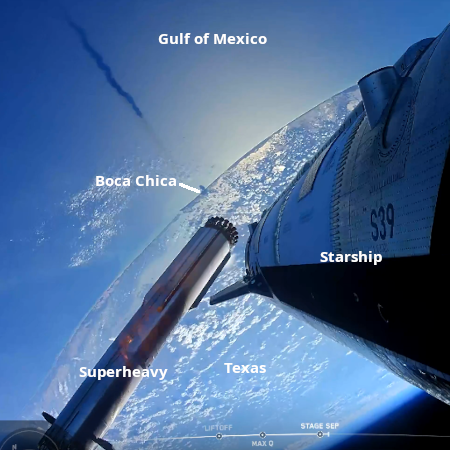
SpaceX today successfully completed its 12th orbital test flight of Starship/Superheavy, with Superheavy lifting off and getting Starship into its preliminary flight path and Starship then firing its engines and getting into a workable orbit that naturally decayed over the Indian Ocean.
There were issues with several Raptor-3 engines, being used in flight on both Superheavy and Starship for the first time. During launch one Superheavy Raptor-3 engines cut off prematurely, forcing the other 32 engines to compensate for the loss. Then, after stage separation (shown in the screen capture to the right) Superheavy’s boost back burn cut off prematurely. As a result, the booster did not come down off the coast for a soft vertical splashdown as planned, but came down in the Gulf, mostly uncontrolled. It did successfully fire some engines for the landing burn, but that splashdown was hard.
As for Starship, it also had one engine shut down prematurely, requiring the other five engines to burn about 90 seconds longer to get the ship up to an acceptable orbit. Because of these engine issues, the engineering team decided to forgo a test restart of one Raptor-3 engine.
Starship then successfully deployed 20 dummy Starlink satellites, followed by two operational Starlink satellites that were modified expressly to provide visual observations of Starship and its heat shield while it is space. Only a few minutes later engineers were able to broadcast those observations, showing Starship as seen from nearby.
Starship then successfully executed its planned maneuver leading to a soft splashdown in the Indian Ocean.
Overall this sets the stage for a quick follow-up. Expect new test flights over the summer and fall, coming almost monthly. The company has made it clear it wants to do a two-week refueling mission with two Starship before the end of the year, as well as begin using Starship to deploy the bigger upgraded Starlink version 3 satellites.
Though this flight did not complete a full orbit, the rocket got Starship into an acceptable orbital path, allowing it to do most of the orbital testing desired. I consider this a success for the 2026 launch race:
60 SpaceX
28 China
8 Russia
7 Rocket Lab
For the third straight year SpaceX leads the entire world combined in total launches, 60 to 51.

On Christmas Eve 1968 three Americans became the first humans to visit another world. What they did to celebrate was unexpected and profound, and will be remembered throughout all human history. Genesis: the Story of Apollo 8, Robert Zimmerman's classic history of humanity's first journey to another world, tells that story, and it is now available as both an ebook and an audiobook, both with a foreword by Valerie Anders and a new introduction by Robert Zimmerman.
The print edition can be purchased at Amazon or from any other book seller. If you want an autographed copy the price is $60 for the hardback and $45 for the paperback, plus $8 shipping for each. Go here for purchasing details. The ebook is available everywhere for $5.99 (before discount) at amazon, or direct from my ebook publisher, ebookit. If you buy it from ebookit you don't support the big tech companies and the author gets a bigger cut much sooner.
The audiobook is also available at all these vendors, and is also free with a 30-day trial membership to Audible.
"Not simply about one mission, [Genesis] is also the history of America's quest for the moon... Zimmerman has done a masterful job of tying disparate events together into a solid account of one of America's greatest human triumphs."--San Antonio Express-News
Based on super heavy having trouble with the boot back burn, are we dealing with dreaded sloshing again?
I was super excited how good Starship looked when it did the flip maneuver over the buoy, I look forward to the next test flight!
I view the numerous engine outs as a step back but hopefully SpaceX will get that figured out sooner rather than later. The fact that they still haven’t managed to even try and light an engine for orbit adjustment after three (four?) missions that had that as an objective is my biggest concern.
David Eastman: Considering this was a new engine design, the engine issues are NOT a step back, they are simply part of the process of verifying the new engine. That so few engines failed (compared to those first test launches were almost half failed) I think is an excellent sign.
Overview
https://m.youtube.com/watch?v=NusIDi9Iu-M&pp=ugUEEgJlbg%3D%3D
Bill Buhler,
The symptoms looked similar, but I can’t imagine how they could let that problem happen again. There had been changes to Version 2 that were there to prevent it.
On the other hand, I don’t have any other hypotheses on what went wrong with the boost back burn.
On different items: The Raptor 3s did OK. One went out on Super Heavy about 100 seconds into the mission, and one went out on Starship about ten seconds after lighting.
I was under the impression that SpaceX would not put a Starship into orbit until they did another relight of one of the engines, so I am concerned that they will have to wait yet another flight until they go into a true orbit.
The expanded Pez dispenser worked well, so progress is happening there. It was quite a sight to see Starship from that last pseudo-Starlink test unit’s camera.
The maneuvering that they did deep in the atmosphere shows that they have much control over the landing guidance. It is not just a straight down bellyflop, anymore.
I noticed that the reentry was not as colorful as previous ones, mostly yellow rather than purple or pink and it didn’t seem to streak as much as before.
In conclusion, we are one step closer to returning to the Moon and to getting to Mars.
Still some engine, tankage and plumbing dynamics issues to work through it would seem. Not nominal, but the Starship stack once again demonstrates it can play hurt. I’d give this mission an overall grade of B+.
Now, let’s see if we can get a follow-on mission by sometime in June.
All: The following comment is by regular reader Mike Nelson, who had problems getting his comment through today:
The failed flip/boost back is a big disappointment given the effort invested in rearchitecting the downcomer fuel system. I agree slosh could be a concern as the rotation imparted by the hot staging appeared surprisingly aggressive. Perhaps just a bit too aggressive.
That aside the rest of the mission was quite impressive. That beast essentially lept off the pad compared to previous flights and the lumbering New Glenn. The loss of one engine during boost is of little concern as it is designed to tolerate losing up to 3 without threatening mission success. And the resilience to reach orbit even after losing an engine on the ship (and early into its flight) was impressive indeed.
Most impressive of all however was how the flight controls handled the loss of that ship engine, not only getting the ship to its intended orbit, but then steering it back down to a precision landing in the Indian Ocean despite the drastically different ascent profile this must have imposed and with just a half orbit in which to achieve this feat.
Finally in the brief clear shot of the ship just before it went boom the heat shield looked to have held up quite well too, although the resolution is insufficient to tell for.
If Pad 2 survived pretty much ready to go again with minimal refurbishment then this was a solid A- performance imho.
Very impressive recovery by Ship after early loss of RVac, but with a minimal payload.
I also noted the essentially flat glide for an extended period during reentry at around 60 km! This baby can fly!
Yes, the hot staging was quite aggressive in appearance. Could it possibly have overwhelmed new anti-slosh design? Makes me wonder if staging rotation was intentionally “pushed”?
The cargo bay images, both from inside and from the deployed satellite, gave the feeling of science fiction becoming science in real-time. Open the bay door, Hal.
Further thoughts: the N1-style “lattice” interstage was brand new this flight. Could all the engine failures have stemmed from a too-rapid hot-staging that sloshed the first stage fuel and somehow damaged the second stage RVac?
Remember that 100% of the side-thrust at hot-staging now comes from the sequence of RVac firing against the top of the first stage, not channel exhaust through an interstage ring as previously.
David Eastman – There have been at least two other Starship engine relights in space, IFT-11 and -10. There might have been a third but unable to confirm this morning.
Concern with multiple engines out is that the Raptor 3s may be a bit more fragile than the -2s. Don’t think so, but two confirmed engines out, one on Booster and one on Ship are a concern, along with whatever happened with the boostback and landing burns are worrisome. OTOH, all engines tested well before launch with multiple hot fires. Onward. Cheers –
A few comments:
I thought the overall engine performance, given that this was the FIRST flight of the Raptor 3 engine, was exceptional. I’m betting the root cause of the lost engine on Ship will be found to be a too-conservative trip setting. Similar for the booster engine lost on ascent.
The booster performance uphill was amazing. Thing leapt off the pad, showing that takeoff thrust ain’t an issue. Comparisons with flight 11 sequencing shows tower clear for flight 11 was T+14s, while flight 12 was t+10s! MECO was 10s earlier, and staging speed was 1000+KPH higher. Yikes!
The hot staging obviously needs work, though. I think they engineered their best of idea of how this new setup would behave, but the data returned will result in future staging being vastly improved. They have a strong track record in that effort.
Ship flew GREAT, starlink sim dispensing went as planned, and can’t wait to see the rest of the video from the on-sat cameras. I too was surprised by the slight gain in altitude on reentry, but given that they’re trying to minimize peak heating at that point, it makes a lot of sense. Proof that almost anything, even a graceful water tank, can be made to fly! Not disappointed that the Raptor relight was aborted, I think the engine team had their wits tested pretty hard and were happy to be in a clean suborbit.
Grade: A (allowing for so many firsts)
Faster fills can equal more abuse…. methane does not like to be sloshed:
https://phys.org/news/2026-01-sloshing-liquefied-natural-gas-cargo.html
Parallel staging is less violent, and if you really want reuse, then that demands both stages separate off to the side. The less the abuse, the longer the service life.
Perhaps a larger barge with a catch only tower could be placed down range.
An SLS/wet-workshop model avoids these concerns.
Winged fly-back boosters reduce slosh and re-lights, allowing for longer life and greater re-use.
The SLS core doesn’t maneuver violently and avoids slosh by simply burning all the way to orbit –where it can be re-used as floor-space, so no need for TPS or control surfaces.
The payload can either stay in space, or return to Earth with only it needing heat-shield material…as opposed to trying to cover tankage with TPS by the acre.
Scott Manley this morning synched up the telemetry with the video and found flashes in the engine bays at both Booster and Ship engine out. No good explanation yet for boostback other than Booster seemed to go the wrong direction. Video at the link. Haven’t made it thru the rest of the Usual Suspects for their after action videos. Cheers –
https://youtu.be/2kxanBYTAaY
It’s important to step back and consider where Elon has set the bar. A perfect score of 10 out of 10 requires dropping off 100+ tons of propellant at a depot in a higher-than-minimal orbit, catching both the booster and the tanker ship with the tower, and avoiding any mishaps that would unnerve people living beneath the ship’s reentry flight path. All with minimal wear and tear, allowing a re-fly rate of 100 times without refurbishment. In an absolute sense, IFT12 was only a 3 out of 10. Don’t forget – we live in a world where the Space Shuttle and SLS achieved at least 8 out of 10 scores right off the pad on the very first try.
Jeff Wright,
SpaceX has already designed slosh baffles into Starship to tackle it.
Less violent doesn’t make it easier to engineer. You’ve got significant issues with thermal stress, you have to have a heavier central core, reducing payload; your bending moments are higher, meaning you need yet a stronger core, further reducing payload; so far as reuse goes, you need more infrastructure to catch multiple boosters, your maintenance gets more difficult because the boosters no longer wear at similar rates (and you can’t just use them interchangeably either), the core stage experiences more structural stress and thus fatigues faster–so it’s not automatically a case of ‘parallel staging=easier reuse’ at all.
Who is going to pay for this and why? I’m asking honestly, I see no realistic path forward to spend the billions needed to make the SLS usable as a wet workshop or give it wings. It cannot stay in orbit and deliver a payload as-is.
This misses the point of reusing upper stages, which is to fly more often at lower cost.
I do not understand why you advocate for the far more expensive and less capable (and less likely) option of trying to adapt the SLS versus simply finishing Starship development. IFT-12 looked great upon splashdown, which is a great step towards reusing both stages.
Marcus House coverage
https://m.youtube.com/watch?v=aPtMGJvJ72g
Jeff Wright,
What you say about SLS anent Starship is true as far as it goes, but also irrelevant. Starship is being designed to support several use cases that each require hundreds of launches per year – deployment of massive LEO satellite constellations (three – Starlink, Starlink Mobile and AI data centers – which I hope get dubbed “Starthink”), frequent crew and cargo missions to the Moon in support of industrialization efforts there, and preparations for dispatch of large armadas to Mars every 26 months.
Complete, low-maintenance, quick-turnaround vehicle reusability is absolutely required to make all of that economically feasible. That is why SpaceX has chosen, in the words of the late JFK, “to go to the Moon and do the hard things.”
SLS can’t do any of that because it’s expendable, costs 10 figures per copy and each such copy takes well over a year to build. I remain dubious that even liberal application of the lash to its contractors by Administrator Isaacman is liable to reduce that production interval to even just a single year – not that doing so would change anything fundamental about SLS’s unsuitability for any realistic use case anent either manned or unmanned spaceflight.
Phil Swan,
Based on the assigned grades, teacher seems to have both a pet and a whipping boy.
STS-1 came within a hair’s breadth of catastrophe a number of times. Orbiter Columbia returned with significant structure and TPS damage. Starship IFT-12, to all appearances, seems to have suffered minimal damage to one engine and no TPS damage at all.
STS-1 carried no payload. IFT-12 carried 22 deployable satellite simulators and test articles and deployed them all. STS almost never carried anything close to maximum payload. Operational Starships will have to carry maximum, or near-maximum payloads on most missions.
To Nate,
I wasn’t saying SLS should have wings, but something like Pyrios except a flyback.
I would like to see MAF produce an SLS tank for a bullet type Starship tanker, though methane would be a stumbling block to wet-workshop use—where hydrogen boil off is a feature, not a bug.
There were those who looked at RS-25 for methalox. Here is where tripropellants could matter. Say some SpaceX engines and tankage falls away…I could see an SLS core actually leaving Earth orbit with a single hydrogen engine.
I would have Space Force pay for the kerolox winged strap-ons, in that I could see them alone thumping smaller TAVs aloft.
You want to try different approaches.
I would like to see SpaceX and MSFC work together on projects.
Jeff Wright,
The question remains: but why? Solids don’t lend themselves to rapid, cheap reuse. There is no point to even trying this.
It’s not going to happen, and tanks can vent propellant, should someone decide to be foolish enough to desire a wet workshop. ‘Bullet type’ Starships are not a thing.
Again: but why? There are no advantages here versus refueling a Starship in orbit.
Trans-atmospheric vehicles do not exist, will not exist for many years if ever, and the USSF has no need for this. They’ll just buy services from the usual suspects.
The private sector is already trying multiple different approaches.
You have many wants. I haven’t seen you identify an actual need for anyone else yet.
Nate P: You forgot to put the closing “blockquote” tag on the final quote. I have fixed it for you.
A suggestion: Insert both the opening and closing tags FIRST and at the same time, then paste the quote between. That way you won’t forget.
Pyrios isn’t a solid…it is like Jarvis…two F-1s
That wasn’t to be winged.
Hu Davis and Ted Talay (pulse-Orion fame) wanted this:
https://www.space.commerce.gov/wp-content/uploads/2002-10-suborbital-LowRes.pdf
More pix of IFT-12
https://forum.nasaspaceflight.com/index.php?topic=64957.msg2791371#msg2791371
Thanks Robert!
Jeff Wright,
Ah yes, my mistake. Regardless, parallel staging introduces a bunch of new problems that in line does not. Recall that even Musk said Falcon Heavy was substantially harder than SpaceX expected, and they aren’t repeating that for Starship.
When the goal is cheap, full, rapid reuse; every design choice has to be made towards those ends. Parallel staging doesn’t help. Solids don’t help. Wet workshops don’t help. Focusing on potential propellants that cannot be produced in industrial quantities doesn’t help. Exotic materials that can’t be mass manufactured don’t help. What does help? Designing for cost, around mass manufacturing, flying often, and being willing to experiment (to name but a few things). The way designers created expendable rockets have some lessons to teach, but only some. We now optimize for different targets, which means writing a new rulebook.
Any reports on how the pad stood up?
Chuck wrote: “I’m betting the root cause of the lost engine on Ship will be found to be a too-conservative trip setting.”
Could be. Just because an engine works on the test stand does not guarantee that it will work in flight. There is a difference between a stand mounted to the earth and the vibrations to and from the structure in flight. Making the trip settings conservative is standard practice for early tests and early flights. It is being cautious on the safe side.
__________
Phil Swan wrote: “In an absolute sense, IFT12 was only a 3 out of 10. Don’t forget – we live in a world where the Space Shuttle and SLS achieved at least 8 out of 10 scores right off the pad on the very first try.”
Don’t forget, the first Space Shuttle launch was less of a development flight and more of a protoqualification test, but probably without the qualification levels of testing. Let’s not over-stress a manned mission.
__________
Jeff Wright wrote: “I would like to see SpaceX and MSFC work together on projects.”
With apologies to Nate P, who points out that the two groups already work together: Only if the guys at Marshall Space Flight Center learn from the guys at SpaceX.
Well put Edward.
Testing and models are great but until you start launching and getting real data to some degree its all guess work. Really good guess work but the real world has a way kicking you in the face when you least expect it.
It would have been nice to see better results from this flight but SpaceX has shown the ability to improve as they get more data. There is little reason not to expect that here. Real question right now do we see quick turn around with flight 13 or do they want to apply fixes first. I would bet on the second based on SpaceX track record over the last year.
Ed Wright, do you even listen to yourself?
Had NASA gone with a simple Shuttle-C for the STS follow-on, by now, they would have had hundreds of flights using the essential Shuttle stack – ET, SRBs and a cargo blivet with disposable SSMEs. Michoud had an on the shelf proposal for reusable strap-ons when I did O’Neill’s ET report in 1986. Nobody was interested, similar to the lack of interest in Chrysler’s Project SERV in 1968 which would have also worked. Sadly, NASA and congress wanted wings.
Instead, they opted for the unaffordable monster they are attempting to fly today along with your interest in growing out Falcon Heavy, which Musk already acknowledges was a lot harder than they expected while ignoring the success of even the modest Block 2 Starship Booster stack.
If you choose stupid, please try not to be surprised when stupid is actually stupid. Respectfully submitted for your consideration. Cheers –
Shuttle-C had some of the same enemies as SLS.
Dwayne Day has this idea that nothing should be spent on nuclear spacecraft, in the the planetary scientists don’t need it.
JPL uber alles
So help me, had MSFC wanted to build FH or SS, the Handmers would have tried to kill them too.
My philosophy is that you don’t subject LVs to what amounts to a shuttle RTLS abort as a matter of course.
RTLS is something that only Falcon seems to endure well. The horse-breaker approach won’t work with a Clydesdale that can buck you away and stomp you flat.
Varda believes there is a market for returnable space goods. Tiny capsules will not service that market. A Buran like shuttle-2 can.
For space manufacturing, you need floorspace.
This is why the high-volume of hydrolox is a feature, not a bug.
The steady ascent profile also has the benefit of not being as punishing to the launch vehicle. RS-25s have flown more often than Raptor….but if a reusable SLS (or the original shuttle) had the same flight profile—I could easily see it suffering engine losses that it never experienced before due to a more leisurely flight profile.
You can baby a rocket and still find ways to make money—that’s my point.
But if you want to tread on road spikes rather than smooth pavement—that’s on you.
“Parallel staging is less violent, and if you really want reuse, then that demands both stages separate off to the side. The less the abuse, the longer the service life.”
Okay, so let’s look at actual engineering practice on that, present and projected near-future. There are (just barely) two cases of the first, both half re-usable; and a few more being actively worked on, to look at next.
Space X’s Falcon 9, two serial stages. Literally hundreds of flights, with booster re-use totals approaching 40 per stage. Avoids “the abuse” by cold staging in a near-vacuum between (1st stage) shutdown and (2nd stage) startup (using a pneumatic “pusher” ram); though recent practice is more like “warm staging” showing clearly visible evidence of plume-on-booster interaction, see most any launch video (without “boostback” etc.).
Blue Origin’s New Glenn, two serial stages. Less obvious exactly how its staging works (no public video I’ve seen); but apparently also some kind of fairly conventional cold staging in near vacuum. One (count it, one) booster re-use to date, using swapped-out engines. Still on the board.
Now we get into speculation, prediction, hopes and dreams. One candidate for re-use *was* the operational Rocket Lab Electron, with booster recovery and refurbishment and firing of flown engines. Now dropped. Also fractional re-use plan by ULA, via some sort of engine re-entry pod thing (“Smart Re-Use”), complete with (now embargoed) video making merry fun of the exact way Space X would soon demonstrate routine re-use of entire stages.
Rocket Lab’s (upcoming?) Neutron, two serial stages, half re-usable. It features the unique(?) idea of enclosing its second stage *inside* the first, with integral fairing halves, the “Hungry Hippo” system. The staging is (again) presumably in near-vacuum, with some sort of “pusher” launching the then-nearly-weightless 2nd stage outside.
Stoke Space’s (upcoming?) Nova, two serial stages, entirely re-usable at least by design and intent. Again, it seems quite likely to be staging in vacuum, though I’ve never heard much detail. Their *truly* innovative 2nd stage engine design (quasi-aerospike with many-multiple peripheral thrust chambers around a regeneratively cooled heat shield) *might* allow some form of hot-staging; but I’d guess cold for simplicity.
(Yes, there are indeed more that could be added; but I think I’ve hit the highlights pretty well. Remember, e.g., Relativity’s never made orbit.)
Not much “abuse” visible in any of it. And now, the elephant in the room:
Space X’s Starship, two serial stages, fully reusable by design. Lots of potential abuse on the booster, due to its unusual fully hot-staged way of separating, with the first-stage engines still (partly) running. Earlier versions of this one (as we know) have recovered and re-used first stages despite all the above (by using an expendable interstage ring). Now, we’ll begin to see how recovery and re-use actually work out with its new Version 3 variant… here it’s worth noting that one milestone on the last flight was a significant payload delivered to (marginal) orbit, something close to 40 tons (short or even metric), which is more than the Shuttle ever delivered (max. 65,000 lb. or so, I seem to remember).
Not a one of ’em uses anything but serial staging, two stages to orbit.
By contrast, let’s look now at the Falcon Heavy, which does use parallel staging: “two and a half” stages to orbit. Partly re-usable, only the two side boosters have ever been recovered and re-flown, though that’s become almost routine on many less-demanding missions. The center (“core”) stage between those side boosters has (despite a few interesting tries) never once even been recovered; and there’s at least one good reason why.
Assuming the side boosters separate first (and they basically have to, if staging isn’t going to be all 3 shut down at once), the center booster is going to burn even longer and end up going yet faster. Without enough fuel margin to do a big-ish “slowdown” burn, it’ll have trouble on re-entry. It seems inherent to this design concept that any center booster must be at least as robust, at least as hardy to re-entry loadings (remember re-use was pooh-poohed, once upon a time, based partly on the huge differences in mechanical and thermal loads between ascent and re-entry). So, it seems pretty inescapable to me that parallel staging, unless any side stages do separate very “early” by current practice… makes it harder, not easier.
And nobody (in the re-usable or wanna-be reusable real world) does it.
Sometimes, reality is not your friend. (Pro tip: make friends fast!)
agimarc,
Did Edward and Jeff merge into a superbeing? I kid, I kid.
Jeff Wright,
Why should anyone care what Dwayne Day says about anything?
I’ve long wondered why you believe things like this. Is it because you think that opposition is primarily about who is doing something, and thus solely boils down to partisanship? Don’t get me wrong, MSFC shouldn’t be in the business of developing launch vehicles, but that’s a separate question.
Starship’s boostback burn is significantly less punishing than a Shuttle RTLS.
We’ve debated this before–well, I debated it. You stated an absolute and then never defended it. Using my previous example, a few hundred pounds of pharmaceuticals can be worth dramatically more than dozens of tons of steel; and you’re also making the implicit assumption that their present vehicle is the largest they’ll build, when a more logical assumption is that it’s ideal for testing what they can make profitably before both expanding in size and frequency of flights. They also are willing to put money behind their assumptions, whereas practically no one wants a ‘Buran-like Shuttle 2.’
It depends on what you’re making. It seems you want the space manufacturing market to be immediately huge and making lots of money. That is not realistic.
As for volume, it would be substantially cheaper to get large amounts of it through buying expandable habs such as Sierra’s LIFE-5000, scaling up Max Space’s habitat under production (deploying four or five of those aboard Falcon 9s would give you more room for less cost than a single SLS launch, and it could be done far faster, too). or paying SpaceX to build and deploy large pressure vessels from Starship, versus spending the billions necessary both to redevelop the SLS to stay in orbit and make it usable as a wet workshop.
As of IFT-11, more Raptors have flown (468 total including IFT-12) than RS-25s (413 including both SLS launches), though to be fair, both some RS-25s and some Raptors have been reused, making it a bit murkier. However, the gap will continue to widen, and not in the RS-25s’ favor.
Lambert’s Problem,
Yes. It’s not that we can’t do parallel staging or that it has no benefits, but the tradeoffs are substantial, and for what most companies are trying to do, not worth it.
Can someone explain, perhaps you JW?, what this “wet workshop” thing is?
David Bakin: The wet workshop concept was first conceived during the development of the Saturn-5, but became most popular with the shuttle. You see, the shuttle’s big external tank always reached orbit. Engineers suggested keeping it there, draining its leftover fuel, and using it as the hull for a space station.
Lots of research over the years was done to show this could be done, but NASA was never interested, and so all hundred-plus external tanks were purposely deployed to burn up in the atmosphere.
Some still propose it for other big rockets.
Apologies, Ed Wright. A bit more frustrated than I should have been this morning.
You can find the SSI ET Report at: https://ssi.org/reading-old/ssi-report-on-tank-applications. Cheers –
David Bakin,
To elaborate somewhat further, the reason it’s not practical with the SLS is that while the SLS core does reach a high altitude, it doesn’t stay in orbit once it gets there, the RS-25 isn’t space-startable, the core isn’t designed to handle repeated thermal cycling, it has no life support systems, radiation shielding, or a docking mechanism; to redesign it to both leave the core stage in orbit and to send Orion to the Moon probably isn’t fiscally reasonable–which is to say that it’s possible technically, but it wouldn’t make sense versus doing something else. The mass necessary to make that happen would be taken directly from what we could allocate to Orion and the ICPS, and so the rocket would require extensive (and expensive) upgrades to manage it.
Hi fellow readers!
Allow me to translate another inscrutable Jeff Wright statement:
“So help me, had MSFC wanted to build FH or SS, the Handmers would have tried to kill them too.”
Jeff here is referring to this blog post by Casey Handmer https://caseyhandmer.wordpress.com/2025/10/31/nasas-orion-space-capsule-is-flaming-garbage/
I highly recommend you read Casey’s post.
Jeff doesn’t seem to understand that Casey’s complaints have nothing to do with WHO did the work, rather it’s all about the RESULTS (or lack thereof). If SpaceX had built SLS, and Marshall (MSFC) had built Starship/Super Heavy, why then we would all be cheering on MSFC! and SpaceX would be bankrupt… with lots of SpX engineers fired because they did a poor job of optimization.
Casey himself said to Jeff: “You are most welcome to write a rebuttal and I will link it near the top.” but Jeff hasn’t taken Casey up on that offer, I wonder why? Come on Jeff, we want to see your analysis supporting Orion. And your answer cannot simply be “I like the people at Marshall.”
Steve Golson,
I remember that post. I’d love to see a well-written rebuttal, but I don’t think we’ll ever get one. That requires having enough respect for other people that you value addressing their concerns, and I haven’t seen Jeff demonstrate that much respect for anybody.
Jeff Wright wrote: “Varda believes there is a market for returnable space goods. Tiny capsules will not service that market. A Buran like shuttle-2 can. For space manufacturing, you need floorspace.”
Varda is right. We all believe that there is a market for goods manufactured in space to be employed here on Earth. Medications have always been an example of a value add that is worth the high cost of launch into orbit, and now that the cost is much lower, the profit is much more likely, despite a tiny capsule factory. “Floorspace” is not mandatory, so a shuttle-2 is not mandatory.
We really do not know what anyone means by a comparison with Buran. It did not prove to be useful or affordable. Or reusable. All we know is that it could fly two orbits and land again, but we have no idea of its actual cost, its payload capacity, or its ability to land with a payload aboard. Maybe we will need something more like the Space Shuttle or the X-37. Dream Chaser or Starship may fit the bill, and they are already commercially owned.
What we need is a manufacturing vessel that does the job. Varda has shown that it has one. Whether Varda scales up its orbital manufacturing facility is up to them, but the competition that is working to enter this market seem to all be planning similar scales of capsule. The manufacturing scale is right for now.
“You can baby a rocket and still find ways to make money—that’s my point.”
SLS is too expensive and flies too infrequently for there to be many ways to make money with it, but there are existing better rockets — babied or not — to use to make money. That is everyone else’s point.
Maybe SLS has been babied and pampered so much that it is spoiled and entitled, making it the useless, privileged, blue-blooded aristocrat that it is, buoyed up by Congress.
No one wants to use it to loft a telescope to orbit, or a space station module, or any satellites. NASA rejected it for the only probe that Congress had wanted to use SLS for. Congress only wants to use it for three more Artemis flights. SLS is so expensive that only government can afford it, and that government only wants it for one purpose and no more.
“but if a reusable SLS (or the original shuttle) had the same flight profile—I could easily see it suffering engine losses that it never experienced before due to a more leisurely flight profile.”
To continue inappropriate comparisons, if Starship were intended to be expended, like SLS, she would already be outperforming the aristocratic vehicle. Instead, she is intended to outperform the reusability of the Space Shuttle. Starship’s development cost still is less than the Shuttle’s, adjusting for inflation. She is shaping up to be superior to both SLS and the Shuttle and so inexpensive to manufacture that there can be scores of them available for use, not just four or one at a time.
“Parallel staging is less violent, and if you really want reuse, then that demands both stages separate off to the side.”
Side-mounted stages is what killed all of the fourteen dead Space Shuttle astronauts. Challenger, because a leaking SRB joint burned through the external tank. Columbia, because debris from the external tank struck the Orbiter’s leading edge. I’ll stick to stick rockets, thank you very much.
___________
Lambert’s Problem,
You wrote: “Sometimes, reality is not your friend. (Pro tip: make friends fast!)”
“No plan survives contact with reality.” — Unknown
“Reality betrays us all.” — Benjamin Hoffman, Hoffman
Some people are unencumbered by reality. To them, the ideal idea is not only possible, it is definitely doable, if only someone (else) would do the work to make it happen. Oh, and to them the cost of such achievement is low, even when the stated cost of the rocket is high, because someone else’s money will be used. Additionally, the practicality of the accomplishment is high, even when the announced launch cadence is low.
Those people dream that the failed projects of the past and present are the best, much better than the innovations and improvements made since those failures. To them, projects are for their pleasure rather than for the benefit of society and the owners of the projects. There are things that they would like to see, but those things are expensive and impractical.
We engineers undertake projects by starting with some ideal idea, which somehow comes with requirements, and immediately we run into the need for compromises in order to plan a design to meet each requirement. Further tradeoffs must be made as the plan begins to contact reality, as the contradicting requirements conflict with the ideal, and as the budget collides with the actual costs.
Project Apollo was a simple idea with minimal requirements: Put a man on the Moon and return him safe to the Earth, all by the end of the decade. Science fiction already had a solution: 1) launch a few men in a V2 rocket, 2) land it on the Moon, 3) get out and fight the Moon Monster, and 4) get back in and fly the V2 back home. Reality betrayed the science fiction fan at step 1.
Project Occupy Mars is a simpler idea: Colonize Mars. Science fiction already has a solution: 1) Land on Mars, 2) get eaten by martians, who then grok mankind, 3) the surviving baby returns to Earth, and 4) he starts a religion. Um, maybe we need a better plan.
To Robert Zimmerman,
Thank you for acknowledging the potential use of the old Shuttle ET. I think a lot of Gene Meyers and Mr. Holderman, who also wants to see hydrolox cores harvested
A single SLS core has more floorspace than all of ISS, and that cost $150 billion.
The SSMEs were re-used, then they were returned to be examined, something that SuperHeavy has not done with Raptor 3 as yet.
Since the provenance of RS-25 is so well known, a more leisurely single, one-way launch of an SLS core is in my mind more of a sure-bet than something violent.
If you want to re-use a rocket, well–you actually need to re-use it.
To me, this should mean winged systems and a good pilot who could work around some in-fight problems and still glide back so the vehicle can be inspected on return.
That last Starship could have made it to Edwards and remained intact…could it have glided.
People rag on SLS about it being thrown away. My goal isn’t to throw it away, but see it made less complex and flown more often. Here, any payload hit isn’t a big deal in that the rocket IS the payload.
Winged spaceflight has taken hits…but my guess is that brave pilots could have salvaged some of these SS/SH cores had they simply been given the chance and the tools to do so.
My biggest problem with Elon is that he still has this automate everything attitude, even after he admitted that got him in trouble at Tesla. A winged SS/SH would also have a greatly reduced payload, but that would at least build up experience.
I want re-use same as everyone, I just believe the largest LVs should be re-used in the wet workshop manner, and rapid re-use needs to be winged TSTOs like the one Martin Bayer worked on. He a frequent contributor to the Secret Projects Forum.
He is a member of Generation Jones, a bit ahead of GenX’rs like me.
https://www.linkedin.com/posts/sarahmmckay_more-good-news-for-gen-x-brain-owners-a-activity-7385084480493019136-T3I0
Mr. Bayer is an inspiration to me, there…and I just wish he had that tech-brah money.
Jeff Wright,
Your wishes around the SLS are essentially guaranteed to never happen, and most of what you desire for Starship runs completely counter to what SpaceX intends. Some of it is completely absurd, such as the following:
I don’t think you realize how far away Starbase is from Edwards–there’s no chance the booster could have made it that far, pilot or no.
You’ve bragged about the SLS sending Orion to NRHO. As it stands, the rocket has miniscule reserves before it becomes incapable of achieving that goal; the SLS ends up with a negative margin if you want to use it as a wet workshop and send Orion to the Moon. It just can’t do the job. We don’t need it anyway; companies like Varda and SpaceForge are already actively flying missions, and more companies (such as the newly emerged firm Dispatch, and SpaceX itself) will be manufacturing goods in space soon. Rather than assuming that bureaucrats can properly assess the market and effectively allocate resources, we can do things the right way and let the private sector learn through real-world experience what is actually profitable and how best to expand.
No. That would require a significantly different design.
‘SpaceX has extensive experience with automation and uses it very effectively. How does this relate to giving Starshp wings?
A question you need to answer, should you hope to sway others to your side, is why anyone else should agree that large rockets should be turned into wet workshops. You have many feelings on this, but not so much in the way of facts to back your claim. Given that so many of us think that learning to reuse upper stages routinely and affordably is a far more valuable concept than wet workshops, you have an uphill battle.
Jeff Wright,
There was a company, a few years ago, that seriously proposed turning an upper stage into a “wet workshop” space station. I think their example was a Centaur upper stage. Not all upper stages launched to orbit should be turned into wet workshops, otherwise we would have more of them than we can use. To make one of these wet workshops takes a lot of effort that we are not yet capable of performing on orbit. We still have some techniques to develop to make this work. This is not yet a realistic dream, but perhaps one day there will be companies reusing upper stages in this way.
Reducing the payload of Starship and Super Heavy defeats the purpose. A large payload to Mars is handy for colonization, and wings with a horizontal landing adds time to the turnaround of the vehicles. SpaceX explained this concept several years ago, as they told us the reason for the (then) proposed crane on the tower: to quickly put the landed vehicles back on the pad, stacking them for rapid reuse.
If Starship had wings, it still would not yet be operational, because the company is still working out the thermal tiles, and she won’t need wings with the way she flies now. Forget wings on the Starship stack. The fins that Starship has now are the closest you will see of wings. For Starship’s purposes, they are a distraction and a detraction.
Starship is not yet ready for a manned version, so she wasn’t going to try to go to Edwards, at least not yet, and even the wings on the Space Shuttle didn’t increase the downrange travel, as they were only intended to be used for cross range redirection. Wings on Starship would behave the same as the wings on the Shuttle.
SpaceX’s methods for developing Starship may be infuriatingly slow, but the company is in violent combat with the rocket equation as applied to reusable space vehicles. A little extra time spent now to improve these vehicles will payoff in the next couple of decades. The lessons learned now can be applied to many other space vehicles in the near future.
Consider coming to grips with the different solutions to the different launch and operational problems that the different companies have. Many solutions have been tried, and some of them have not worked out well. This is why those solutions are not popular. There could be a time in the future when failed solutions may be attempted again with different, better implementations, but for now, we have to live with the solutions that are being used or developed.
Nate P’s suggestion of reusing upper stages routinely and affordably is not new. A decade ago, ULA planned to redesign Centaur upper stages so that they could be used as tugs, called ACES, after launching a payload to orbit. They abandoned this idea as well as the follow-on Xeus, which would have been a lunar lander version of ACES.
A problem that the space industry is having right now is that many of their ideas are not yet practical. The reason that there are so many new ideas being tried, right now, is that the industry is looking for the practical efficiencies, such as wet workshops, and trying the ones that are low hanging fruit. Not being low hanging fruit is why that company did not try their wet workshop proposal.