
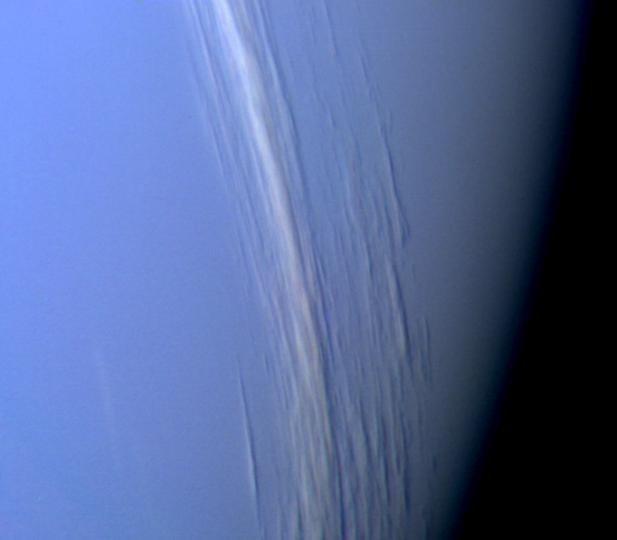
Voyager-2’s view of clouds on top of clouds on Neptune
Click for original image.
Time to continue our cool image tour this week of the Voyager-2 archive of Neptune, taken during the spacecraft’s August 25, 1989 close fly-by of the gas giant, zipping only 2,700 miles above the cloud-tops. This remains the only mission to visit Neptune so far.
The picture to the right, rotated, cropped, reduced, and sharpened to post here, was taken two hours before Voyager-2’s closest approach. From the caption:
These clouds were observed at a latitude of 29 degrees north near Neptune’s east terminator. The linear cloud forms are stretched approximately along lines of constant latitude and the sun is toward the lower [right]. The bright sides of the clouds which face the sun are brighter than the surrounding cloud deck because they are more directly exposed to the sun. Shadows can be seen on the side opposite the sun.
These shadows are less distinct at short wavelengths (violet filter) and more distinct at long wavelengths (orange filter). This can be understood if the underlying cloud deck on which the shadow is cast is at a relatively great depth, in which case scattering by molecules in the overlying atmosphere will diffuse light into the shadow. Because molecules scatter blue light much more efficiently than red light, the shadows will be darkest at the longest (reddest) wavelengths, and will appear blue under white light illumination.
The resolution of this image is 6.8 miles per pixel and the range is only 98,000 miles. The width of the cloud streaks range from 30 to 125 miles, and their shadow widths range from 18 to 30 miles. Cloud heights appear to be of the order of 31 miles.
Of all the high resolution images taken of Neptune by Voyager-2, this is the only one that clearly shows some dimensionality. Later photographs taken by Hubble and other ground- and space-based telescopes can only show global views that are far less sharp than the global views produced by Voyager-2.
This picture hints at Neptune’s very complex weather patterns, which has no well-defined surface and is made up mostly of gas and liquid. Though scientists have used Hubble to roughly track those weather patterns, they can only glean the most basic facts. For example, its fast-changing weather appears to be driven by high winds, thought to move as fast as 1,300 miles per hour. This fact however is woefully incomplete and very uncertain, as we have no way to track detailed weather patterns at multiple depths.
Our tour will continue tomorrow.

On Christmas Eve 1968 three Americans became the first humans to visit another world. What they did to celebrate was unexpected and profound, and will be remembered throughout all human history. Genesis: the Story of Apollo 8, Robert Zimmerman's classic history of humanity's first journey to another world, tells that story, and it is now available as both an ebook and an audiobook, both with a foreword by Valerie Anders and a new introduction by Robert Zimmerman.
The print edition can be purchased at Amazon or from any other book seller. If you want an autographed copy the price is $60 for the hardback and $45 for the paperback, plus $8 shipping for each. Go here for purchasing details. The ebook is available everywhere for $5.99 (before discount) at amazon, or direct from my ebook publisher, ebookit. If you buy it from ebookit you don't support the big tech companies and the author gets a bigger cut much sooner.
The audiobook is also available at all these vendors, and is also free with a 30-day trial membership to Audible.
"Not simply about one mission, [Genesis] is also the history of America's quest for the moon... Zimmerman has done a masterful job of tying disparate events together into a solid account of one of America's greatest human triumphs."--San Antonio Express-News