
The new Rubin telescope discovers over 11,000 new asteroids in first observations
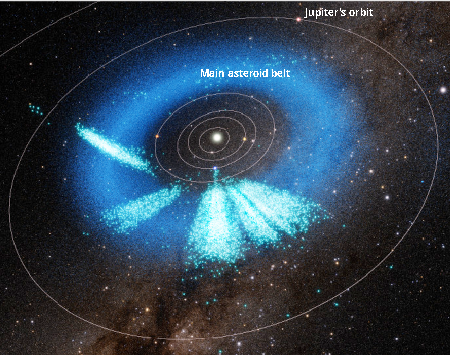
Click for full animation.
The new Rubin Observatory, a ground-based telescope in Chile, has discovered over 11,000 new asteroids in its first preliminary observations, with most in the main asteroid belt but a large number in the Kuiper Belt beyond Neptune and 33 previously unknown near-Earth asteroids.
The graphic to the right, annotated by me to post here, shows all of Rubin’s asteroid detections in light blue.
The submission to MPC [Minor Planet Center] comprises approximately one million observations, taken over the span of a month and a half, of over 11,000 new asteroids and more than 80,000 already known asteroids, including some that had previously been observed but were later “lost” because their orbits were too uncertain to predict their future locations. You can interact with all of Rubin’s asteroid discoveries in the Rubin Orbitviewer, which uses real data to provide an intuitive way to explore the structure of our cosmic backyard in three dimensions and in real time. Also, visit the Rubin Asteroid Discoveries Dashboard to learn about the new objects Rubin has uncovered.
…Among the newly identified objects are 33 previously unknown near-Earth objects (NEOs), which are small asteroids and comets whose closest approach to the Sun is less than 1.3 times the distance between Earth and the Sun. None of the newly discovered NEOs pose a threat to Earth, and the largest is about 500 meters wide.
Astronomers predict that Rubin will eventually find 90,000 new near-Earth objects, with some expected to pose a risk of hitting the Earth. It does this by repeatedly surveying the southern sky with its large mirror, then identifying new objects with its sophisticated software.

On Christmas Eve 1968 three Americans became the first humans to visit another world. What they did to celebrate was unexpected and profound, and will be remembered throughout all human history. Genesis: the Story of Apollo 8, Robert Zimmerman's classic history of humanity's first journey to another world, tells that story, and it is now available as both an ebook and an audiobook, both with a foreword by Valerie Anders and a new introduction by Robert Zimmerman.
The print edition can be purchased at Amazon or from any other book seller. If you want an autographed copy the price is $60 for the hardback and $45 for the paperback, plus $8 shipping for each. Go here for purchasing details. The ebook is available everywhere for $5.99 (before discount) at amazon, or direct from my ebook publisher, ebookit. If you buy it from ebookit you don't support the big tech companies and the author gets a bigger cut much sooner.
The audiobook is also available at all these vendors, and is also free with a 30-day trial membership to Audible.
"Not simply about one mission, [Genesis] is also the history of America's quest for the moon... Zimmerman has done a masterful job of tying disparate events together into a solid account of one of America's greatest human triumphs."--San Antonio Express-News
Bringing nearer the day when everything in the Solar System out to the orbits of Neptune and Pluto that is larger than a softball will be cataloged and tracked including all bits of human-created flotsam. New finds are already flooding in far faster than would-be asteroid miners will be able to visit and knack them into usable industrial materials for decades and perhaps even centuries to come. And then, of course, there’s the Kuiper Belt and the Oort Cloud. Quite a bit of human presence growth left in Sol’s neighborhood before anyone lights a shuck for other stars – though I expect that to occur well before we get anywhere near even Kardashev Type 1 status.
Dick Eagleson: We could not ask for better resources. Close enough to be reasonably accessible, (most) far enough away not to pose a threat, and conveniently broken up. If history is any indication, someone will be starbound the moment the capability exists. I don’t expect many on this Forum will see the future we read about as kids, but we can see it coming.