
America’s first foreign war on “the shores of Tripoli” has apparently never ended
I have just finished two books that very nicely recount America’s first foreign war in the first decade of the 1800s, following its independence from Great Britain. The war was President Thomas Jefferson’s effort to stop the piracy of American ships by the three Islamic nations on the north coast of Africa — Algeria, Tunis, and Tripoli (now in Libya) — then called the Barbary coast.
These Arab nations had for decades made it policy to hold all Mediterranean shipping hostage, demanding tribute from everyone or else they would attack ships, steal their goods, and either enslave their crew and passengers or hold them for ransom. The European nations paid, endlessly, rather than fight. The U.S. initially paid, but by 1800 and the election of Jefferson as president, it was tired of paying — especially because the payments were never enough to stop the raiding, nor were they enough to free those already captured and enslaved. When the ruler of Tripoli declared war against the U.S., Jefferson was glad to oblige.
The war that followed was the first in which American troops fought on foreign soil and planted the American flag in victory. It was also the first in which joint operations by American naval and land forces led to that victory. And finally, it was the first battle for the U.S. Marines, thus establishing firmly that branch of the military.
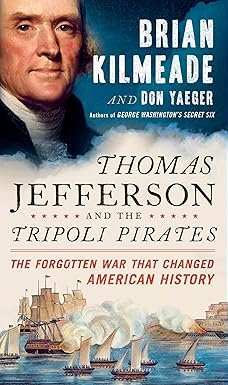
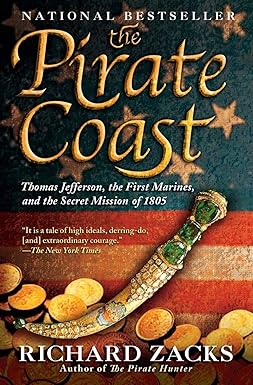
The two books to the right tell this story most effectively, but in very different ways.
First there is The Pirate Coast: Thomas Jefferson, the first Marines, and the secret mission of 1805 by Richard Zacks. Published in 2005, it is a very rich and well-researched work, while being remarkably readable because it tells the story from the point of view of the individuals involved. There is much triumph and tragedy in this story, and Zacks captures both.
Then we have Thomas Jefferson and the Tripoli Pirates, written by Brian Kilmeade and Don Yaeger and published ten years later in 2015. Unlike Zacks’ book, it does not delve as deeply into the lives of the many players, Instead, it is a fast-reading short but very thorough overview of this war.
Both books are worth reading, though The Pirate Coast is the better history. I strongly recommend you read both, however, beginning with the Kilmeade/Yaeger book.
Thomas Jefferson and the Tripoli Pirates is perfect introduction for educating you quickly on what happened and why. You then can follow-up with The Pirate Coast to get the deeper background. And trust me, that background is worth every second of your time. The story of William Eaton and his effort — with government approval — to bring an Arab/Greek mercenary army from Egypt across the African desert to conquer Tripoli and install a new ruler there is the stuff of movies.
In fact, it astonishes me that no Hollywood producer has ever made a film about it. It is as epic as Lawrence of Arabia, and just as compelling. Maybe more so, as it tells an American story that is foundational to our history.
And the story both books tell of this 19th century war is remarkably pertinent to modern 21st century events, which is another reason to read both. In the prologue of Kilmeade/Yaeger book the authors describe the first meeting of Jefferson and John Adams with Tripoli’s ambassador to Great Britain in London, Sidi Haji Abdrahaman. Both tried their best to convince the envoy that his government’s best policy would be to stop the piracy and instead allow open trade with America. Both were horrified however by his response:
Adams asked how the Barbary states could justify “[making] war upon nations who had done them no injury.” The response was nothing less than chilling.
According to his holy book, the Qur’an, Abdrahaman explained, “all nations which had not acknowledge the Prophet were sinners, whom it was the right and duty of the faithful to plunder and enslave.”
…Abdrahaman refused to play the role of “benevolent and wise man.” Despite the Americans’ horror, he wasn’t apologizing in any way. He showed no remorse or regret. He believed the actions of his fellow Muslims fully justified. “Every mussulman,” he explained, “who was slain in this warfare was sure to go to paradise.”
To Abdrahaman, this was not complicated. In his culture, the takers of ships, the enslavers of men, the barbarians who extorted bribes for safe passage, were all justified by the teaching of the prophet Muhammad. “It was written in our Qur’an,” he said simply.
Sound familiar? It appears little has changed in the Muslim world after more than two centuries. This is the identical attitude of the leaders of Hamas, Hezbollah, and Iran today, based on their holy book and the warlike power-based approach to religion that Muhammad advocated. Just as in 1800s Muhammad’s words encouraged piracy and slavery, his words now drive an endless cycle of genocidal acts, against Jews and Christians worldwide, merely for being Jews and Christians.
At the end of this book there was another equally telling quote:
America had stood up to the pirates, something that most of the more established European nations hadn’t been willing to do. … In prevailing off the Barbary Coast, the United States proved that it would not only go to war for its own interests but would do what it could for oppressed citizens of other nations.
Once again, after two centuries, nothing has changed. For decades Europe was harassed by the Barbary pirates and did nothing but try to buy them off — with mixed and usually poor results. It took a new nation from the opposite side of the globe to finally clean up the situation. When America finally ended the war in 1815 the piracy was over as well, with every nation now free to enjoy safe travel in the Mediterranean for the next two centuries.
In the 21st century the Barbary Coast returned, this time in the guise of the Islamic Republic in Iran. And as in the 19th century, Europe sits with folded hands, letting the U.S. do the dirty work, despite the reality that Europe has far more to lose than we do if Iran remains emboldened and powerful. They are far more dependent on Middle East oil than we are.
What lesson can we derive from this? I think the lessons are obvious, for those with the intellectual honesty to see. Islam is fundamentally a dangerous ideology. Europe is unreliable and foolish. And America remains the hope and glory for the future, because at its base it was created to defend the right of every human to “life, liberty, and the pursuit of happiness.

On Christmas Eve 1968 three Americans became the first humans to visit another world. What they did to celebrate was unexpected and profound, and will be remembered throughout all human history. Genesis: the Story of Apollo 8, Robert Zimmerman's classic history of humanity's first journey to another world, tells that story, and it is now available as both an ebook and an audiobook, both with a foreword by Valerie Anders and a new introduction by Robert Zimmerman.
The print edition can be purchased at Amazon or from any other book seller. If you want an autographed copy the price is $60 for the hardback and $45 for the paperback, plus $8 shipping for each. Go here for purchasing details. The ebook is available everywhere for $5.99 (before discount) at amazon, or direct from my ebook publisher, ebookit. If you buy it from ebookit you don't support the big tech companies and the author gets a bigger cut much sooner.
The audiobook is also available at all these vendors, and is also free with a 30-day trial membership to Audible.
"Not simply about one mission, [Genesis] is also the history of America's quest for the moon... Zimmerman has done a masterful job of tying disparate events together into a solid account of one of America's greatest human triumphs."--San Antonio Express-News
“America Dismantles Pirate Nations for Touching Their Boats – The Barbary Wars”
Presented by the Fat Electrician (November 2023)
https://youtu.be/lcJhmm3D3OY
(24:51)
Sad to say, I have read neither of these, though I was aware of Kilmeade’s book. Time to add them to my Amazon queue…
It’s true that the Barbary Wars only provided temporary victories, and only temporary relief from the piracy. Heck, the British under Pellew utterly flattened Algiers in 1816, and even that didn’t really end the problem, either, as they were back at it again a few years later under a new Dey. The only real solution turned out to be *conquest*, when the French finally snapped and invaded in 1830. But that day is over, as we all know, and the Muslim slave networks seem to be back with a fury again.
OBJECTIVELY: THE NOW VISIBLE AND GROWING PROBLEM IN THE WEST: ARE YOU LISTENING?
“If the world is to move into the future in a general positive manner the extremism, any extremism on either end of the cultural, political and religious spectrum Left or Right must be removed from being relevant in the world and or made impotent and of no consequence to others. One way or the other, by choice or by force.”
More: https://www.sigma3ioc.com/post/the-objective-problem-in-the-west-are-you-listening
Geert Wilder @ CPAC talking about radical Islam and its continuing invasion of the EU: https://youtu.be/k4zVHU82dP4?si=5DdIahl6NPkaKsk_ 6 min.
“Immediately after being inaugurated the third U.S. President, Jefferson received a demand from the Muslim Pasha of Tripoli for $225,000 as an extortion tribute payment, or they would declare war. Jefferson refused and sent over the U.S. Navy and Marines in the First Muslim Barbary Pirate Wars.”
https://static.wixstatic.com/media/e691e8_40b58f1b40844cc0a9ee9a9d9c1dad46~mv2.jpg/v1/fill/w_925,h_616,al_c,q_85,usm_0.66_1.00_0.01,enc_avif,quality_auto/e691e8_40b58f1b40844cc0a9ee9a9d9c1dad46~mv2.jpg
Ask Hillary or Susan Rice about this, and you’ll hear that the Barbary Pirates were simply attacking us in response to ” . . . a video . . . “
Minor typo in last paragraph: “Islam is fundamentally a dangerous ideology”
Andi: Thank you. Fixed.
Six Frigates: The Epic History of the Founding of the U.S. Navy
Ian W. Toll
2006
Whilst it is a Naval History book, much is written on the problem of the Barbary Pirates, as they were a principle motivation for building a Navy.
He covers in greater detail the concerns of the politicians, all well known players, during the crisis.
But it is also Naval History, and covers that in detail as well, including the War of 1812, which is barely taught anywhere anymore. I recommend it.
I read Kilmead’s book years ago. I had also read his book about Andrew Jackson, and the one on Washington’s spy ring. Entertaining, but superficial. He hits the wave tops of history. I think of his books as “Pop History”.
F: Nice. I’d forgotten that little historical tidbit, but I now remember the brouhaha.
There have been several op-eds in British papers recently that recognize, if Europe does not, that Europe needs America. The Chinese, like the Russians before them, have base values markedly different than America. Aligning with China is a recipe for subjugation. Europe does need America, if for no other reason than to have a place to go when the Second Islamic Invasion becomes the dominant European culture.
Timely book Bob! Will be picking this one up too. Keep typin Bob!
I’ll keep reading.
Dang it!
I read the headline wrong and got so excited to read another of your historical analysis.
Rushed right to the comments before I figured out the blunder.
Oh well, I guess I’ll just read those.
Thanks for bringing them to my attention Mr Z!
I would modestly also suggest “To the Shores of Tripoli” (1991) by A.B.C. Whipple.
https://www.amazon.com/Shores-Tripoli-Birth-Marines-Bluejacket/dp/1557509662
With Trump wanting to pull out of NATO, perhaps resulting in bases overseas not accessible to us–WWII can finally end and we can fund milspace properly without all the Cold War logistical overhead. Let Russia have Europe, let China deal with Iran and we make orbit the source of power projection like Medaris of the ABMA called for decades ago.
“The Warship Voyager”
Season 4, Episode 23
https://youtu.be/TWfSvBGtYYI
3:23
“When diplomacy fails there’s only one alternative, violence. Force must be applied without apology. It’s the Starfleet way.”
“The best way to bring down a ruler is to make his people suffer. This is no time for half-measures.”
Related: Classic Hitchslap which I fully agree with:
https://youtube.com/shorts/8BvXV6bsYSo?si=4QIoE2wy0LvM8z4W All wrapped up in 1 minute.
My observations and comment on Religion V Spirituality:
GOD & SPIRITUALITY V POLITICS, GOVERNMENT, LAW AND JUSTICE, COMMERCE & RELIGION
https://www.sigma3ioc.com/post/god-spirituality-v-politics-law-and-justice-commerce-religion-1
Now there are some very “compassionate” and “understanding” people in the world who would classify these positions on religion and government as being “racist” or xenophobia, and I would counter:
THE CONSTITUTION OF THE UNITED STATES IS NOT A SELF EXECUTING SUICIDE PACT!
The Brian Kilmeade book is one of the best history lessons I’ve ever had. This was the start to America’s becoming the world’s policeman and exposing the Islamic threat for all to see. Although the Barbary Coast War officially ended in 1830, we still fight Islam today. This is why:
https://www.americanthinker.com/articles/2011/03/what_israel_knows_about_hamas.html
https://www.frontpagemag.com/the-collapse-of-gaza/
https://www.americanthinker.com/blog/2026/03/you_gotta_love_the_israelis.html
https://www.americanthinker.com/articles/2026/04/iran_s_real_motivation.html
Dan M: I agree that the Kilmeade book is good, but it is, as another commenter here noted, somewhat superficial. It gives a great overview, but I see it as a great first lesson.
The other book I review, The Pirate Coast, is far better, and is as readable. It delves into the events much more fully, in a way that is very worthwhile.
It wasn’t just “pay rather than fight” for the European nations. The problem there was that the nations all had one eye on each other.
When you’re England, France and/or Spain and/or Prussia were the primary enemies.
The Barbary nations were not on the same order. Fighting them in that manner would have been a distraction and might have allowed their current European enemy an advantage.
It didn’t help that the Europeans were often allied with one of them at times, generally against one of the other European nations.
The US (at least at the time) didn’t have the same interests and alliances, and so was able to wage war undistracted.
There’s a 1950 movie called “Tripoli” about William Eaton and the march from Egypt to Tripoli.
https://www.imdb.com/title/tt0043072/?ref_=fn_t_1
I think the important lesson is that we were in the end incredibly inept and ineffective against the Barbary Pirates and we resumed paying tribute.
Captain Bainbridge ran the Philadelphia aground on a shoal, and rather than await the tide to float the ship, he surrendered. He and his crew was put in captivity. He caused a lot of trouble.
There were a lot of shenanigans with Bainbridge and money for the expedition too.
There were good points, but over all the whole thing failed on just about every objective. Beyond those good points, it’s not a time we should emulate. It was poorly planned, poorly funded, poorly executed, and had poor results. Those six frigates should have been a lot more effective.
M, you bring to light an important parallel with what is going on still today.
“It didn’t help that the Europeans were often allied with one of them at times, generally against one of the other European nations.”
Why are the European / EU and their reluctance in participating in freeing up their own energy supply, aside from and because of their traditionally weak Liberal leadership?
Because the enemy they need to fight has been imported into their own countries and are now an existential internal threat if they were to participate IMO.
All of these EU countries are chocked full of those who weep because the head Mullah was sent on to his heavenly reward.
(And in the heavenly reward what do we find? We find the men rewarded with 72 young virgins to do with what they please, and as I understand it the women are rewarded with their own slaves. And there we can see clearly why these two cultures should never mix. But then again, what might be the only thing in life that has the potential to transform the dark perversions of the book and its author’s proposal that it be the ONLY way? Force the two cultural realities together? That IMO cannot happen while the one gives advantage to the other, because the other is commanded to usurp, infiltrate and dominate the one. The other must be driven down minimized and forced to renounce their dark perspective, and that is what the Iran action will better accomplish. IMO)
And who uses infiltration to gain advantage with their enemies?
Any smart combatant who knows it is better to softly take over and fulfill their goals then face a force that has proven it can violently reinstruct them.
And right now, that would be Islam I.E. The Muslim Brotherhood types and……….the CCP Chinese and they are both using the U.N. Agenda 2030 Leftist “destroy the Patriarchy” foolishness as their wedge to gain entry. The Trojan Horse on nuclear steroids!
Both entities are inserting themselves in the open societies of the Liberal West.
And I reiterate: THE CONSTITUTION OF THE UNITED STATES IS NOT A SELF-FULFILLING SUICIDE PACT!
I stumbled across this and found it extremely informative. Our grandson is 17, in public schools, loves history but could not answer my questions about the Barbery pirates. I was looking for books on the topic when I found this.
We MUST educate our children and a large portion of Our adults.
Thank you all for your comments and for the post.
You be the GOAT!
To my point about the East invading the West and using the U.N. Agenda 2030 as their vehicle of conquest:
Regarding the King of England and being the head of the Church of England: https://youtube.com/shorts/PHGs36kVcf4?si=qs3XEDP8rreeLAjy
The King of England today is an adherent not of the church of England but of the Religion and the church of the Globalists.
A little more: King Charles: https://youtu.be/pqhwXFyf-e0?si=_xb3NGE_O2PsdzsC
Language warning on that one.
To M
Alliances can actually make things worse…some thought that WWI was all but a certainty…something the Founders knew.
Tony Blair drags Clinton into war…Dubya drags Tony Blair. Trump wants to leave NATO since they won’t play ball, and they will likely want us to BRAC.
Suits me as an isolationist.
Had Trump simply struck Fordow and left it at that, we wouldn’t have this instability.
I say to you right now that NATO should have been disbanded in the 1990s.
The only triple alliance that would bring stability would be an America/China/Russia triumvirate…it would not be pretty, but it would be the fastest way to end Islam once and for all.
Imagine if we pounded Iran as we have, with China supplying manpower.
It would be glorious.
An interesting element of the Treaty of Tripoli:
“The Treaty of Tripoli, signed in 1796, stated that the United States is not in any sense founded on the Christian religion. This statement was included in Article 11 of the treaty, which aimed to protect American ships from Barbary pirates and to reassure a Muslim state that the U.S. would not treat Tripoli as an enemy for religious reasons. The treaty’s language has been used to counter arguments that the United States is a “Christian nation,” although it is important to note that the phrase “Christian nation” does not appear in the Arabic text of the treaty. The treaty’s purpose was to secure commercial shipping rights and protect American ships in the Mediterranean Sea from local Barbary pirates.”
Who authored article 11 of the treaty?
The great man, George Washington himself apparently.
M
While the US was actively avoiding getting drawn into those European wars, we were at the same time actively working to build maritime commerce. Those European wars greatly complicated this effort. The Quasi-war with the French was part of this. Additionally, England did nothing to aid against the Barbary pirates as the piracy placed an additional burden on our commerce, which the English saw as the competition.
Source for this POV listed above.
Deaths of Presidents
https://m.youtube.com/watch?v=TC5N-76FJKU&pp=0gcJCdMKAYcqIYzv
What Russians learned about America:
https://m.youtube.com/watch?v=9QpjhBc_-Kg&pp=ugUHEgVlbi1VU9IHCQkDCwGHKiGM7w%3D%3D
Not a flattering drawing of Washington..eesh…they made him out to be George III