
Northrop Grumman completes successful test of new nozzle for its solid-fueled boosters
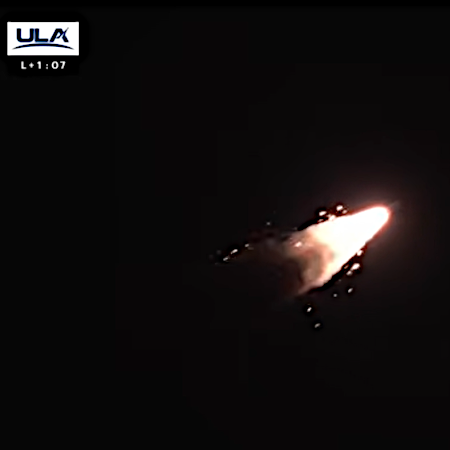
Nozzle failure during February 12, 2026 Vulcan launch
Northrop Grumman on April 15, 2026 successfully completed a test of a new nozzle design of a GEM solid-fueled booster, the strap-on booster whose nozzle failed on two previous ULA Vulcan rocket launches.
On April 15, the company said Northrop Grumman performed a successful static fire test of a Graphite Epoxy Motor (GEM) 63XL Solid Rocket Booster (SRB). A spokesperson told Spaceflight Now on Thursday that the test served to “demonstrate nozzle design enhancements which were already in work and an advanced propellant technology for future solid rocket motors across their portfolio.”
“The information gathered from this test, along with findings from the investigations will provide critical data to validate analytical models and support Vulcan’s return to flight,” the spokesperson said.
At the moment the Pentagon has grounded all Vulcan launches because of this nozzle issue, and has given several planned Vulcan payloads to SpaceX instead. ULA hopes to resume normal Vulcan flights using GEM boosters before the end of the year, but it also hopes to launch Vulcan sooner without the boosters. It is right now preparing a boosterless Vulcan to do a launch for Amazon, placing an as yet undetermined number of Leo satellites into orbit. It is also possible it will do the same with AST SpaceMobile’s Bluebird satellites.

On Christmas Eve 1968 three Americans became the first humans to visit another world. What they did to celebrate was unexpected and profound, and will be remembered throughout all human history. Genesis: the Story of Apollo 8, Robert Zimmerman's classic history of humanity's first journey to another world, tells that story, and it is now available as both an ebook and an audiobook, both with a foreword by Valerie Anders and a new introduction by Robert Zimmerman.
The print edition can be purchased at Amazon or from any other book seller. If you want an autographed copy the price is $60 for the hardback and $45 for the paperback, plus $8 shipping for each. Go here for purchasing details. The ebook is available everywhere for $5.99 (before discount) at amazon, or direct from my ebook publisher, ebookit. If you buy it from ebookit you don't support the big tech companies and the author gets a bigger cut much sooner.
The audiobook is also available at all these vendors, and is also free with a 30-day trial membership to Audible.
"Not simply about one mission, [Genesis] is also the history of America's quest for the moon... Zimmerman has done a masterful job of tying disparate events together into a solid account of one of America's greatest human triumphs."--San Antonio Express-News
“It is right now preparing a boosterless Vulcan to do a launch for Amazon, placing an as yet undetermined number of Leo satellites into orbit.”
This is an interesting question for me, actually. Partly because I haven’t been following Vulcan developments that closely.
Yesterday, as we know, ULA showed off those photos of a Vulcan being assembled in their new vertical assembly facility (which they call VIF-A).
https://x.com/Amazonleo/status/2054959519000576212
This coming launch for Amazon LEO is designated LV-01. Originally, LV-01 was supposed to be a VC6 configuration (that is, it would have 6 GEM boosters).
There’s been some discussion in the usual venues about whether this might still be the case. Amazon, of course, is not restricted by DOD suspensions; if they want to take a risk on a Vulcan using GEM boosters, and ULA is willing to offer them that risk, then that is their prerogative. Amazon has stated in recent weeks that they have hundreds of LEO satellites sitting on the ground, waiting for a launch. If that is true, then they may have a greater risk tolerance. A satellite sitting in a clean room is not making you any money, as Elon likes to point out.
So, will this launch really be boosterless? Or is ULA close to a solution that Amazon is willing to take a risk on? This successful test may inform the answer to that.
By the way, just to clarify, Amazon confirmed that it had satallites stacked and ready to go for more launches just yesterday on X — a diplomatic way of saying, I think, that the holdup is no longer manufacturing, but launcher availability. Just in case FCC officials are scrolling their X account.
https://x.com/Amazonleo/status/2054959519000576212
Richard M,
Given that the GEM 63 XL test took place a month ago and that the next Vulcan mission for Amazon is listed by nextspaceflight.com as targeting a 3Q launch – no specific date yet given or even a particular month – and that the next Vulcan mission for Amazon after that is specified only as “NET 2026” – which I take to mean some time in 4Q – it would appear that NorGrum’s production cadence for their piece of kit may not be very impressive. Or perhaps it has just been busy cranking out the two sets of five GEM 63s needed for the two Atlas 5 551 missions ULA has scheduled for Amazon on May 29 and 2Q 2026, respectively.
nextspaceflight.com still shows ten additional Vulcan launches for Amazon in 4Q 2026 in addition to the one already mentioned. It also shows 11 New Glenn missions for Amazon during what’s left of 2026. I think we can safely regard nearly all of those as strictly aspirational.
The 10 additional Falcon 9 launches for Amazon and two more Ariane 64 missions are also listed as scheduled for the balance of this year. Those two bits of schedule I would take to be far more likely of accomplishment as specified.