
A “thermal anomaly” in young Martian lava

Click for original image.
Cool image time! The picture to the right, cropped and reduced to post here, was taken on May 1, 2026 by the high resolution camera on Mars Reconnaissance Orbiter (MRO).
The science team labels this picture “Thermal Anomaly in Young Lava Flows”. The anomaly, indicated by the arrow, is the distinctly blue floor of the unnamed small 300-foot-wide crater about a third of a mile east of that 30-foot-high mesa. According to MRO guidelines [pdf] for interpreting the colors the camera produces:
Frost and ice are also relatively blue, but bright, and often concentrated at the poles or on pole-facing slopes. Some bedrock is also relatively bright and blue, but not as much as frost or ice, and it has distinctive morphologies.
The guidelines say more, but based on this information it suggests the floor of that crater is unusually cold, able to hold frost and ice. The picture was taken during the Martian winter, so seeing frost inside this crater at this time is possible, though its location, deep inside the dry equatorial regions of Mars where no near surface ice is generally found, tells us that if this is frost, it is truly unusual, deserving the description of “an anomaly.”
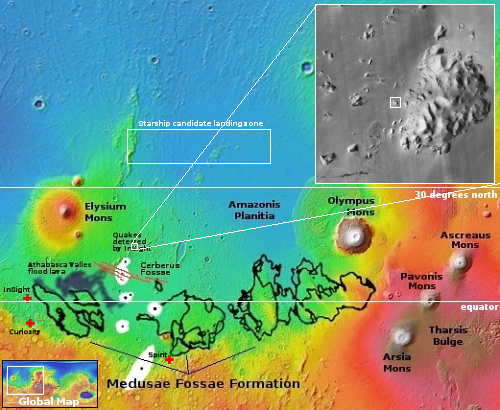
The white dot on the overview map to the right marks the location, deep inside the lava flood plains that fill the region between all of Mars’ biggest volcanoes. The crater and mesa are within a mountain chain called Tarturus Montes that is partly buried by these lava flows. It is also close to the vent from which poured the Athabasca Valles flood lava, thought to be the last major flood lava event on Mars, about 600 million years ago.
I must add that my interpretation of this blue color as indicating frost could be quite wrong. The colors produced by MRO can be interpreted in many ways, and to better determine their meaning requires access to materials unavailable to me. Whether it is frost or something else, it certainly merits a closer look, standing out as it does so distinctly.

On Christmas Eve 1968 three Americans became the first humans to visit another world. What they did to celebrate was unexpected and profound, and will be remembered throughout all human history. Genesis: the Story of Apollo 8, Robert Zimmerman's classic history of humanity's first journey to another world, tells that story, and it is now available as both an ebook and an audiobook, both with a foreword by Valerie Anders and a new introduction by Robert Zimmerman.
The print edition can be purchased at Amazon or from any other book seller. If you want an autographed copy the price is $60 for the hardback and $45 for the paperback, plus $8 shipping for each. Go here for purchasing details. The ebook is available everywhere for $5.99 (before discount) at amazon, or direct from my ebook publisher, ebookit. If you buy it from ebookit you don't support the big tech companies and the author gets a bigger cut much sooner.
The audiobook is also available at all these vendors, and is also free with a 30-day trial membership to Audible.
"Not simply about one mission, [Genesis] is also the history of America's quest for the moon... Zimmerman has done a masterful job of tying disparate events together into a solid account of one of America's greatest human triumphs."--San Antonio Express-News