
Canada’s Nova Scotia spaceport signs German rocket startup Isar Aerospace
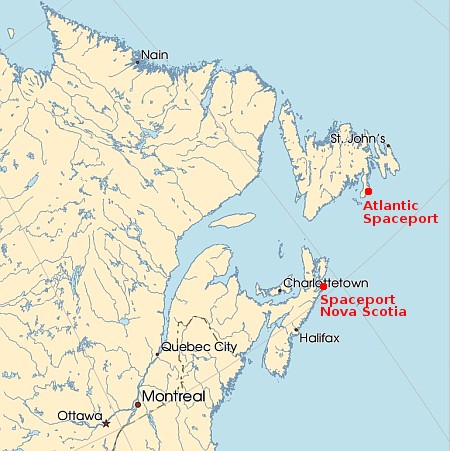
Proposed Canadian spaceports
After a decade of effort, Canada’s Spaceport Nova Scotia has finally closed a deal with a rocket company. German rocket startup Isar Aerospace yesterday announced it has finalized a deal first signed in May 2026 with Maritime Launch Services, which operates the spaceport for the Canadian government on a 10-year $200 million lease, to launch its Spectrum rocket there.
Maritime Launch Services will provide the licensed launch site, including the launch pad, assembly, integration and testing (AIT) facilities, a launch operations center, and a facility for payload integration. Build-out is planned to begin in 2026, with first orbital launches targeted for 2028. The launch site will be designed to support frequent launches, with the potential for Spaceport Nova Scotia to offer additional capacity for future expansion. To anchor its North American presence, Isar Aerospace has established a dedicated Canadian entity, Isar Aerospace Canada Inc.
Maritime was formed in 2016, but for a decade was unable to attract any customers. That changed in March 2026 when the present Canadian government signed its ten year lease, committing itself to finance the spaceport in order to develop what it called a “sovereign” Canadian launch capability.
This deal apparently convinced Isar that Nova Scotia was a viable launch site. The deal is for ten years, with the option for two more five year extensions. During the first 2.5 years all fees will be waived, after which Isar will pay Maritime $3.75 million quarterly, with the intention to ramp up to 40 launches per year by 2029. It will also pay additional per launch fees.
Isar however still has to successfully complete its first launch. It has had one launch failure in 2025, and has repeatedly scrubbed for technical reasons its second attempt in 2026, first in January, then in March, and then in June. Though there are indications it will try again later this month, no new launch date has been announced. All these launches have been from Norway’s Andoya spaceport.
The irony here is that the Canadian government isn’t really getting its own rocket capability. It is buying it from a German company.

On Christmas Eve 1968 three Americans became the first humans to visit another world. What they did to celebrate was unexpected and profound, and will be remembered throughout all human history. Genesis: the Story of Apollo 8, Robert Zimmerman's classic history of humanity's first journey to another world, tells that story, and it is now available as both an ebook and an audiobook, both with a foreword by Valerie Anders and a new introduction by Robert Zimmerman.
The print edition can be purchased at Amazon or from any other book seller. If you want an autographed copy the price is $60 for the hardback and $45 for the paperback, plus $8 shipping for each. Go here for purchasing details. The ebook is available everywhere for $5.99 (before discount) at amazon, or direct from my ebook publisher, ebookit. If you buy it from ebookit you don't support the big tech companies and the author gets a bigger cut much sooner.
The audiobook is also available at all these vendors, and is also free with a 30-day trial membership to Audible.
"Not simply about one mission, [Genesis] is also the history of America's quest for the moon... Zimmerman has done a masterful job of tying disparate events together into a solid account of one of America's greatest human triumphs."--San Antonio Express-News
The timing might not be coincidental. The consensus is that ThyssenKrupp will be awarded a contract to built submarines for the Royal Canadian Navy. One comment I heard, which might simply be a rumour, was that part of the sub deal includes TK building a number of carbon capture facilities.