
GAO releases a schizophrenic report on NASA
The Government Accountability Office (GAO) earlier this week released a report on the state of NASA’s major projects and the impact on the agency of Trump’s work force reductions.
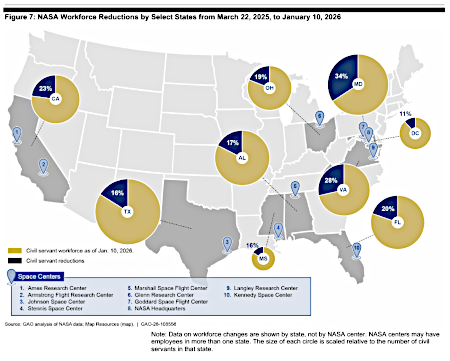
The graph to the right, from the report, shows those reductions across numerous NASA centers nationwide.
In reading the report [pdf], I couldn’t help noting the sharp contrast from its first section, outlining the generally solid state of the agency’s major projects, and its second section, describing the terrible impact of Trump’s workforce reductions, which reduced NASA workforce by about 22%.
The report appeared almost schizophrenic, having a dual personality, with the first section written by a Republican and the second section by a Democrat.
In the first section, after reviewing the major changes imposed on the Artemis program by NASA administrator Jared Isaacman, the key paragraph was this:
Most major projects in development in NASA’s portfolio reported no schedule delays or cost overruns over the last year. Only four of the 18 major projects are anticipating additional schedule delays or cost overruns to the estimates they reported last year, with delays totaling 2 months and overruns totaling a half-billion dollars.
In other words, the work force reductions had no significant impact. The half-billion overrun and total delay of only two months across the entire portfolio is trivial compared to past NASA overruns and delays. If anything, these numbers suggest Isaacman and the work force reductions are making NASA more effective and efficient.

Chicken Little strikes again!
When the GAO then began to describe those work force reductions in the latter section, suddenly Chicken Little took over and the world of NASA was about to come to an end! While the first section found — looking at the actual numbers — that these reductions had not had a serious impact on most of NASA’s projects, the second section screamed disaster by accepting the opinions of agency officials, without using real data to back up those claims.
Of the 36 projects in the portfolio, 25 reported that they had been affected by the workforce reductions. According to agency officials, individual projects within the portfolio have generally addressed the loss of workforce by having remaining civil servants take on the responsibilities of those who left. Some projects, however, have reported more serious negative effects from the workforce reductions. [emphasis mine]
The report than listed four examples, SLS, Orion, the Near Earth Surveyor program, and a now canceled Venus probe. With the first three, these agency officials failed to outline any specific issues caused by the reductions, other than a need by them to rearrange staffing to make up the loss. As noted in the report’s first section, the projects were proceeding pretty much as planned.
In other words, the reductions simply eliminated extraneous employees, saving the agency a lot of money and tightening the workforce to make it more efficient. Only one project, to Venus, has been cancelled, but that cancellation was because of far more reasons than simply these work force reductions.
The highlighted phrases are important, because they show that the only evidence of problems were the statements by agency officials, whining about the reductions in the typical manner of government management. “We need more money! We need larger staffs!” It doesn’t matter that the empirical data proves they don’t need that money or staff. It is wired in their DNA to demand it.
As expected, our propaganda press has latched onto the second section to echo these cries of disaster, while ignoring the first section. The predictability of this has become incredibly boring and tedious. Does no one in the press every have any other opinion or perspective other than “The government is God and must always get everything it wants!”?

On Christmas Eve 1968 three Americans became the first humans to visit another world. What they did to celebrate was unexpected and profound, and will be remembered throughout all human history. Genesis: the Story of Apollo 8, Robert Zimmerman's classic history of humanity's first journey to another world, tells that story, and it is now available as both an ebook and an audiobook, both with a foreword by Valerie Anders and a new introduction by Robert Zimmerman.
The print edition can be purchased at Amazon or from any other book seller. If you want an autographed copy the price is $60 for the hardback and $45 for the paperback, plus $8 shipping for each. Go here for purchasing details. The ebook is available everywhere for $5.99 (before discount) at amazon, or direct from my ebook publisher, ebookit. If you buy it from ebookit you don't support the big tech companies and the author gets a bigger cut much sooner.
The audiobook is also available at all these vendors, and is also free with a 30-day trial membership to Audible.
"Not simply about one mission, [Genesis] is also the history of America's quest for the moon... Zimmerman has done a masterful job of tying disparate events together into a solid account of one of America's greatest human triumphs."--San Antonio Express-News