
Martian crater with many gullies flowing into corroded “irregular cellular structures”

Cool image time! The picture to the right, rotated, cropped, reduced, and enhanced to post here, was taken by the high resolution camera on Mars Reconnaissance Orbiter (MRO) and downloaded on June 1, 2026.
The science team labels the features on the floor of the crater vaguely as “irregular cellular structures on crater floor,” which to my eye — after looking at innumerable MRO pictures of craters on Mars — looks like glacial fill that has begun to sublimate away. As it does, from below, its protective top layer of dirt and debris begins to resemble peeling paint, or in this case the “irregular cellular structures” as described by the scientists.
Their description is purposely vague because they have probably not yet confirmed the presence of ice in this particular crater, though this supposition is reasonable based on almost two decades of orbital data.
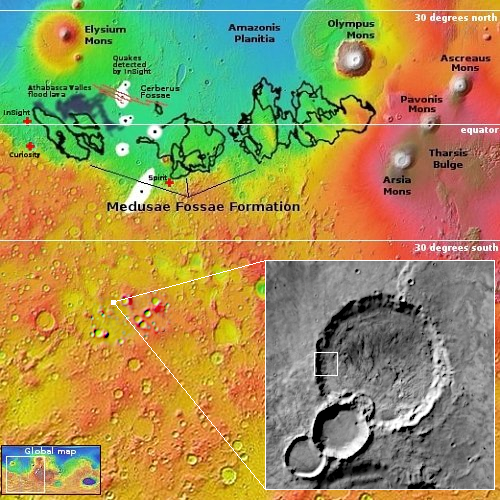
The white dot on the overview map to the right marks the location, in the southern cratered highlands of Mars at about 43 degrees south latitude. The inset shows the entire unnamed crater, about 19 miles wide and about 2,700 feet deep. In the picture above the elevation difference from the rim to the floor is about 2,000 feet.
What makes this geology even more interesting is the string of gullies that appear to flow down the crater’s western interior rim. On Earth explaining these would be simple: They are drainage gullies produced by flowing water.
On Mars that explanation doesn’t work, based on what we know at present. Liquid water cannot exist in the thin atmosphere and cold conditions on Mars. These gullies have got to have another origin, likely related to ice or dry ice or some mixture of both combined with other minerals that could mix with the H2O.
Either way, this crater is another data point indicating the ubiquitous presence of near surface ice on Mars. As long as you are not in the Martian dry equatorial regions, you will find frozen water close to the surface.

On Christmas Eve 1968 three Americans became the first humans to visit another world. What they did to celebrate was unexpected and profound, and will be remembered throughout all human history. Genesis: the Story of Apollo 8, Robert Zimmerman's classic history of humanity's first journey to another world, tells that story, and it is now available as both an ebook and an audiobook, both with a foreword by Valerie Anders and a new introduction by Robert Zimmerman.
The print edition can be purchased at Amazon or from any other book seller. If you want an autographed copy the price is $60 for the hardback and $45 for the paperback, plus $8 shipping for each. Go here for purchasing details. The ebook is available everywhere for $5.99 (before discount) at amazon, or direct from my ebook publisher, ebookit. If you buy it from ebookit you don't support the big tech companies and the author gets a bigger cut much sooner.
The audiobook is also available at all these vendors, and is also free with a 30-day trial membership to Audible.
"Not simply about one mission, [Genesis] is also the history of America's quest for the moon... Zimmerman has done a masterful job of tying disparate events together into a solid account of one of America's greatest human triumphs."--San Antonio Express-News