
Decline in sunspots continues
Late Sunday NOAA posted its monthly update of the solar cycle, covering sunspot activity for October. As I do every month, I am posting it here with annotations to give it context.
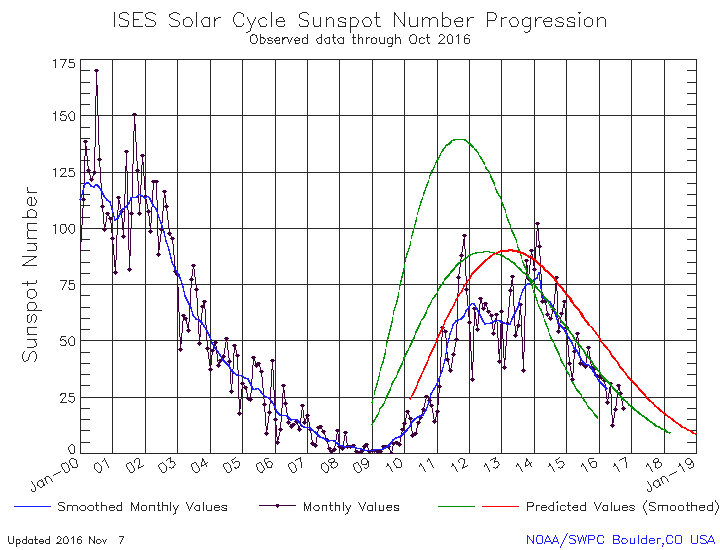
The graph above has been modified to show the predictions of the solar science community. The green curves show the community’s two original predictions from April 2007, with half the scientists predicting a very strong maximum and half predicting a weak one. The red curve is their revised May 2009 prediction.
The sunspot decline continued in October, dropping the sunspot number for the month to below the 2007 low prediction. Though the decline continues to track that low prediction, the sunspot count for November has been even lower, suggesting that the ramp down to solar minimum will continue to under perform that prediction and will arrive at minimum sooner than expected. As I noted last month, this fast decline will also mean that the ending solar cycle will be a both a weak and a short cycle, two phenomenon that in the past never went together. In the past, a short cycle meant the maximum was strong, while a long cycle would correspond with a weak maximum.
The Sun continues to behave in a manner that is unprecedented, and suggests the possibility that a Grand Minimum might be coming.

On Christmas Eve 1968 three Americans became the first humans to visit another world. What they did to celebrate was unexpected and profound, and will be remembered throughout all human history. Genesis: the Story of Apollo 8, Robert Zimmerman's classic history of humanity's first journey to another world, tells that story, and it is now available as both an ebook and an audiobook, both with a foreword by Valerie Anders and a new introduction by Robert Zimmerman.
The print edition can be purchased at Amazon or from any other book seller. If you want an autographed copy the price is $60 for the hardback and $45 for the paperback, plus $8 shipping for each. Go here for purchasing details. The ebook is available everywhere for $5.99 (before discount) at amazon, or direct from my ebook publisher, ebookit. If you buy it from ebookit you don't support the big tech companies and the author gets a bigger cut much sooner.
The audiobook is also available at all these vendors, and is also free with a 30-day trial membership to Audible.
"Not simply about one mission, [Genesis] is also the history of America's quest for the moon... Zimmerman has done a masterful job of tying disparate events together into a solid account of one of America's greatest human triumphs."--San Antonio Express-News
That the heliophysicists could predict the fall of the sunspot cycle so very well already 9 years ago, before it had even bottomed out last time (only 6 years ago), is amazing. The prediction exactly fits with the monthly data and with the moving 12 months average since the top.
Obviously, sunspot cycles are not a simple sinus function. It has double tops, which I heard was predicted too, and that the distance between the tops would continue to widen. A slightly more advanced model could easily give an even better fit. They are certainly on to something here. The early prediction of this anomaly is better than random to say the least.
Less sunspots means weaker Solar magnetic field and less protection against cosmic rays. The 11 year double top of the sunspot cycle and the 15 year Earth/Mars close conjunction cycle happen to somewhat coincide, giving more than average free radiation protection during the 2033 launch to and the 2035 return from Mars.
The downside is more frequent solar proton bursts during sunspot maxima, but they can be blocked by 15 cm or so water shield directed only towards the Sun, during only hours or a few days. The Sun’s protection against more powerful cosmic rays coming from all directions is more valuable for missions in deep space lasting for months to years.