
ISS tour, part 1

An evening pause: We talk a lot about the International Space Station. Why not take a tour? In this January 2009 video, part 1 of 4, astronaut Mike Finke starts us out at the docking port used by the shuttle and takes us through the Harmony and Kibo modules. Along the way he gives a great view out the port side of the station.

You can see the remaining parts of Mike’s tour by clicking through, or you can wait until I post them over the next week.
1 comment

Aqua tracks carbon monoxide over Russia from wildfires

Data from the AIRS instrument on NASA’s Aqua satellite shows the dramatic increase in carbon monoxide in the atmosphere at 18,000 feet over Russia due to the wildfires there. Key quote from press release:

The concentration of carbon monoxide is continuing to grow. According to Aug. 4 NASA estimates, the smoke plume from the fires spans about 3,000 kilometers (1,860 miles) from east to west.

0 comments

Mapping daylight at the Moon’s South Pole

Using data from the Japanese lunar orbiter Kaguya, scientists have identified several locations near the Moon’s south pole that are in daylight from 86 to 94 percent of the time. Key quote from abstract:

The place receiving the most illumination (86% of the year) is located close to the rim of Shackleton crater at 88.74Β°S 124.5Β°E. However two other areas, less than 10 km apart from each other, are collectively lit for 94% of the year. We found that sites exist near the south pole that are continuously lit for several months during summer. We were also able to map the locations and durations of eclipse periods for these areas. Finally we analyzed the seasonal variations in lighting conditions, from summer to winter, for key areas near the south pole. We conclude that areas exist near the south pole that have illumination conditions that make them ideal candidates as future outpost sites. [emphasis mine]

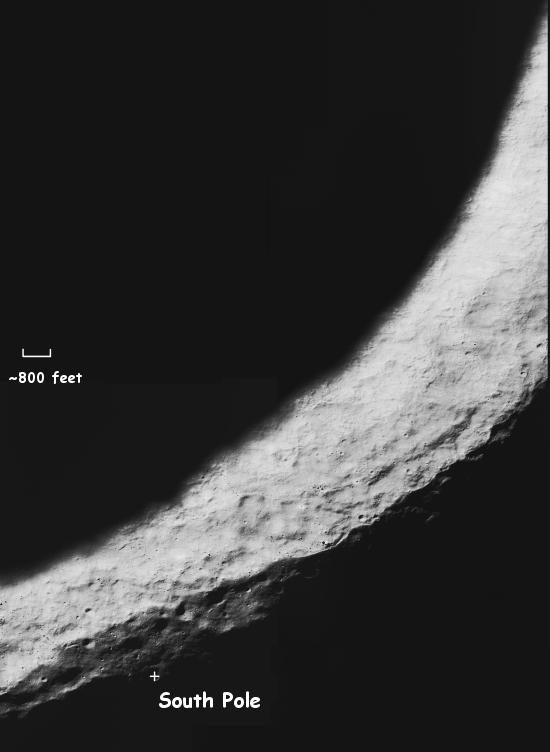
Below is a composite close-up image of the rim of Shackleten crator that I assembled using this Lunar Reconnaissance image. The key quote from the full caption :

The full [Narrow Angle Camera] mosaic reveals a shelf on the southeast flank of the crater that is more than two kilometers across and perfectly suitable for a future landing. The extreme Sun angle gives the surface an exaggerated rough appearance, but if you look closely at this scale any area that is between the small craters might make a good landing site.

Rim of Shackleton Crater

1 comment

First spacewalk to replace pump module

The first spacewalk to replace the failed pump module on ISS is finished, and it did not go as well as hoped. The astronauts had problems removing one of four cooling system ammonia lines to the old pump. They eventually succeeded, actually using a hammer to lightly tap the quick-disconnect latch free. They then had to seal an ammonia leak coming from the problematic line. These issues caused them to run out of time, preventing them from removing the old pump and installing the new one. It is expected they will pick up where they left off on the next spacewalk, presently scheduled for Wednesday.

0 comments

PG police kill another dog

Yesterday a sheriff’s deputy from Prince George’s County, Maryland, shot and killed a family dog while trying to serve an eviction notice. This comes two years after a mistaken raid by Prince George’s police of the home of the mayor of Berwyn Heights killed his two dogs. Key quote:

[Mayor] Calvo, who is suing Sheriff Michael A. Jackson, alleging his deputies engaged in excessive force when they killed his dogs, said deputies have shown a disturbing propensity to kill family pets. “This is part of a pattern,” Calvo said. From 2005 to 2008, deputies shot at least nine dogs in eight incidents, according to sheriff’s department records.

The real horror of this story for those of us who live in Prince George’s County and own dogs (as I do) is that Michael Jackson is running for county executive, and in some polls, is leading the pack.

1 comment

Scientists have plans to go to killer asteroid

Talk about thinking ahead! Since 2007 a team of scientists have actually been planning a mission to 1999 RQ36, the asteroid that has a 1 in 1000 chance of hitting the Earth in 2182. Their mission, dubbed OSIRIS-Rex (Origins Spectral Interpretation Resource Identification Security Regolith Explorer), has already been picked as one of two finalists in NASA’s New Frontiers program. The decision on which mission NASA will fund will be made next summer.

0 comments
1 2,889 2,890 2,891 2,892 2,893 2,927