
Minute particles found in Hayabusa capsule
Japanese scientists have detected minute particles in the Hayabusa capsule! Whether these particles are from the asteroid or not remains unknown.
Japanese scientists have detected minute particles in the Hayabusa capsule! Whether these particles are from the asteroid or not remains unknown.
The press finally notices the absurdities of Obama’s new space policy, something I have been talking about for months, and noted again earlier this week.
Saturday’s weekly dump of publications from the American Geophysical Union also included a paper that showed visual proof of avalanches on Mars! In this case, the location is Russell Crater, “a large crater in the southern hemisphere that exposes a large dune field in its center.” The avalanches occur because a frost layer made up of dry ice and a little bit of frozen water builds up on the crest of the dunes. When that frost melts, dark streaks about three to six feet wide and about 150 feet long appear, flowing downhill. The scientists believe these are avalanches made up of “a mixing of sand, dust, and unstable CO2 gas.”
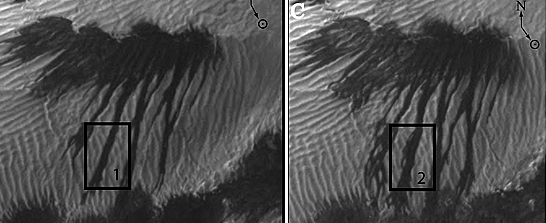
Before and after shots of the dark streaks flowing down the dune.
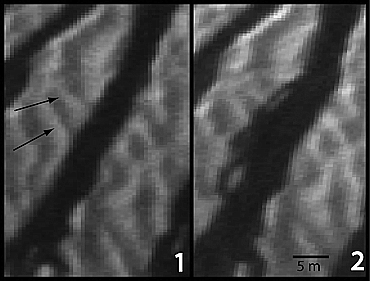
Close-ups of the streaks, before and after.
A very long (182 pages) and detailed preprint paper was published today on the Los Alamos astro-ph website, describing the completion of a survey of just about all the sunlike stars within approximately 82 light years of the Earth. I haven’t had time to read the whole thing, but the abstract made these notable points:
In other words, the evidence continues to suggest that solar systems like ours are very common.
I haven’t been posting that much this weekend because I’ve been very busy, doing American July 4th types of things: mainly guns and fireworks! On Saturday, I went to the 12th Precinct Pistol and Archery Club for the range’s twice weekly bullseye target pistol league competition. Shot a pretty good 817 out of 900 with my 22 caliber pistol, and a mediocre 733 with my 45.
» Read more
After its docking failure Friday, the Russian unmanned Progress freighter successfully docked with ISS today.
How about some music to celebrate July 4:
For those who fantasize that Mars might still have vast underground lakes with fish, the recent data is unfortunately not encouraging. A paper published today by the American Geophysical Union suggests that if groundwater exists on Mars, it is going to be increasingly difficult to find, possibly only in the low latitudes at low elevations. These paragraphs from the conclusion of the paper say it all:
Various lines of evidence suggest that at the time of the Late Hesperian, Mars possessed a planetary inventory of water equal to a global ocean ~0.5 km deep, much of which is believed to have been stored as ground ice and groundwater in the subsurface. The potential survival of groundwater to the present-day has important implications for understanding the geological, hydrological and mineralogical evolution of the planet, as well as the potential survival of native Martian life. The two most important factors affecting the persistence of groundwater on Mars are the depth and pore volume of the cryosphere.
To date, the orbital radar sounding data from MARSIS [an instrument on Mars Orbital Express] has provided little evidence of any deep reflectors potentially indicative of subpermafrost groundwater. Here we have examined two (of several) possible explanations for this lack of evidence: (1) that subpermafrost groundwater no longer survives on Mars or (2) that groundwater is present, but that a thicker than expected cryosphere has restricted its occurrence to depths that exceed the estimated ~3 km maximum sounding depth of MARSIS.
[snip]
Which one (or combination) of explanations discussed here is responsible for the lack of deep reflectors on Mars is unknown. But our revised estimates of cryosphere depth suggest that a successful detection of subpermafrost groundwater, outside of those areas on Mars that combine low latitude and low elevation, is unlikely. In an effort to better constrain this problem, a more comprehensive investigation of the MARSIS sounding data obtained over Athabasca Valles, and four other low-elevation, near-equatorial sites, is currently underway.
Tonight, from 9 pm to 1 am (EDT), I will be on the John Batchelor Show. John is off tonight, so the guest host is Simon Constable, with yours truly acting as his co-host. For my part, I’ve arranged four guests:
Then I have brought in three guests to talk about the Obama administration’s new space policy and the space war developing between the administration and Congress over the administration’s effort to cancel the Constellation program:
Each will have his own 15 minute segment to express his views. Should be a fun time tonight.
Want to know how big the Sun really is? Go here for a great image.
I just thought I’d note the interesting juxtaposition illustrated by my previous two posts: In one case there is a battle between Congress and the President over the future of the American manned space program, prompted by the impending shutdown of the shuttle program with no immediate replacement in sight. In the other case, the only remaining program with the capability to provide manned access to the International Space Station has a serious docking failure.
With manned spaceflight, redundancy is all important. This juxtaposition illustrates very clearly the precarious position we will be in once the shuttle is retired.
The political space war continues. The Senate Commerce Committee is going to propose on July 15 one extra shuttle flight and the immediate move to develop a “heavy-lift” rocket (which is merely another name for the Ares rocket).