
Engineers shut down another instrument on Voyager-1
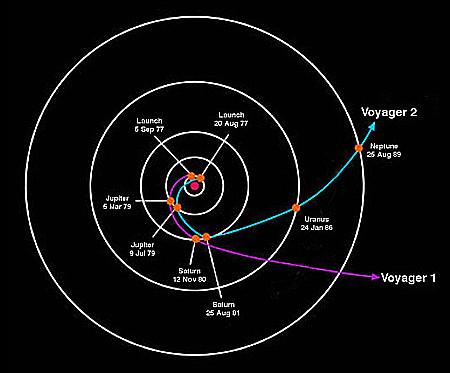
The routes the Voyager spacecraft have
taken since launch. Not to scale.
Due to the continuing and expected decline in power, engineers have now shut down another instrument on Voyager-1 in the hope of keeping the spacecraft operating for just a few more years.
On April 17, engineers at NASA’s Jet Propulsion Laboratory (JPL) in Southern California sent commands to shut down an instrument aboard Voyager 1 called the Low-energy Charged Particles experiment, or LECP. The nuclear-powered spacecraft is running low on power, and turning off the LECP is considered the best way to keep humanity’s first interstellar explorer going.
The LECP has been operating almost without interruption since Voyager 1 launched in 1977 — almost 49 years. It measures low-energy charged particles, including ions, electrons, and cosmic rays originating from our solar system and galaxy.
…The choice of which instrument to turn off next wasn’t made in the heat of the moment. Years ago, the Voyager science and engineering teams sat down together and agreed on the order in which they would shut off parts of the spacecraft while ensuring the mission can continue to conduct its unique science. Of the 10 identical sets of instruments that each spacecraft carries, seven have been shut off so far. For Voyager 1, the LECP was next on that list. The team shut off the LECP on Voyager 2 in March 2025.
Both spacecraft now have only three operating science instruments. Engineers hope a major reboot on both spacecraft planned later this year might make each operate more efficiently, allowing both to survive maybe until 2030. At a minimum the hope is to make them last until 2027, which would the fiftieth anniversary of their launch.
The bottom line remains: the nuclear power source on board both is running down. The goal now is less gathering science data and more engineering: How long can we keep these spacecraft alive, at the very outskirts of our solar system?

On Christmas Eve 1968 three Americans became the first humans to visit another world. What they did to celebrate was unexpected and profound, and will be remembered throughout all human history. Genesis: the Story of Apollo 8, Robert Zimmerman's classic history of humanity's first journey to another world, tells that story, and it is now available as both an ebook and an audiobook, both with a foreword by Valerie Anders and a new introduction by Robert Zimmerman.
The print edition can be purchased at Amazon or from any other book seller. If you want an autographed copy the price is $60 for the hardback and $45 for the paperback, plus $8 shipping for each. Go here for purchasing details. The ebook is available everywhere for $5.99 (before discount) at amazon, or direct from my ebook publisher, ebookit. If you buy it from ebookit you don't support the big tech companies and the author gets a bigger cut much sooner.
The audiobook is also available at all these vendors, and is also free with a 30-day trial membership to Audible.
"Not simply about one mission, [Genesis] is also the history of America's quest for the moon... Zimmerman has done a masterful job of tying disparate events together into a solid account of one of America's greatest human triumphs."--San Antonio Express-News
The science and technical knowledge to be gained from the Voyagers is pretty limited at this point, especially with the LECP no longer in action. But it certainly isn’t *nothing*, and for an annual operating budget of only $5 million, it’s not hard to think the money spent generates sufficient return to justify keeping them going until the very end.
Would shutting down all but one instrument keep it running even longer?
So I think this is a classic Pu-238 thermal nuclear reactor. Pu-238 has a 87.7 year half life. So after 50 years about 1/3 of the PU-238 is gone (courtesy https://www.omnicalculator.com/chemistry/half-life half life calculator). Presuming power output is linear and unaffected by other issues (e.g. age of the thermocouple) with mass of Pu-238 that is at 67% of initial, power output is essentially at 2/3s. Honestly, something launched when I was a sophomore in High School (I’m now retired) still working is darned impressive.
Because the power generated by these radioisotope thermoelectric generators (RTG) is related to the temperature difference between the hot radiation side and the cooler deep-space radiator side, the drop in electrical output is not proportional to the amount of radioactive material left in the generator. There may be ⅔ of the radioactive material left, but the hot-side temperature may not be proportional to the amount of material remaining, either.
My assumption is that the simplicity of thermocouples means that they do not degrade over time, but that is only an assumption.
The lifespan of the generator is not affected by reducing the power, so turning off instruments will not allow the probe to last longer. The radioisotope degrades at the same rate whether or not any power is used from the generator. This is an unfortunate feature of this kind of power source, but the desirable feature is that it is reliable as a power source and produces power even far, far away from the local star, our Sun.
“My assumption is that the simplicity of thermocouples means that they do not degrade over time, but that is only an assumption.”
Actually, they do get damaged by the radiation, and (“I read it somewhere on the internet” so …) are the limiting factor. (“I read it somewhere on the internet” so …)
Despite the lower power output these days, Voyager’s nuclear Radioisotope Thermoelectric Generators (RTG) are still supplying more power than the RTG’s on the Mars Curiosity and Perseverance rovers. Voyager seems to require a lot more power.
The RTGs on the rovers weigh about 99 pounds (45 kilograms) and produce about 110 watts, which is less than I expected. The RTGs on the Voyager spacecraft were originally producing about 480 watts, but have degraded over the past 48 years to about 180 to 230 watts. That’s still about twice as much power than the rovers.
According to Grok, the primary reason Voyager requires so much more power is due to the “massive” transmitter power draw. However, the transmitter only produces about 23 watts of RF output, so I’m not sure how accurate that is. Grok says that the electronics are less efficiency, but that’s a secondary issue. It also needs to keep propellant lines from freezing.
I remember reading that the supply of plutonium has been in short supply for a while, so maybe that is a factor in why the rovers run with significantly lower power. Does anyone have any insight into this?
I had a small thread on my X account here:
https://x.com/JasonMLewis3/status/1924229095132696783
Tregonse314 observed: “Honestly, something launched when I was a sophomore in High School (I’m now retired) still working is darned impressive.”
True that. I would hope that any of the original design/build team left, would be enormously proud of their work. My hope would also be that there is some sort of recognition for those folks next year, if the craft survives. It really is a stunning achievement.
I would tell apprentices to do their best work even in places no one was likely to look, because you want to take pride in your ability, and the results. If you do mediocre, or bad, work, in the trades, someone will notice. Hopefully, not in a fatal way.