
Juno flies past the Jupiter moon Thebe
Click for original image.
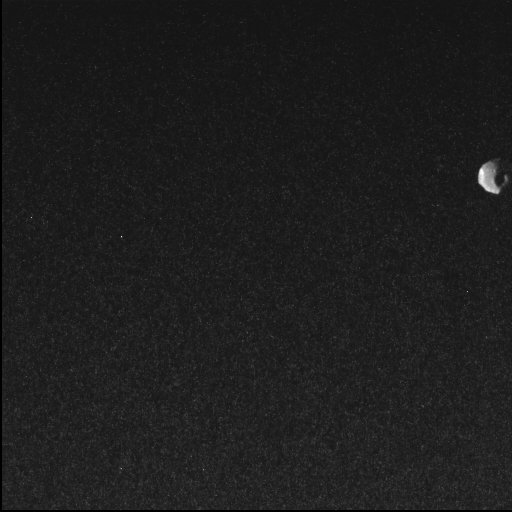
Though the Jupiter orbiter Juno is in its final orbits as it is running out of fuel, on May 1, 2026 it did a close fly-by of the 50 by 72 mile-wide Jupiter moon Thebe, getting within 3,100 miles.
The picture to the right, cropped and expanded to post here, is the best image released from that fly-by. It is very comparable to a photo taken by the Galileo orbiter on January 4, 2000. Both show the very large crater, dubbed Zethus.
The picture was taken by Juno’s Stellar Reference Unit (SRU) camera, designed not to do science but to “image star fields for navigation.” Thus, the picture is somewhat fuzzy, and was pointed poorly so the moon is on the far right, almost off camera.
It is very unclear how much longer Juno will function. It has apparently survived attempts by the Trump administration to zero out its operating budget, but there have been indications that its fuel supply is low.

On Christmas Eve 1968 three Americans became the first humans to visit another world. What they did to celebrate was unexpected and profound, and will be remembered throughout all human history. Genesis: the Story of Apollo 8, Robert Zimmerman's classic history of humanity's first journey to another world, tells that story, and it is now available as both an ebook and an audiobook, both with a foreword by Valerie Anders and a new introduction by Robert Zimmerman.
The print edition can be purchased at Amazon or from any other book seller. If you want an autographed copy the price is $60 for the hardback and $45 for the paperback, plus $8 shipping for each. Go here for purchasing details. The ebook is available everywhere for $5.99 (before discount) at amazon, or direct from my ebook publisher, ebookit. If you buy it from ebookit you don't support the big tech companies and the author gets a bigger cut much sooner.
The audiobook is also available at all these vendors, and is also free with a 30-day trial membership to Audible.
"Not simply about one mission, [Genesis] is also the history of America's quest for the moon... Zimmerman has done a masterful job of tying disparate events together into a solid account of one of America's greatest human triumphs."--San Antonio Express-News
It’s amazing that a crater of such size relative to the impacted body can exist, with the impacted body continuing with (or being pushed into) a stable orbit.
While Juno’s main mission is scientific investigation, we continue to benefit from and enjoy images.
Probably my favorites are the Jupiter South Pole images. Close up, those images are eerily similar to Van Gogh’s Starry Night.
Why do a lot of moons look like the DeathStar?
I can’t seem to track down a precise number for the propellant remaining on Juno. But, apparently it is sufficient to cover the needs of another full extended mission, which has in fact been proposed, and is surprisingly ambitious, I think….
Link: https://assets.science.nasa.gov/content/dam/science/psd/resources/senior-review/2025/PMSR25_Final_Report_Package_June9_2025_Tagged.pdf
However, the prospects of approval for such an extension look uncertain at best. At the Outer Planets Assessment Group meeting a couple weeks ago, Planetary Science division director Louise Prockter stated that under the present budget situation, missions will only receive funding incrementally, one year at a time.
So….stay tuned, I guess. And keep enjoying the JunoCam images.
I took one look at that pic, and the Obi Wan Kenobi quote “That’s no moon” popped in my mind. LOL.
Mike Borgelt asked “Why do a lot of moons look like the DeathStar?”
That’s a darn good question. I would be much surprised if there aren’t many grad student papers on the subject. Still worth an independent look, though.
F,
In the early history of the Solar System there seem to have been a lot of high-speed collisions between objects of considerable size. The survivors with the impressively large craters still showing had just the right combination of structural solidity and size to be scarred, but not destroyed by their sufficiently smaller impactors. In a lot of cases – probably most – both bodies likely ended in flinders.
Mike Borgelt,
As I noted to F, above, I think it’s a case of “What does not destroy me makes me Death Star.” Still-extant bodies are the survivors. Even a body as small – and non-spherical – as Phobos has a big-arse crater at one end of its potato-ish form.
Isn’t the correct question: “Why does the DeathStar look like so many moons?”