
Springtime on the residual icecap of the Martian south pole

Click for original image.
Cool image time! The picture to the right, cropped and rotated so that north is to the top, was taken on March 28, 2026 by the high resolution camera of Mars Reconnaissance Orbiter (MRO).
It shows what the science team labels a “south polar residual cap site.” The location is about 200 miles from the Martian south pole, well within the south polar ice cap. A second picture of this same spot was taken only a few days later, and was labeled “bright and dark fans on patterned ground.” With the second image the science team added their nickname for this location, “Troy,” which makes referencing it easier.
The hatchwork is the mystery here. In fact, the scientists have been monitoring this geology since 2020 to see if there have been any changes, either long term or seasonally. Almost certainly they have spotted seasonal changes, as indicated by the hatchwork itself and explained below, but I don’t access to the higher resolution images that would show any major modifications on a larger scale.
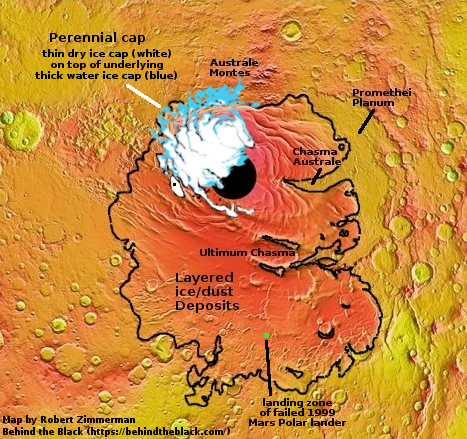
The black dot on the overview map to the right marks the location of this strange hatchwork, on a section of the white perennial cap of ice and dry ice that sits over Mars’ south pole.
So what causes this hatchwork? At both Martian poles carbon dioxide falls as snow in the winter to form a thin mantle of dry ice that then sublimates away in the spring. That sublimation process however starts at the base of the mantle. As the solid dry ice turns to gas, pressure builds, until the mantle cracks at weak points so that the gas can escape.
For reasons that are not yet explained, this process is different between the north and south poles. In the north the breakage and release happens at random and different points from year to year. At the south pole it instead repeats along the same weak points each year, producing permanent features that resemble spider webs. This is what I think we are seeing here. This hatchwork marks those weak points, where the mantle is cracking to let the sublimating gas escape.
At least, that is what I think is happening here, based on past discussions with planetary scientists and my reading of their papers. It is very likely however that some other process is involved, either newly discovered or completely inexplicable.

On Christmas Eve 1968 three Americans became the first humans to visit another world. What they did to celebrate was unexpected and profound, and will be remembered throughout all human history. Genesis: the Story of Apollo 8, Robert Zimmerman's classic history of humanity's first journey to another world, tells that story, and it is now available as both an ebook and an audiobook, both with a foreword by Valerie Anders and a new introduction by Robert Zimmerman.
The print edition can be purchased at Amazon or from any other book seller. If you want an autographed copy the price is $60 for the hardback and $45 for the paperback, plus $8 shipping for each. Go here for purchasing details. The ebook is available everywhere for $5.99 (before discount) at amazon, or direct from my ebook publisher, ebookit. If you buy it from ebookit you don't support the big tech companies and the author gets a bigger cut much sooner.
The audiobook is also available at all these vendors, and is also free with a 30-day trial membership to Audible.
"Not simply about one mission, [Genesis] is also the history of America's quest for the moon... Zimmerman has done a masterful job of tying disparate events together into a solid account of one of America's greatest human triumphs."--San Antonio Express-News
Similar patters show up on Earth in both tundra permafrost, and desication cracking in dryed lake beds.